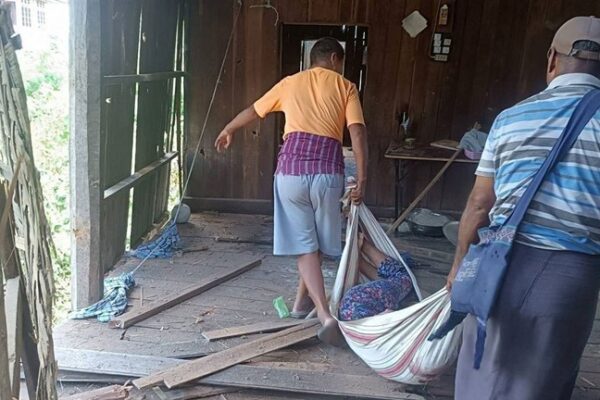
Junta raid kills 10 Rohingyas, injures 17 in Myanmar’s Rakhine state

Ten Rohingyas were killed and another 17 injured in the Buthidaung and Mrauk-U townships in Myanmar’s Rakhine state, as a result of airstrikes by the junta on Thursday, local residents told RFA Burmese on Friday. At around 9 p.m. on Thursday night, heavy artillery fired from a junta camp struck Zay Di Taung village in Buthidaung township. The attack resulted in the loss of six family members, including three Rohingya children who were at home asleep, and left another member of the family critically injured, according to the residents. The casualties included Zafaul, a 60-year-old man; Ansaula, a 19-year-old man; Sotyod Ahmed, a 5-year-old boy; Norol Ahmed, a 3-year-old boy; Halayar, an 11-year-old boy; and Tausmi Nara, a 20-year-old woman. “Three heavy weapons fell into the village on Thursday night. One [of three] fell directly on the houses. All six members of the family who were sleeping in the house died and it was also burned down,” a Rohingya resident of Zay Di Taung village, who wished to remain anonymous for his security reasons, told RFA Burmese Friday.  “So the bodies were also burnt. The other one was injured while trying to evacuate,” said the resident, adding that the heavy artillery was fired by the junta camp at Thone Se Ta Bon Zay Di hill in Buthidaung township. Rohingyas are fleeing due to battles in Mrauk-U’s Myaung Bway village on Dec. 28. (AK/Citizen journalist) Locals said that there are more than 60 households with more than 300 population in the Rohingya-dominant Zay Di Taung village.  Despite the pervasive fear among villagers caused by the casualties from the conflict, Rohingya Muslims remain restricted from moving freely, even within Rakhine state. Consequently, they are compelled to stay in their village, lacking any refuge to flee to in times of danger. Zay Di Taung village is not alone. Four Rohingya were killed and 16 others were injured in junta’s Thursday airstrikes on Rohingya villages, including Kaing Taw, Bu Ta Lone and Baung Dut villages in Mrauk-U township, according to the locals. The junta raid came after anti-junta force Arakan Army (AA) attacked the Myaung Bway, also known as Myaung Bway Chay, Police Station in Mrauk-U township on Thursday, a resident, who wished to remain anonymous for fear of reprisals, told RFA Burmese on Friday.  “The AA attacked the Myaung Bway Police Station on Thursday. Then the junta army attacked with heavy artillery and airstrikes, causing casualties when the nearby villages were also shot. The homes were also burned down. The junta opened fire from the side of Mrauk-U and Minbya, and shot them with jets,” the resident said.  The AA claimed on Thursday that the junta attacks were “deliberately” carried out.  The junta said in a Friday statement that no air strike had been carried out on Mrauk-U’s Myaung Bway village and surrounding area on Thursady.  It also claimed that when the AA used the drone to attack the Myaung Bway police station from a distance, the junta security forces used anti-drone weapons, or jammers, which made drone bombs fall near the surrounding villages. The statement made no mention of the death of Rohingyas in Buthidaung township’s Zay Di Taung village. Rohingyas are fleeing due to battles in Mrauk-U’s Myaung Bway village on Dec. 28. (AK/Citizen journalist) Based on records gathered by RFA, 40 civilians lost their lives and over a hundred were wounded during the clashes between the AA and the military junta, which reignited for over a month from Nov. 13 to Dec. 29. Following the military clearance operations and assaults in 2017, over 700,000 Rohingyas from Northern Rakhine sought refuge in Bangladesh. Presently, over a million Rohingyas are residing in refugee camps along the Bangladesh border, as reported by the United Nations and various international organizations. It is said that about 1.4 million Rohingyas still remain in Myanmar’s Rakhine state, and these Rohingyas are enduring food scarcity and severe limitations in Myanmar, while also grappling with criminal activities and gang violence in refugee camps in Bangladesh. Consequently, they are taking perilous sea journeys to reach Indonesia or Malaysia. Since last November, over 1,500 Rohingyas have reached Indonesia’s Aceh province by boat. Indonesian President Joko Widodo has pledged temporary aid for these Rohingya refugees, yet there is resistance from the local population. This situation has raised alarms among human rights groups. Translated by RFA Burmese. Edited by Taejun Kang and Elaine Chan.

Read More

Disinformation campaign spurred student attack on Rohingya shelter, Indonesian activists say

Human rights activists and some observers on Thursday alleged that university students who stormed a Rohingya shelter in Aceh province the day before had been influenced by an “organized” disinformation campaign, which some even linked to the upcoming general election.  Their comments came amid a flood of condemnation of the “inhumane” incident, which resulted in the students forcing the 137 terrified refugees in Banda Aceh, mostly women and children, into trucks to another location. The Rohingya will now be guarded by security forces, a top minister said Thursday. Observers noted that the mob action on Wednesday – which was captured on video and widely circulated – was not typical of student protests in Aceh.  Hendra Saputra, the project coordinator of Jesuit Refugee Service (JRS) Indonesia, an NGO in Aceh, said he suspected that Wednesday’s incident was not spontaneous, but “organized and systematic.” He told BenarNews that the students were influenced by social media posts that spread hate and misinformation about the Rohingya. “[The posts] also accused the refugees of taking their food and land, and of sexual harassment and other bad behavior. But these are all false accusations,” he said, adding that no evidence was presented to substantiate the claims.  Besides, the refugees couldn’t be a burden because the government is not spending money on them, Hendra said. “There’s no government budget allocated for refugee management,” he said. A Rohingya woman reacts as she is relocated from her temporary shelter following a protest demanding the deportation of the refugees, Banda Aceh, Aceh province, Indonesia, Dec. 27, 2023. [Riska Munawarah/Reuters] Aceh, a predominantly Muslim province that has special autonomy status in Indonesia, has a history of welcoming the Rohingya refugees, who are also Muslim.  However, as more than 1,500 Rohingya have arrived since mid-November, the province’s villagers have been demanding they be sent back, claiming there weren’t enough resources for the refugees as well. Those demands grew to small protests, which on Wednesday escalated to the student mob charging into the Rohingya shelter, kicking their belongings and creating mayhem, as many of the refugees sobbed uncontrollably or looked on, frightened and shocked. The government will move the 137 Rohingya refugees to the local Indonesian Red Cross headquarters and the Aceh Foundation building, said Mohammad Mahfud MD, the coordinating minister for political, legal, and security affairs. “I have instructed security forces to protect the refugees because this is a humanitarian issue,” Mahfud told journalists in Sidoarjo, East Java. Newly arrived Rohingya refugees return to a boat after the local community decided to temporarily allow them to land for water and food, having earlier rejected them, Ulee Madon, Aceh province, Indonesia, Nov. 16, 2023. [Amanda Jufrian/AFP] Some analysts have attributed the hostility towards the Rohingya to deliberate misinformation. Chairul Fahmi, a Rohingya researcher and law lecturer at Ar-Raniry State Islamic University in Banda Aceh, said some of this disinformation could be linked to political actors who have an interest in exploiting the refugee issue for their own agenda. “The authorities might have had a hand in the Rohingya disinformation campaign. The protest yesterday did not reflect the typical student movement,” he told BenarNews. “There is a possibility that the students were instructed.” Political parties or groups could try to stir up anti-Rohingya sentiment ahead of the general election in February, suggested Ahmad Humam Hamid, a sociologist at Syiah Kuala University in Banda Aceh. “Aceh should not be used as a battleground for the presidential election over the Rohingya matter. It would be very dangerous,” Ahmad told BenarNews. Meanwhile, Defense Minister Prabowo Subianto, the frontrunner in the Feb. 14 presidential election, was in Aceh on Thursday, and spoke about the Rohingya. He said that while Indonesia should be humanitarian towards the stateless Rohingya, it should also prioritize the welfare of its own people. “Many of our people are struggling, and it is unfair to take in all the refugees as our responsibility, even if we feel humanitarian and sympathetic,” Prabowo said, according to local media. Newly arrived Rohingya refugees wait to board trucks to transfer to a temporary shelter after villagers rejected their relocated camp, in Banda Aceh, Aceh province, Indonesia, Dec. 27, 2023. [Chaideer Mahyuddin/AFP] Della Masnida, 20, a student at Abulyatama University who took part in Wednesday’s incident at the shelter, accused Rohingya refugees of making “unreasonable demands.” “They came here uninvited, but they act like this is their country. We don’t think that’s fair,” she told reporters on Wednesday. The student mob collectively issued a statement saying they rejected the Rohingya “because they have disrupted society.”  “We all know that President Joko Widodo has stated that there is a strong suspicion of criminal acts of trafficking among them. Even the Aceh police have said that this is an international crime,” they said in the statement issued Wednesday. The Rohingya are a persecuted Muslim minority from Myanmar, who have been fleeing violence and oppression in their homeland for years. Close to one million live in crowded camps in Bangladesh. With few options after years of a stateless existence, many Rohingya are desperate to leave and that makes them susceptible to exploitation by human traffickers, analysts have said. Gateway to Malaysia Most of the Rohingya who arrived in Aceh recently had left violent and crowded refugee camps in Myanmar’s neighbor, Bangladesh, where 740,000 of them took shelter after a brutal crackdown by the Burmese military in 2017. For the Rohingya, Indonesia is a gateway to Malaysia, which is a top destination for migrant workers from many South Asian and Southeast Asian nations. The Indonesian government, which has not ratified the 1951 Refugee Convention, has said that it does not have the obligation or the capacity to accommodate the Rohingya refugees permanently, and that its priority is to resettle them in a third country. Earlier this month, government officials complained they were overwhelmed and Indonesia was alone in bearing the burden of the Rohingya. Mitra Salima Suryono, spokeswoman for the U.N. refugee agency UNHCR in Indonesia, believes nothing could be further from the truth, and cited…

Read More

Burmese city hit by huge job losses amid Chinese factory closures in Dec.

About 3,000 workers were left unemployed and without full compensation following the ongoing shutdowns of Chinese garment factories in December in Pathein, Ayeyarwady region of Myanmar, according to workers on Wednesday.  Since the first week of December, the three factories – Haubo Times, He Shan, and North Shore – have been shut down, and it’s planned that some of the remaining employees will be laid off by the end of the month, a women from Haubo Times who was laid off told RFA Burmese.  “Hubo Times was closed this December. They [the factory officials] pay workers for four to six days of their work (in the first week of the month). After that, there are only a few workers left until Dec. 20,” said the woman, adding that some sections of the factory are still operational, but workers there were also asked to work only until the end of December.  Labor activists close to the matter said the closure was due to the lack of power supply, difficulties in purchasing fuel for generators to run the factory, a lack of demand and raw materials shortage. The activists noted that while the affected workers did receive compensation equivalent to three months’ salary from the factories, they have not been given overtime pay and social security benefits by their employers that are provided by the junta council’s Ministry of Labor. An activist in Pathein township, preferring anonymity due to fear of repercussions, highlighted that the compensation process was handled unjustly, disproportionately impacting workers with longer tenures. “Workers with longer tenures should receive more compensation based on the labor law. They expect that too. It’s demoralizing and disappointing for them when the company does not abide by this law,” the activist told RFA Burmese.  The three garment factories as well as Aung Thein Win, the junta council spokesman for Ayeyarwady region and a regional minister for social affairs, have not responded to RFA’s inquiries as of this writing. There were about 15 garment factories in Pathein before the military coup, but now more than half of them have been closed, a local resident told RFA Burmese.  Pathein is not alone. The garment industry in the Yangon Industrial Zone also suffered rising raw material prices, difficulty securing the materials and extreme power outages among other issues. As of August, there were 817 factories in the whole country that are members of Myanmar Garment Manufacturers Association, or MGMA, according to the association. Among them 546 were up and running, while 271 were reportedly closed down, it said. Of these 546 operational, 311 were China-owned factories. Translated by RFA Burmese. Edited by Taejun Kang and Elaine Chan.

Read More

Candlelight Party tries to win over Nation Power Party

The Candlelight Party is urging the new Nation Power Party to join forces with it to form a stronger opposition alliance to the ruling Cambodian People’s Party ahead of Senate elections in February, a former Candlelight official said Wednesday. Rong Chhun, former Candlelight Party vice president who now serves as an advisor to the Nation Power Party, told RFA that leaders from both parties held informal talks in the name of democracy to discuss the strategy for upcoming Senate election on Feb 25.  Rong Chhun and Chea Mony, a prominent former union leader, left the Candlelight Party to form the Nation Power Party after Candlelight’s candidates were excluded from participating in the July general election by the National Election Committee. The committee did not recognize the party because it couldn’t produce an original registration form issued by the Interior Ministry. As a result, the Cambodian People’s Party won 120 of 125 seats in the National Assembly.  Efforts by Candlelight leaders to regain official status in recent months have failed, prompting them to seek out smaller parties certified by the ministry.  Though there have been no official discussions between the Candlelight and Nation Power parties, the latter is ready to make concessions so that they will have to allocate their candidates to stand for specific constituencies and electoral regions without having to compete with each other, Rong Chhun said.  “As for now, I cannot confirm that there will be any specific concessions, but there should be mutual concessions and win-win solutions,” he said.   RFA was unable to reach Ly Sothearayut, secretary general of the Candlelight Party, for comment. Kimsuor Phirith, former Candlelight Party spokesman who currently serves as a member of the Khmer Will Party, said he was not aware of any informal talks between Candlelight and the Nation Power Party, but he urged the latter to join the opposition “Alliance Toward the Future.” The Candlelight Party said in October that it would join forces with three smaller parties — the Khmer Will Party, Grassroots Democratic Party and Cambodia Reform Party — to form a political alliance that would aim to field candidates in the 2027 local commune elections and the 2028 general election.  So far, the National Election Committee has officially registered the ruling Cambodian People’s Party, Khmer Will Party, Nation Power Party, and the royalist Funcinpec Party, to run in the upcoming Senate elections in which 58 of the body’s 62 seats are up for grabs.  Cambodia’s Constitution allows King Norodom Sihamoni to nominate two senators and the National Assembly to nominate another two.  Both the Khmer Will Party and the Nation Power Party have registered candidates for all the eight Senate constituency regions nationwide, representing the 58 seats.  Sam Kuntheamy, president of the Neutral and Impartial Committee for Free and Fair Elections, said if the Nation Power and Candlelight parties failed to work together, their votes would be divided in the upcoming election because most opposition voters, who are commune councilors, are Candlelight Party members.  Translated by Sovannarith Keo for RFA Khmer. Edited by Roseanne Gerin and Malcolm Foster.

Read More

Junta attack kills 8 civilians, injures 25 in Myanmar’s Laukkaing city

Junta’s recent deployment of heavy weaponry in Laukkaing, a city within the Kokang Self-Administered Zone in Myanmar’s Shan State, has resulted in the death of eight civilians and left 25 others injured, according to the anti-junta Myanmar National Democratic Alliance Army (MNDAA) on Tuesday.  The MNDAA said in a statement that the military junta’s two heavy weapons landed near the Crown hotel in Dong Cheng neighborhood in Kokang, bringing civilian casualties. It added that the injured individuals were transported to the hospital, while those who passed away were cremated. A local resident, who wished to remain anonymous for fear of reprisals, told RFA Burmese that he eye-witnessed the death of several civilians when a shell hit and detonated on a car parked near the Crown Hotel. “The heavy weapon dropped straight on that car and one of the people in the car and the two others near the car died. Children and women were among the dead,” said the resident.  He further explained that the incident occurred when troops from the MNDAA positioned near the Sel Ton gate, just outside Laukkaing city, launched an attack on the 77th Division of the military junta as they entered the city. A heavy weapon used in this exchange landed near the Crown Hotel and exploded, resulting in casualties. The military junta continues to bombard Laukkaing city, and frequent disruptions in internet and telecommunication services have made it difficult to ascertain the full extent of the casualties. RFA Burmese called Li Kyarwen, a MNDAA spokesman on Wednesday regarding the local’s claim, but he did not respond. The military junta has yet to issue a statement on this incident as of Wednesday noon. RFA Burmese also contacted Maj. Gen. Zaw Min Tun, the State Administration Council spokesman, but the call went unanswered. Separately, the MNDAA said three civilians were killed and ten were injured on Dec. 24 in an junta’s airstrike in Laukkaing and Hseni (Hsenwi) township. Between Oct. 27 to Dec. 23, a total of 55 civilians were killed and more than 40 people were injured due to the junta airstrikes in Kokang Region, according to data compiled by RFA based on the MNDAA’s statements.  Translated by RFA Burmese. Edited by Taejun Kang and Elaine Chan.

Read More

Military burned more than 440 bodies over 19-month period

More than 440 bodies, mostly those of civilians, were burned by ruling junta forces across Myanmar between March 2022 and September 2023, according to a report by a U.K.-based nonprofit group dedicated to exposing human rights abuses and war crimes. The report from the Centre for Information Resilience, or CIR, said the military regime’s soldiers have routinely set villages ablaze and torched civilians – including some believed to be burned alive – amid the ongoing conflict with anti-junta forces to spread fear and control the population. The report, issued on Dec. 24, the second anniversary of a Christmas Eve massacre in Kayah state, was based on information from local media reports and user-generated content  compiled by the Myanmar Witness project which has monitored and documented human rights violations in Myanmar since the coup. At that massacre two years ago, Myanmar army soldiers killed at least 35 civilians, including women and children, and burned their bodies near a village called Moso, Radio Free Asia reported. The number was later increased to 50 civilians. Despite clear evidence and witness accounts pointing to national troops as the perpetrators, Myanmar’s military junta, which seized power from an elected government in a February 2021 coup, denied responsibility for the killings and blamed local resistance forces. Matt Lawrence, director of the Myanmar Witness project, called the incidents “another horrific dimension to the impact of the conflict on the people of Myanmar.” Grisly images Investigators relied on local media reports and user-generated content to determine how many civilians were burned during the 19-month period, using photos and videos from social media platforms.  In one instance, the photos and videos allowed investigators to identify the burned bodies of 150 victims, including what appeared to be the charred bodies of children, and corpses of others stacked before being set ablaze, the report said. “Who these individuals were, and how they ended up here, is far less clear, but open source evidence suggests that some were burnt alive, while others were burnt after death or as a result of an artillery or air strike.” CRI said. The remains of burned bodies are seen in Pa Lon Twi village of Mindat township in western Myanmar’s Chin state, Nov. 10, 2022. (Chinland Defense Force-Mindat) Most of the burnings occurred in northwestern Myanmar’s Sagaing region, a hotbed of armed resistance to the junta, but the report did not specify whether civilians there were burned after being killed or burned to death before they died. A local resident said that when the junta troops raided the villages and set fire to their homes during the clearance operations, some elderly people who could not escape were also burned to death. During a raid of Mu Gyi in Sagaing region on Nov. 24, 2022, about 100 Myanmar soldiers burned down nearly 200 houses killing about six people, said a resident, who did not want to be named for security reasons. Among them was 80-year-old Aye Yin, who died because she could not escape.  “The junta troops raided the village and torched houses owned by people who had connections to members of People’s Defense Forces,” said the resident, referring to local armed resistance fighters. “The fire spread and burned down other houses.”   Seeking justice The greatest number of civilians burned in a single incident occurred during the December 2021 attack in Kayah state’s Moso village. Zue Padonmar, one of the secretaries of  the Karenni State Interim Executive Council, said local officials tried to take action against the military, which had committed the mass killings but still enjoyed impunity. “We talked  to international organizations to find ways to punish this army, especially for committing these war crimes [and] genocide, and in order to not support the mechanisms of the military council. We also continuously recorded accounts about the perpetrators.” Those who burned civilians to death or burned dead bodies should receive capital punishment, some Burmese legal experts said. Because the acts are war crimes, top military leaders and commanders should be prosecuted by the International Criminal Court, said Kyee Myint, a veteran high court lawyer. “The people who gave the orders will be sent to jail, [and] the rest will be tried under domestic law,” he told RFA. “Burning people alive is an international crime.” RFA’s calls to junta spokesman Maj. Gen. Zaw Min Tun for comment went unanswered on Tuesday.  Translated by Htin Aung Kyaw for RFA Burmese. Edited by Roseanne Gerin and Malcolm Foster.

Read More

Junta attack claims lives of 3 people in Myanmar’s Rakhine State

The junta army’s heavy artillery shelling in Myanmar’s ancient capital of Mrauk-U in Rakhine State between Sunday and Monday resulted in the deaths of three civilians and the arrest of nine others, local residents told Radio Free Asia on Monday. The shelling also caused damage to an archaeological museum that is renowned for its ancient Buddhist pagodas and temples, they added. Locals said that the junta army has been continuously firing heavy weapons all over the Mrauk-U city after the battle between the junta army and the anti-junta force Arakan Army (AA) on Sunday.  The roof and antiques inside of the Cultural Museum which displayed the ancient cultural heritages in the city’s Nyaung Pin Zay neighborhood were damaged by a junta heavy weapon at around 5 a.m. on Sunday, according to locals.  Three monasteries, Setdamma Sukarama, Gandamar, Mingalar Man Aung, and some houses in the city were also damaged during the attack, a monk in the city who wished to remain anonymous for fear of reprisals told RFA Burmese on Monday. “They [junta troops] are shooting with heavy artillery continuously. We could not enter the city and there was no one in the city. The fighting broke out on Sunday [Dec. 24] morning. They are shooting with heavy weapons all day and night,” said the monk.  The archaeological museum in Mrauk-U’s Nan Yar Kone was hit and destroyed by junta heavy artillery on Dec. 25, 2023. (Citizen journalist) The AA launched attacks on the police station and junta camp on the hill near Ngwe Taung Pauk bridge on the way out of Mrauk-U city early Sunday morning, and the junta responded with heavy weapons, killing three residents and injuring at least five others in the city, the locals explained. Another anti-junta force Three Northern Alliances also confirmed in a Sunday statement that the junta army had targeted the city’s residential areas of civilians and villages with heavy weapons. After the battle, about 70 soldiers from Mrauk-U-based junta Infantry Battalion (377) entered the city’s Aung Mingalar and Bandula neighborhoods and arrested nine civilians, said local residents.   The arrested include a 25-year-old man, Wai Lin Che, a 35-year-old man, Maung Hla Bu and a 50-year-old, Aung Tin Shwe. The names of the rest are still unknown. A Mrauk-U resident, who declined to be named for security reasons, told RFA Burmese that the junta troops arrested the civilians to use them as a human shield.  “They were arrested on Sunday afternoon. The junta troop assumed that the AA troops were also in the city. The [junta] troops were afraid of being attacked when they patrol into the city, so they took the civilians as human shields. All the residents are fleeing and some of the names [of those arrested] still unknown,” he told RFA Burmese.  This photo shows a group of Arakan Army officers. (Arakan Army) Anti-juta forces the Three Brotherhood Alliances also confirmed the arrest on Sunday night and said the nine civilians were arrested by the military council. Locals said that almost the entire city residents had to flee amid arrests, battles and casualties. As of 2014, the population of Mrauk-U stood at around 40,000. Junta’s military council has not released any statement about the incidents. Both Hla Thein, the council’s spokesman for Rakhine state and Attorney General, and Maj. Gen. Zaw Min Tun, a military council spokesman, did not answer RFA’s inquiries.  Meanwhile, the AA released a statement on Monday that it will “respond effectively” to the military council army that deliberately attacked and destroyed the ancient cultural heritage of the Rakhine people. Separately, the shadow National Unity Government (NUG) blamed the junta in a Monday statement calling its attack on the museum “inhumane” and “act of war crime,” adding that it is bringing these cases to domestic and international courts. Translated by RFA Burmese. Edited by Taejun Kang and Elaine Chan.

Read More

Southeast Asia’s ‘narco-state’ and ‘scam-states’ undercut authoritarian rule boasts

The year 2023 has been one of disorder in Southeast Asia.  War is still raging in Myanmar, where perhaps thousands of civilians were killed this year, on top of hundreds more soldiers and anti-junta fighters. ASEAN, the regional bloc, has failed yet again to either bring the warring parties to the negotiation table or, as a result, take a sterner position on the military government that took power through a coup in early 2021. A consequence of the escalation of political violence in Myanmar has been the proliferation of crime. According to the Southeast Asia Opium Survey 2023, published by the United Nations Office on Drugs and Crime (UNODC), the country reclaimed the spot as the world’s biggest opium producer, with the area of land used to grow the illicit crop increasing by 18 percent to 47,100 hectares in 2023, compared to the previous year.  Poppy fields stretch across pastures in mountainous Shan State, Myanmar in 2019. Myanmar reclaimed the spot as the world’s biggest opium producer according to the UNODC Opium Survey for 2023. (Ye Aung Thu/AFP) The report noted that “although the area under cultivation has not returned to historic peaks of nearly 58,000 ha (143,300 acres) cultivated in 2013, after three consecutive years of increases, poppy cultivation in Myanmar is expanding and becoming more productive.”  At the same time, production of methamphetamine has also increased.  One result has been to flood the rest of Southeast Asia with cheap drugs. On Dec. 13, the Thai police seized 50 million methamphetamine tablets near the Myanmar border, the country’s largest-ever drug bust and the second largest in Asia.  Alastair McCready, reporting for Al Jazeera in November, noted that yaba pills—combination of methamphetamine and caffeine—are selling for US$0.24 cents each in Laos.  The flood of drugs has led to an explosion of other criminal activity. Radio Free Asia has reported on the growing anger of ordinary Laotians about the authorities inability to investigate even petty crimes, which has been compounded by the ongoing economic crisis in the communist state, another indication of the disorder now infecting the region.  Enter ‘scam states’ Singapore, after staying capital punishments for years, felt it necessary to begin state-enforced executions again, killing the first woman defendant in two decades this year for drug-related offenses.  If Myanmar has the distinction of becoming Southeast Asia’s “narco-state” once again, some of its mainland neighbors now have the reputation of being what could be called “scam-states.” The blockbuster Chinese hit of the year No More Bets—a film about unwitting Chinese youths being lured into working for scammers somewhere in Southeast Asia, whereupon tragedy unfolds—was banned by several Southeast Asian governments, including Cambodia’s, which presumably thought its “ironclad” friend was spreading malicious propaganda.  Bags containing about 2 million methamphetamine tablets seized in a northern Thai border town near Myanmar are displayed during a news conference in Chiang Rai province, Thailand, Dec. 17, 2023. (Office Of the Narcotics Control Board via AP) Indeed, if in China No More Bets was a Tarantino-esque public health warning, in Southeast Asia it was an alarming indictment of all that’s wrong in their nations, a held-aloft mirror they couldn’t ignore, hard as they tried. The Office of the UN High Commissioner for Human Rights reported in August that at least 120,000 people in Myanmar and 100,000 in Cambodia “may be held in situations where they are forced to carry out online scams.” According to a UNODC report, there could be “at least 100,000 victims of trafficking for forced criminality” in Cambodia alone. “If accurate,” the report added, “these estimates of trafficking for forced criminality in Southeast Asia would suggest that this is one of the largest coordinated trafficking in persons operations in history.”  Note that those numbers are only of people forced to work in Southeast Asia’s scam compounds, which stretch from mainland Southeast Asia to Malaysia and the Philippines. The number of workers who choose, however you understand that word, to work in this industry is no doubt many times higher. Half of national GDP The UNODC was more hesitant in its language than it could have been. It offered a “conservative estimate” that the scam industry of one Mekong nation, which it did not name, “may be generating between $7.5 and $12.5 billion” in revenue annually, around half that country’s official GDP in 2021.  Some think it was a reference to Cambodia, whose GDP was US$27 billion that year. My guess is that the UNODC was being vague because it knows this estimate could also apply to Laos and Myanmar.  Five telecom and internet fraud suspects who were handed over to the Chinese police pose for a photo at Yangon International Airport in Yangon, Aug. 2023. (Chinese embassy in Myanmar/Xinhua via AP) Moreover, it’s possible that online scamming, with its associated human trafficking and money laundering, might now be the most profitable industry in all three states, and this increasingly un-shadowy sector may be worth as much as the entire GDP of all three states.  To quote the UNODC report: “the scam industry is earning criminal groups the equivalent of billions of U.S. dollars, with profits rivaling the GDP of some countries in the region.”  There have been some busts in Cambodia and the Philippines. One of the sparks for the “Operation 1027” offensive that unfolded in October across northern Myanmar, touted as the biggest rout of the junta’s forces since the February 2021 coup, was the apparent inability of the military junta to tackle Chinese-run scam compounds in Shan State. Because of the junta’s inactivity, a number of armed ethnic groups stepped in to tackle the scam compounds, which was well received in Beijing.  However, the task of tackling these groups is beyond the capabilities of the police and militaries of Southeast Asian states. In authoritarian mainland Southeast Asia, law enforcement is a patronized, pay-for-promotion extension of ruling parties, which makes them not only ineffective but also systematically corrupt.  Political protection Naturally, there is a good deal of political protection of these…

Read More

Lao Christians given permission to celebrate Christmas

Christians in Laos are preparing to celebrate Christmas more freely this year after the Lao Evangelical Church received permission to do so from the Ministry of Interior, several believers told Radio Free Asia. In the past, Christians across the country had to get permission from their village and district authorities – approval that was not granted in many cases. Even though Laos has a national law protecting the freedom of religion, Christians have been restricted, persecuted and sometimes attacked in the one-party communist country with a mostly Buddhist population. Earlier this year, 15 Christian families and a pastor in Luang Namtha province were evicted and their homes destroyed because they didn’t participate in traditional and cultural activities of the communities. This year, however, the security minister sent a notice asking the district and provincial authorities to facilitate Christmas celebrations. Christmas, which celebrates the birth of Jesus as the promised messiah, falls on Monday this year, but churches are marking the holiday with various services and gatherings during this time. “We’re inviting some local leaders to attend our Christmas celebration,”  a member of the Lao Evangelical Church in Savannakhet Province, who like other sources in this report requested anonymity for safety reasons, told RFA Lao. “This year, we don’t have to request permission to celebrate the holy day from the local authorities because we got permission from the central government more specifically from the Ministry of Interior,” he said. “The ministry has just sent a notice of the authorization to all provinces then the provincial authorities passed it down to the districts,” he said. “A district official told us that there are some changes this year; one of the changes is that we don’t have to request permission from the local authorities.” The Lao Evangelical Church is the largest registered Christian church in Laos with in 2021 more than 200,000 followers and around 200 pastors. Restrictions in some places Still, Christians in Savannakhet Province said they faced restrictions. “We’re celebrating Christmas this year, but not in our village because our village chief wouldn’t allow us to celebrate the holy day here, we would have to join the celebration in another village in the district,” a follower in Nong district said. Last year, Christians in three villages in that same district requested permission to celebrate Christmas, but the district authorities gave permission to only one village, Nalao. When Christians defied those restrictions and set up stages, tables and tents in all three villages, about 20 police and military officers armed with guns came. They dismantled and confiscated all the things the people had set up, prompting the women and children to cry, said a believer from the province. “We lost everything. We lost about 30 wooden planks, several hundreds of tables, chairs and tents. We rented these materials and equipment: so, we lost a total of ten million kip (US$500), and religious ceremonies were canceled,” he said. Historically, the district has been resistant to Christians. In 2018, seven Christian leaders in Nong district were arrested then released about a week later for organizing services without proper permission.  A Christian in the district called for more freedom to exercise one’s faith.  “We’d like to call on the authorities to allow us to freely celebrate Christmas and other religious ceremonies in every village, not just only one or two villages,” he said. Translated by Max Avary. Edited by Malcolm Foster.

Read More

Breaking the laws of the land: Vietnam’s real estate scandals

For a country whose regime was founded as a land-to-the-tiller movement, one would expect the Vietnamese government to be more sensitive to real estate issues. While abuse and corruption have been a persistent irritant in the countryside, they’ve increasingly spread to the cities and impacted the middle and emerging middle classes. Land has always been a very sensitive issue in Vietnam. Technically, the state owns all land, but since the Doi Moi reforms and the implementation of a contract based agricultural system in the mid-1980s, people can acquire leases.  Yet, not all land is created equal, and the best often goes to local officials and their cronies. Local-level officials routinely appropriate land for development projects or to profit from urban sprawl.  Farmers complain of unfair compensation. And even when compensation is market value, the forced sale is an irritant. Farmers are often not provided with new skills to make a living. Social media has amplified these cases, resulting in an increased number of civil demonstrations. To respond to the growing unrest, the National Assembly recently passed legislation that consolidated a myriad of existing local-level security forces to augment the police. RFA reported some 3.5 trillion dong (US$145 million) was earmarked for what could be a 400,000-man force, with powers of arrest.  But corruption and a lack of government accountability in the real-estate sector is also being felt by the urban middle class, though in very different ways. Vietnam’s real estate market has been booming. By 2021, the real estate sector accounted for at least 12% of GDP, up from 2% in 2018, fueled by the country’s burgeoning middle class.  Workers at a construction site in Hanoi, Vietnam in 2023. (Hau Dinh/AP) Property developers rushed to develop apartment complexes, luxury villas, and malls. The more politically connected they are, the cheaper the land and faster the approvals.  In return for approvals, local officials receive bribes or real estate. Proceeds of land sales are supposed to go into local coffers to pay for government services, but are routinely misappropriated. Developers tried to finance their projects through pre-sales, but this was never sufficient. Beginning in 2016, developers began turning to the nascent corporate bond market to raise funds.  And raise they did. For the developers, it was literally minting money. NovaLand, alone, raised some 160.7 trillion dong (US$6.5 billion) through the bond market by 2021. Some US$15 billion in real estate debt alone will mature in 2025.  Defaults, followed by investigations But then the defaults began. So, too, did the investigations.  In the first half of 2022, at least four high profile real estate executives were arrested for either stock price manipulation or fraud in financial disclosures in bond sales.  Then came the big one: Truong My Lan, the CEO of Van Thinh Phat.  The Ministry of Public Security (MPS) said upon her arrest on October 8, 2022, Lan had “fraudulently engaged in the issuance and trading of bonds in contravention of the laws to appropriate thousands of billions of dong from the people.”   They were not even close.  In the end, the MPS concluded that she had raised 30 trillion dong (US$1.23 billion) in bonds and embezzled some US$12.53 billion from Saigon Commercial Bank that she secretly controlled, through more than 900 shell companies.  To put that into perspective, that’s equivalent to 3.2% of Vietnam’s GDP.  Newly built buildings jam the skyline in Hanoi, Vietnam in 2016. (Tran Van Minh/AP) Lan’s scheme worked because she paid US$5.2 million in bribes to 24 government regulators. In all, 15 officials from the State Bank, three from the Government Inspectorate, and one from the State Audit Office will face charges.  To date, no one higher than the former head of the department of inspection and supervision of the State Bank’s office in Ho Chi Minh City has been investigated, let alone prosecuted. Not coincidentally, the government’s investigation into Lan has shed no light on how she acquired some 156 properties, including some in the most high-end district in Ho Chi Minh City. She was well-served by her political connections, and no one wants to open up that can of worms.  Another recent case merits attention, though with a mere US$345 million in embezzled funds. Property developer Tan Hoang Minh got into financial trouble during the pandemic. Between July 2021 and March 2022, three of its subsidiaries began selling bonds to raise funds.  But the lack of scrutiny and oversight allowed them to fabricate business activity and withhold or obfuscate pertinent financial information in their disclosures. The category of the nine tranches of bonds was only supposed to be sold to institutional investors, but they marketed them to retail investors. Of the 10.3 trillion dong  (US$437 million) raised through those bond sales to 6,630 investors, Tan Hoang Minh’s chairman, Do Anh Dung, embezzled 8.6 trillion dong (US$354 million). Three apartment buildings were left unfinished, leaving homebuyers in the lurch. Why fraud in the real-estate market matters Real estate is where Vietnam’s middle class parks their money. They have few other investment alternatives, while the emerging middle class struggles to buy a home. Access to vast amounts of capital, without regulatory oversight, created – at the same time – an oversupply in the housing market and a bubble. Do Anh Dung, for example, flew onto the authorities’ radar screen when he made substantially above-market bids on properties to drive up all real estate prices. Truong My Lan purchased much of her property on the secondary market from competitors at above market prices.  Market manipulation was their game. But in the process, they created a glut.  By August 2023, the 10 largest property developers had a combined US$11.4 billion in unsold inventory. In Ho Chi Minh City, real estate prices are expected to fall 5-7%, while the prices of high-end homes are expected to fall by 10%. The investigations into several of these real estate developers led to a credit crunch. In short, the State Bank blocked the issuances of new bonds for periods, meaning many developers…

Read More