Retracted study was based on unethically collected Uyghur DNA samples, experts contend

The recent retraction of an academic journal article that discussed the genetic information of Uyghurs and Kazakhs in China’s northwestern Xinjiang region has raised questions and concerns about ethical standards in scientific research, as people familiar with the study believe that genetic samples were obtained under duress. In June, Elsevier, a Dutch publisher, announced the retraction of a scientific article published in 2019 in its journal “Forensic Science International: Genetics.” The retraction was attributed to the failure to meet necessary ethical approvals in scientific research, The Guardian reported. The deleted study, entitled “Analysis of Uyghur and Kazakh populations using the Precision ID Ancestry Panel,” was authored by Chinese and Danish researchers in Ürümqi.  It involved the collection of blood and saliva samples from 203 Uyghurs and Kazakhs, which were then tested using genetic sequencing technology developed by the American biotech company Thermo Fisher Scientific. The article’s authors claimed that their findings could help police in using genetic sequencing techniques to identify suspects in cases. “A clear knowledge of the genetic variation is important for understanding the origin and demographic history of the ethnicity of the populations in Xinjiang… [which] may offer an investigative lead for the police,” the article said. In the redaction notice, the journal said that an investigation revealed that those who collected the samples did not obtain the necessary ethical approval. Forced collection Yves Moreau, a professor at the University of Leuven in Belgium, has raised the concern that the Chinese government forcibly collects and arbitrarily uses genetic information from Uyghurs and other ethnic minorities. He told Radio Free Asia’s Uyghur Service that he had been critical of the 2019 study for a considerable period of time before it was finally deleted. “The article that was retracted … That’s a case that has been open for a very, very long time,” said Moreau, who added that he is working toward getting journals to reevaluate numerous articles, many on the same subject.   Moreau had also taken issue with a similar study published in the June 2022 issue of “Forensic Science Research,” a journal acquired by the Oxford University Press in 2023. That article detailed a study sponsored by China’s Ministry of Justice that analyzed the genetic information of Uyghurs based on blood samples collected from them. The retracted 2019 article and the 2022 article was written by the same authors, Claus Børsting, Niels Morling, and Xalmurat Ismailjan (Halimureti Simayijiang) from the forensic genetics department at the University of Copenhagen. Qelbinur Sidiq, shown speaking at the “Uyghur Tribunal” in 2021, says she saw samples collected from blood, as well as collections of fingerprints and retina scans. She said she herself was made to give all three in 2016. (Tolga Akmen/AFP) Ismailjan is known to have ties to China’s public security agencies and is listed as being jointly affiliated with Xinjiang Police College, The Guardian report said.  Experts like Moreau contend that the blood samples utilized in both studies were obtained from people who had no choice but to participate.  Moreau was reluctant to take on the 2022 article, he said, because one of editors-in-chief of the journal was from the Institute of Forensic Science of the Chinese Ministry of Justice. “So I thought, well, if I’m going to write a letter asking for ethical re-evaluation of an article in that journal, I’m not going to get much of an answer,” he said.  But when the journal was acquired by Oxford University Press, he was able to raise the issue with that institution, he said. “Now I can write to Oxford University and tell them, … you know, you were actually publishing this journal for the Institute of Forensic Science of the [Chinese] Ministry of Justice,” said Moreau. In an email sent to Irene Treacy, vice chancellor of the University of Oxford, Moreau noted that “such consent should be given voluntarily, and he does not believe that the Uyghurs consented to [biometric data collection] voluntarily.” After Mr. Moreau raised the issue, the editorial departments of the University of Copenhagen and the editor departments of the aforementioned journals replied via email that they would investigate the matter, he explained. Coerced samples Witnesses have observed coerced genetic data collection both inside China’s secretive “reeducation camps” in Xinjiang and also outside of the camps.   Qelbinur Sidiq, who currently lives in the Netherlands, said she saw samples collected from blood, as well as collections of fingerprints and retina scans. She said she herself was made to give all three in 2016. “Blood samples and DNA sequencing are mandatory, whether you are inside the camp or outside. There is an order where authorities instruct you on when to go to which hospital for the collection of your blood sample and DNA,” she said. “There is no freedom or choice to refuse.” Sidiq said that the police inform residents through the chat platform WhatsApp as to when they must appear at a specific hospital for collection. “Participants are given one week, and the notice explicitly states that failing to participate will result in severe consequences,” she said. “As a result, there is no freedom or choice in the matter, and individuals are unable to inquire about their results. Asking for the result of the blood sample is not an option.” Duarte Nuno Vieira, the co-editor-in-chief of “Forensic Science Research,” denied the journal had received financial support from China’s Ministry of Justice, according to the Guardian report. Journals have a responsibility to evaluate the ethics of the studies that appear in articles they publish, Maya Wang, associate Asia director for New York-based Human Rights Watch, told RFA. “Given the brutality of the collection process, I believe it is important for such journals to check and review research articles on samples taken from Uyghurs and Tibetans by Chinese police agencies,” she said. “It is unlikely these journals not know the background of such articles.”  In 2021, Professor Yves Moreau initially uncovered similar articles published by Chinese researchers about Uyghurs in the American journal Molecular Genetics and Genome…

Read More

Anti-junta groups claim they seized junta military camp in Shan state

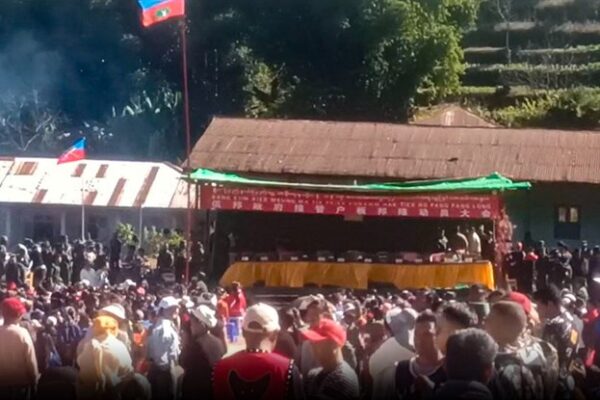
Myanmar’s anti-junta forces Ta’ang National Liberation Army (TNLA) and Mandalay People’s Defense Force (PDF) jointly seized a junta military camp in Than Bo village in northern Shan state on Wednesday, according to the groups on Thursday. The Mandalay PDF announced that on Tuesday, their combined forces launched an attack on the junta’s base camp, effectively taking control of it and capturing a platoon commander, Col. Thet Aung.  During the battle, there were casualties on both the military junta and some PDF troops, the group stated, without specifying the total number of casualties. The seized junta camp is under the command of the junta’s Central Region Military Command, which has between 50 and 100 forces, according to the TNLA on Friday.  RFA was unable to reach junta spokesman Maj. Gen. Zaw Min Tun for comments about the group’s claim.  The Mandalay PDF is currently participating in Operation 1027 led by the anti-junta Three Northern Brotherhood Alliance. The Mandalay-Nawnghkio-Gote Twin road, connecting the Mandalay region and northern Shan state, has been obstructed and closed off through a joint effort by the TNLA and Mandalay PDF.  This has led to regular clashes between the junta and resistance groups situated in regions such as Ho Hko, Hsam Ma Hse, Thone Se, Ohn Ma Hkar, and Kyauk Kyan villages in the Nawnghkio township. Over the span of more than two months during Operation 1027, the Three Brotherhood Alliances have successfully overtaken 10 townships in northern Shan state and seized control of over 200 camps belonging to the military junta.  The group continues its attacks against the junta camps in the cities of Hseni and Kutkai in northern Shan state, with the combat remaining intense up to the present day. Edited by Taejun Kang and Elaine Chan.

Read More

No candy for old kids in North Korea

North Korea is toning down its annual candy giveaway to children this year ahead of leader Kim Jong Un’s Jan. 8 birthday, handing out less candy and snacks than in previous years – and to fewer children, residents in the country told Radio Free Asia. The quality of candy is also lower, they said. Meanwhile, adults were buying their annual New Year’s “present” from the state: wall calendars that came with a variety of illustrations, including rockets and images of plump children. The calendars, marking the important dates for “Juche 113” –  also known as 2024 – were once free, but now must be purchased. Gifts of sweets to children on or around the birthday of the country’s leader has been a tradition in North Korea dating back to the reign of national founder Kim Il Sung – Kim Jong Un’s grandfather – and continued during the rule of his father Kim Jong Il. But this year the government is limiting the gift to kids aged 6 or younger. The government began distributing this year’s candy gift on Dec. 31, a resident of the northeastern province of North Hamgyong told RFA Korean on condition of anonymity for security reasons. But children will likely be disappointed because they are getting less this year, and the quality has declined, he said. “The number of recipients who qualify for the gifts also decreased significantly,” he said. “Starting this year, elementary school students [and anyone older] are excluded from receiving confectionery gifts.” The gift package this year consists of hard candy, packaged snacks like chips or sweet breads, bean powder coated candy, and other select items, he said.  The government has not overtly said that the candies are for Kim Jong Un’s birthday, however. But residents assume that must be the reason, because they remember that under the rule of the previous leaders, children received candy ahead of their birthdays, the resident said. Self-reliance With the changing of the year from Juche 112 to Juche 113, adults are also “given” paper calendars from the state, which they must purchase. “Juche,” is North Korea’s founding philosophy of self-reliance, and the Juche era is said to have begun with the birth of Kim Il Sung in 1912.  RFA reported in 2022 that pandemic concerns had resulted in people having to pay for their own annual calendar gift, and those who could pay more received better quality calendars. That trend is continuing into this year, but the people have several versions of the official calendar they can buy, with themes centered around missiles, the cult of personality, the military, education, and tourism, another North Hamgyong resident told RFA on condition of anonymity for personal safety. The missile calendar is titled “The Status of the Juche Powerhouse,” he said, while the calendar about soldiers and marines is called, ”Let’s Destroy the U.S. Imperialist Invaders, the Bitter Enemies of the Korean People.” A North Korean wall calendar for the year ‘Juche 113’ or 2024. Residents were “gifted” calendars like these, this year, though they had to be purchased. (RFA) The tourism-themed calendar seemed tone deaf though, because it pictures a lifestyle that most North Koreans can not even dream of, he said. “How many people in North Korea can enjoy sightseeing and eating at restaurants on a boat like in the calendar?” he said. “Furthermore, there are students who cannot go to school because they are starving, and there are all these chubby students featured in the [education] calendar.” The calendars are printed on low-quality paper this year due to a paper shortage, and even then there are different versions of varying cost, a resident of North Pyongan province in the northwest told RFA on condition of anonymity to speak freely. “A multipage calendar costs 5,000 won (59 U.S. cents), and a single page calendar [displaying the entire year] costs 500 won (6 cents),” she said. “Well-off residents purchase the multipage calendars and there is a high demand for calendars featuring pictures of flowers and souvenirs.” She said that the militaristic calendars were less popular because they feature missiles, soldiers or scenes from the 1950-53 Korean War, which North Korea calls the “Great Fatherland Liberation War.”  The overly militaristic themes are a turnoff for some, but the resident said that people will always find reasons to complain.  “Last year’s calendar featured a picture of a young child holding a milk cup, but milk is a luxury for most people.” she said. Translated by Claire Shinyoung Oh Lee. Edited by Eugene Whong and Malcolm Foster.

Read More

Myanmar’s junta releases more than 9,600 prisoners

Myanmar’s junta granted amnesty to 9,652 prisoners on Thursday, according to a statement released by the junta’s State Administration Council on Thursday.  The prisoner release took place on the 76th anniversary of the country’s independence from the United Kingdom. The amnesty was conditioned on the agreement that, should they reoffend, they would be required to serve both the remaining sentence and any new punishment. About 114 foreign prisoners were included in the amnesty, according to a separate statement from the junta. It said they were released to maintain friendly relations with other countries. Among those released is Kaung Set Lin, a photojournalist from the Myanmar Press Photo Agency in Yangon, who had been sentenced to three years on charges of damaging public interest. Kaung Set Lin was arrested while injured when police and soldiers, using a vehicle, charged into an anti-coup protest he was covering on Pan Pin Gyi Street in Yangon’s Kyimyindaing township. “Yes, he is freed. My son is among the released. Now we are about to go home. Needless to say, I am so happy. I wanted to see my son’s face before I died. Now my wish has come true,” Myo Myint, the father of the journalist, told RFA Burmese.  A Burmese photo journalist Kaung Set Lin was released from Insein Prison on Jan.4, 2024. (RFA) However, another journalist, Hmu Yadanar Khat Moh Moh Tun from the Myanmar Press Photo Agency, who was arrested alongside him, has not been released.  Actress Thin Zar Wint Kyaw and model Nan Mwe San, who faced criticism from the junta and were sentenced to several years in prison on charges of undermining Myanmar culture and sexual orientation, were also released, according to media reports. But RFA has not been able to independently verify this information. While a few political prisoners were released today, detained former political leader Aung San Suu Kyi and former President Win Myint, who have received lengthy prison sentences under various charges, along with members of the National League for Democracy (NLD) Government, lawmakers, university students, and democracy activists, remain incarcerated. A family member of Tun Tun Hein, NLD-led government’s deputy speaker, said he has not heard any news about his release yet. Tun Tun Hein, the 72-year-old deputy speaker who also served as the chairman of the country’s lower house in the parliament, had been sentenced to more than 30 years.  “I wished he would be released because he is old. I hope he comes out with amnesty and I am praying for it. I haven’t heard any news yet,” said the family member.  A lawyer, who is handling the cases of political prisoners and requested anonymity for security reasons, informed RFA Burmese that none of the political prisoners serving long-term sentences were among those released on Thursday. Only those who had been sentenced to terms between two and three years and were close to their scheduled release dates were freed, the lawyer added.  Based on the junta statements, there have been 14 amnesties granted since the coup, including the one on Thursday. In total, more than 92,000 prisoners have been released during these amnesties, but only a small number of them were political prisoners. Edited by Taejun Kang and Elaine Chan.

Read More

India repatriates 151 junta soldiers who fled fighting

India has repatriated 151 junta soldiers who entered the country last week to escape ethnic Rakhine fighters during clashes across the border in western Myanmar’s Chin state, according to residents and media reports. On Dec. 27, Arakan Army, or AA, troops attacked a military base in Chin state’s Paletwa township, prompting the junta soldiers to flee across the border into India’s Mizoram state. A resident of Mizoram told RFA Burmese that the 151 troops surrendered to a unit of India’s Assam Rifles in Lawngtlai district’s Tuisentlang village two days later. “From there, they were brought to [Mizoram’s capital] Aizawl via Lunglei [township],” said the resident, who spoke on condition of anonymity citing security concerns. “I saw a Myanmar plane fly by [on Jan. 2] that appears to have taken the soldiers back. I saw it twice and I believe it made two trips because there were over 150 [soldiers].” Indian media reported that local police sent the soldiers – nine of whom were injured – to Aizawl, where they would be interrogated by Indian officials before being handed over to Myanmar’s junta. Additional reports said that the troops would be sent back to Myanmar’s Rakhine state capital Sittwe after a Myanmar Airlines aircraft landed at Mizoram’s Lengpui Airport. Attempts by RFA to reach Aung Cho, the junta’s spokesman and secretary of Rakhine state, for comment on the status of the troops went unanswered Wednesday. Some of the Myanmar junta soldiers who fled to Mizoram state in India are seen Dec. 29, 2023. (Citizen journalist) The 151 junta soldiers are the latest group of military troops to flee clashes with the AA from Chin state into India. More than 40 soldiers who entered the country after the AA occupied Chin state’s Rihkhawdar township were returned to Myanmar on Nov. 14. Another group of more than 40 soldiers and their family members who fled to India during fighting with anti-junta forces in Sagaing region’s Tamu township were also recently repatriated to Myanmar, according to residents. Translated by Htin Aung Kyaw. Edited by Joshua Lipes and Malcolm Foster.
Read More

Junta helicopter shot down by anti-junta force in northern Myanmar

A junta helicopter has been shot down in Waingmaw township of Myanmar’s northern Kachin State by an anti-junta Kachin Independence Army, or KIA, on Wednesday afternoon, according to a KIA spokesperson. The helicopter was leaving the township after delivering supplies to the Nar Hpawt junta military camp in the area before it was shot down, and the KIA is currently investigating further details, Col. Naw Bu, KIA’s information officer, told Radio Free Asia on Wednesday.  “I can confirm that the helicopter has crashed, and it was our front line that fired upon it. But it is not fully known whether it crashed due to a technical defect or our attack,” said Naw Bu.  “Now the reports from the ground said that the junta council’s jets are hovering around the site where the helicopter crashed. And the locals said that air strikes are being conducted near the location.” The specifics regarding the type of helicopter that crashed, the number of people on board, and any casualties are still unknown, Naw Bu added.  Local residents in nearby village Nam Sang Yang told RFA that they witnessed a military helicopter descending slowly in an upside-down position, while emitting smoke. One resident said that he observed a military helicopter plummeting in a burst of smoke near Nam Sang Yang village, shortly before noon on Wednesday. “It [the helicopter] was shot at around 11.50 a.m. Two helicopters came to drop supplies and one was hit when it took off after completing the delivery. It crashed near a hill not far from Nam Sang Yang village,” said the resident.  Junta’s Nar Hpawt camp is located in the area under the control of the KIA Brigade(5), which is defending KIA’s headquarters in nearby Laizar city. RFA was unable to reach junta spokesman Maj. Gen. Zaw Min Tun for comments about the helicopter. According to weapons experts, the Myanmar Air Force is utilizing Russian-made military helicopters for both transport and combat purposes.  Activists group Justice For Myanmar revealed that Sky Aviator Company Limited, known for its ties to the military leadership, acquired these helicopters from Russia in 2019. Edited by Taejun Kang and Elaine Chan.

Read More

Thai cannabis drinks find their way to Lao markets

Thailand’s easing of laws governing the sale of marijuana last year has led to a proliferation of cannabis products on the market, some of which are ending up in stores in neighboring Laos, where authorities aren’t laughing. In June 2022, Thailand became the first country in Southeast Asia to decriminalize marijuana, prompting a proliferation of related shops across the nation where the drug has always been easy to access, but with the risk of stiff penalties. Among the more popular products being offered for sale in Thailand are so-called “happy drinks,” or juice and carbonated beverages that under the new law may contain a relatively low dose of up to 0.2% tetrahydrocannabinol, or THC – the main psychoactive ingredient in cannabis.  The drug, which can produce a sense of relaxation and euphoria, was previously only available for medical use to alleviate a variety of conditions, including stress and depression. But the new market that has sprung up in Thailand is an exception in Southeast Asia where, in most other countries, the use of cannabis and other drugs is illegal and punishable with lengthy jail terms. Some nations, such as Indonesia and Singapore, execute criminals convicted of sale, possession or consumption. In neighboring Laos, laws prohibit the production, trade and use of cannabis for recreational purposes. A police officer in the capital Vientiane, separated by the Mekong River from Thailand’s Nong Khai province, confirmed to RFA that only cannabis products “authorized by the Lao Ministry of Health to be used for medical purposes” are permitted for sale in the country. “The sale of cannabis is prohibited,” said the officer who, like others interviewed for this report, spoke on condition of anonymity due to security concerns. “We regularly inspect shops and stores, and if we see it, we’ll confiscate it.” But residents told RFA that has not stopped happy drinks produced in Thailand from finding their way across the border and onto the shelves of stores in the capital. One resident of Vientiane told RFA Lao that happy drinks are now on offer at minimarts along the Mekong River – if one knows where to look. “In Laos, the sale of this kind of drink is not legal yet,” he said. “Some individuals sell the drink secretly and if they’re caught, they’ll be arrested.” Another resident of Vientiane, who researches how cannabis can be used for medical purposes, confirmed the availability of the drinks in the city. “This is a new drink and consumers must be careful,” he said. “It’s available but prohibited by law.” RFA’s own investigations found happy drinks openly sold at several markets in the capital, including a brand produced by Thai beverage company Srinanaporn Marketing PLC that is marketed as “fruit juice with cannabis water.” It comes in flavors such as mixed berry, pineapple, lychee and lime. Growing demand among youth But while the beverages are increasingly available in Laos, several business owners told RFA that smuggling them into the country isn’t worth the trouble, citing tough laws and a clientele largely uninterested in such products. “I don’t know whether other stores have cannabis juice, but we don’t,” said one store owner in Vientiane. “We don’t import it because it’s against the law.” A bartender at a nightclub in the capital told RFA that his establishment “serves only beer.” “Unlike Thailand, Laos still bans cannabis,” he said. “Besides, the fruit drink containing cannabis juice is not popular among Laotians yet.” They appear to be gaining fashion among members of the country’s younger generation, however. An officer with Vientiane’s Saysettha District Police Department told RFA that happy drinks containing cannabis and other banned ingredients “are popular among youngsters,” who drink them to “have fun and dance.” One such drink contains kratom – an herbal substance that can produce stimulant-like effects and is also legal in Thailand. Oulayvanh Phonesavanh, the deputy head of the emergency department at Vientiane’s Friendship Hospital, recently told local media that around five patients are admitted to her ward each day due to kratom juice poisoning – most of whom are between the ages of 16 and 35. A young man from Vientiane’s Pak Gneum district said that, despite the risks, happy drinks aren’t going away any time soon. “As their name implies, happy drinks are often drunk at parties,” he said. “Those who drink them can expect to be happy, excited and having fun all night.” Translated by Max Avary. Edited by Joshua Lipes and Malcolm Foster.
Read More

‘End of junta is near’ amid mass surrenders: Myanmar’s shadow govt

The end of the junta is near amid mass desertions and surrenders of junta troops, said Myanmar’s shadow government on Monday.  “We have seen the mass deserting and surrender of the military council soldiers unprecedented in military history … Looking at these, it can be said that the end of the [junta] military council is near,” said Duwa Lashi La, the acting president of the National Unity Government (NUG) during his new year’s address.  “Junta troops are facing the situation where its soldiers are either surrendering or being captured in battles on a daily basis,” said the interim leader, adding that 550 military junta soldiers have surrendered during Operation 1027 by the anti-junta Three Northern Brotherhood Alliance. He also cited a statement by the Karen National Union, or KNU, as saying that more than 18,000 military council soldiers have been killed in the KNU-controlled areas since the coup.  The acting president’s speech came a few days after an intense battle between the anti-junta Arakan Army (AA) and junta troops in Paletwa township, Chin state, on Dec. 29, 2023. As a result of the battle, more than 80 military junta soldiers crossed the border and fled to India’s Mizoram state, according to Paletwa residents. India-based the United News of India (UNI) reported on the same day that 83 junta soldiers entered Tuisenlang village on the Mizoram-Myanmar border.  UNI stated that the junta soldiers would be sent back to Myanmar, noting that there were four instances in November and December last year when junta soldiers escaped to the Indian state of Mizoram. Junta troops who fled to India’s Mizoram state on Dec. 29, 2023 (Citizen Journalist) A Paletwa resident who wished to remain anonymous for fear of reprisals told Radio Free Asia last Thursday that the military council troops had fled to the Mizoram side, fully armed. The resident added, however, he could not confirm whether the junta soldiers were repatriated to Myanmar.  As of Tuesday, the junta’s military council has not commented on the soldiers who fled to India.  Aung Cho, junta council’s spokesman for Chin state and Chin state’s secretary, by phone, has also not responded to RFA’s inquiries.  Translated by RFA Burmese. Edited by Taejun Kang and Elaine Chan.

Read More

An uncensored history of modern China

A partly anonymous team of journalists and historians is setting up an archive of uncensored historical material to allow the Chinese people to “reclaim their history” from the ruling Communist Party’s official narrative, according to its founder. The China Unofficial Archive, founded by Pulitzer Prize-winning journalist and former China correspondent Ian Johnson, is “dedicated to making accessible the key documents, films, blogs, and publications of a movement of Chinese people seeking to reclaim their country’s history” since the Communists took over in 1949. It includes books, films and documentary records from key points in China’s recent history, including the Great Famine of the late 1950s to early 1960s under late supreme leader Mao Zedong, memoirs of the political turmoil of the 1966-76 Cultural Revolution and former Beijing Mayor Chen Xitong’s personal account of the 1989 Tiananmen massacre. “We believe that public domain books, magazines, and films should be widely available, and that there is an inherent value in making different voices heard,” the bilingual Archive’s About section reads. The non-profit archive was co-created and is co-maintained by Chinese journalist Jiang Xue and others “who prefer to remain anonymous,” it says. Johnson, whose recent book “Sparks: China’s Underground Historians and their Battle for the Future” portrays the same people his archive hopes to serve, told Radio Free Asia in a recent interview he hopes that more Chinese people will gain access to materials through the archive that are unavailable in China due to government censorship. “I noticed talking to a lot of people that … although there’s a lot more information possible to share in China, like people emailing PDFs and that sort of thing … it was sometimes difficult to find more information,” Johnson said. “Somebody might send you a book about a topic, but it would be difficult to find other books on the topic or other authors on the topic.” Providing access Currently, the archive has a backlog of around 175 films that are currently being digitized that have yet to appear on the site, which Johnson said is around “75% or 80%” focused on people still living under censorship, with the remainder aimed at non-Chinese overseas. Johnson had the idea to set up a “clearing house” for useful historical research material for those who lack access to big research libraries in major universities like Harvard. “My primary goal was to help people who are doing this kind of research to simply have access to existing materials, all the books and the documentary films, etc,” he said. Ian Johnson, a Pulitzer Prize-winning journalist and former China correspondent, is the founder of the China Unofficial Archive. (Cai Yaozheng) Johnson was careful to note that he doesn’t endorse any of the material on his site as better or more truthful than any other material. “We have chosen these titles because we think that they’re useful and important,” he said. “But we aren’t saying necessarily that we agree with everything written by this author or that sort of thing, so in that sense, it is a bit like a library.” “We think there’s maybe an inherent value in a better flow of information,” he said, adding that the website aims to serve the needs of ordinary people and “citizen historians.” The site is unlikely to be accessible to internet users behind the Great Firewall of government censorship in China unless they employ special tools to get around government blocks and filters. “That’s to be expected,” Johnson said. “We’re looking to reach the people who are trying to research and, and write their country’s history.” “The raw numbers of people is small, but I think they can also be influential people in the long run,” he said. ‘Just the beginning’ The archive has plans to keep on adding new resources from what Johnson termed “a huge amount of potential material.” “What we’ve put on the site right now is just the beginning,” he said.  Not everything is eligible, either. Johnson and his team will steer clear of posting any book that is currently still on sale, although they plan to post an entry signposting readers to publishers and bookstores in the case of some publications. Books that are still readily available in libraries around the world are unlikely to get a spot, whether they’re on sale or not. But books that are out of print, or whose publishers have been shut down, or have been banned from sale will be made available, according to Johnson. “We don’t want to hurt [anyone’s] ability to earn a living,” he said. Even with that content ruled out, there is plenty of new material being published by what Johnson described as “an amazing explosion” of citizen historians in the past two decades in China. “Sometimes in Hong Kong, sometimes just as a PDF, sometimes they make a film and put it on YouTube or some other place like that,” he said. “I don’t think many people, certainly outside of China, realize how much has been done about that.” “It’s remarkable that it’s primarily written by Chinese people inside China under often difficult conditions and without the benefits of being a professor at a big university and a budget and graduate students to help you do all the dirty work, right?” “These are people often working on their own and under quite difficult circumstances,” Johnson said. “And so I thought it was an important trend that needed some highlighting and in this way by putting it all together.” “It shows the scope of this movement.” Edited by Luisetta Mudie and Malcolm Foster.

Read More

Women and children suffer amid Myanmar’s civil war

As Myanmar’s civil war approaches its third year, intensified fighting across the country this year between ruling junta forces and resistance fighters has destroyed villages and parts of towns, displacing hundreds of thousands of civilians, most of whom are women and children.  The number of internally displaced persons, or IDPs, reached more than 1 million this year, nearly 11,000 of whom fled to neighboring India and Thailand, according to a United Nations report. “The lives and properties of our people were destroyed,” said Zin Mar Aung, foreign affairs minister under the parallel National Unity Government, noting the junta’s burning of villages, air strikes targeting civilians and mass killings. At least 330 women died this year as a result of attacks by junta forces amid the escalation of armed conflict, said Tin Tin Nyo, general secretary of the Women’s League of Burma. “The number of civilian casualties increased due to artillery attacks and air strikes,” she told Radio Free Asia. “Most of the victims were women, children and the elderly.” A woman killed by an artillery shell fired by Myanmar junta forces is carried by rescuers in Noe Koe village in Kayah state’s Loikaw township, Aug. 31, 2023. (Karenni Human Rights Group) Since the end of October, the number of internally displaced persons also increased, with most being women and children, Tin Tin Nyo said.  “After a country falls under the rule of dictators, it loses the rule of law and justice,” she said, adding that her organization has seen an uptick in gender-based violence, abuse by husbands amid economic decline, and a growing number sex workers.  “These are both visible and invisible challenges,” said the women’s rights advocate. “2023 was full of severe hardship for women.” ‘Lost hope’ Yu Yu, a woman who fled amid armed clashes in eastern Myanmar’s Kayah state, said she has suffered trauma as an IDP. “We are surviving on the food of donors as we have no jobs,” she said. “We have lost hope.” Women who left their jobs to join the Civil Disobedience Movement, or CDM, to resist the military rule following the February 2021 coup say they’ve had difficulties making ends meet while caring for children or aging parents. “My father is 80 years old, my mother is also elderly, [and] they are not in good health,” said Khin May, who used to teach at a private high school in Bago region but quit to join the CDM. “It is very difficult for us while I have no job,” she said, adding that she believes the resistance forces will triumph over the junta in 2024.  Hla Win, who lost her leg to a landmine, walks with crutches at a camp for internally displaced people near Myanmar’s Pekon township, July 29, 2023. (AFP) Children have suffered amid the civil war as well, and more than 560 have died since the military seized control from the civilian-led government in the February 2021 coup, according to Aung Myo Min, the NUG’s human rights minister. Since Dec. 21, four children between the ages of 8 and 11 were killed in Rakhine state’s Mrauk-U township, a 9-year-old child was killed in Namtu in northern Shan state, and a seven-year-old girl died in an attack by junta troops in Sagaing region’s Paungbyin township, according to figures compiled by RFA. “This is a war crime,” said Aung Myo Min. “It’s everyone’s responsibility to protect children at all times, but we have seen almost every day that killings are taking place where there are children as they sleep alongside their families, as well as the deaths of pregnant mothers.” Utter despair The death of children are often directly linked to women dying mid the fighting, said Thandar, head of gender equality and women’s development under the NUG’s Ministry of Women, Youth and Children’s Affairs. “For example, in Sagaing and Magway regions, grown men are performing revolutionary duties, while the women, the elderly and vulnerable groups like children are fleeing together,” she said. “So, if women are hit, children are hit, too.” According to Shan Human Rights Foundation based in Thailand, 28 children were killed due to the junta’s attacks from Oct. 27 to Dec. 27 during the the Three Brotherhood Alliance rebel offensive that has put junta forces back on their heels. People flee a village after renewed fighting between Myanmar’s military and the Arakan Army in Pauktaw township in western Rakhine state, Nov. 19, 2023. (AFP) Air- and land-based artillery strikes are the most common cause of death, and children are among the mass casualties when such attacks occur, death counts indicate. On Apr. 19, nearly 20 children under the age of 18 were killed in an air strike during a gathering in Pa Zi Gyi village in Sagaing region’s Kanbalu township. Eleven others died during an attack on Mon Laik IDP camp near the headquarters of an ethnic army in the town of Laiza in Kachin state on Oct. 9.  And eight more children were killed during an aerial bombardment of Vuilu village in Matupi township in western Myanmar’s Chin state on Nov. 15. Roi Ji, 40, told RFA that she was in utter despair because all five of her children died in the attack on the Mon Laik IDP camp. “I can’t think about anything anymore,” she said. “I’m in a state of derangement.” Precarious futures Children who live in war-torn areas no longer have access to schools or adequate nutrition, and face bleak futures. Nwe Nwe Moe, a former teacher at Shwebo Technical College who joined the Civil Disobedience Movement and has since become a member of Yinmarbin-Salingyi multi-village strike committee in Sagaing region, said she dare not think about the future of the children living among the chaos of war. “I’m concerned about whether the children will be able to develop into capable young people because there is no safety, no access to study, health care, or nutritious food for them,” she said. “I have a sinking feeling about those who are in life-threatening and emotionally insecure situations.” People…

Read More