Prominent Chinese rights activist ‘paralyzed’ while awaiting trial in Jiangsu

Xu Qin, a key figure in the China Rights Observer group founded by jailed veteran dissident Qin Yongmin, is now using a wheelchair while in a police-run detention center in the eastern Chinese province of Jiangsu, RFA has learned. Xu, 60, is currently being held at the Yangmiao Detention Center in Yangzhou City, where she has been on hunger strike in protest at the loss of letter-writing and receiving privileges, and a months-long ban on meetings with her lawyer. Her lawyer Ji Zhongjiu was finally allowed to meet with her on June 10, when Xu could walk, and again on Wednesday, when she was brought to meet with him in a wheelchair. “When Xu Qin met with lawyer Ji Zhongjiu, they pushed her out for the meeting in a wheelchair,” Xu’s husband Tang Zhi told RFA. “The previous meeting with the lawyer was on June 10; Xu Qin became paralyzed on June 27,” Tang said. “Today, when Ji Zhongjiu saw her, she was in a wheelchair.” Tang said Xu’s blood pressure has been unstable, and her eyesight and hearing have deteriorated in detention. But he has been unable to get confirmation of her medical diagnoses from the authorities. “They refused to talk about it,” he said. “I called the state security police today, and he told me I was talking nonsense.” “He said he called yesterday to ask about her and they told him she was in good health.” Repeated calls to Ji rang unanswered on Wednesday. Refusal to ‘confess’ Xu is being held on suspicion of “picking quarrels and stirring up trouble,” a public order charge typically used in the initial detention of activists and peaceful critics of the ruling Chinese Communist Party (CCP). A vocal supporter of a number of high-profile human rights cases, including that of detained human rights lawyer Yu Wensheng, she was detained under “residential surveillance at a designated location,” a form of incommunicado detention rights groups say puts detainees at greater risk of torture and mistreatment. Xu’s trial was suspended by the Yangzhou Intermediate People’s Court in an April 22 ruling that cited “unavoidable circumstances,” but gave no further details. Tang said her lawyer had told him that the trial had been suspended for the sixth time at the behest of state security police, which he believes was the result of Xu’s refusal to plead guilty or “confess” to the charges against her. The overseas-based Chinese Human Rights Defenders (CHRD) network tweeted about the meeting between Xu and Ji on Wednesday: “Xu was sitting in a wheelchair, looking exhausted, and with poor physical health.” “But even in light of her other physical conditions (heart disease, high blood pressure, & having suffered a stroke), and even after being detained in total for nearly two years cumulatively, the authorities still have not been able to shake her determination to plead not guilty!” the group said. Xu was detained on Feb. 9, 2018 at her home in Jiangsu’s Gaoyou city, and placed under criminal detention the next day on suspicion of “picking quarrels and stirring up trouble.” She was transferred into “residential surveillance at a designated location” a few weeks later, and the charges changed to the more serious “incitement to subvert state power.” She was released, apparently on bail, then re-detained by police on Nov. 5, 2021, and has been awaiting trial since then, CHRD said. Translated and edited by Luisetta Mudie.

Read More

Chinese leader Xi Jinping sets out five-year strategy ahead of bid for third term

Ruling Chinese Communist Party (CCP) leader Xi Jinping has set out his political strategy for the next five years ahead of his bid for an unprecedented third term in office at the 20th party congress later in the year. Xi told a high-level political symposium in Beijing this week that the CCP should “focus on deploying strategic tasks and major measures for the next five years.” “The next five years will be a critical time to start building a socialist modernized country in an all-round way,” Xi told the symposium. “We must firmly grasp the problem of unbalanced and insufficient development, focus on making up for shortcomings, strengths and weaknesses, consolidate the bottom line, and promote advantages, and study and propose new ideas and new measures to solve problems,” state news agency Xinhua paraphrased him as saying. Current affairs commentator Xiao Di said Xi’s comments suggest he plans to take China back to a state-controlled, command economy. “He’s steering China away from the capitalist road, back in the direction of communism,” Xiao told RFA. “That’s why he says the next five years will be a critical period to determine whether CCP rule will last forever.” “There should be no obstacle to his being re-elected as general secretary [at the 20th party congress],” he said. Some commentators have suggested that the fact that Xi’s speech to the symposium was given prominent coverage by state news agency Xinhua and the CCP’s official newspaper, the People’s Daily, indicates that Xi will likely get his way. The timing of the coverage ahead of the secretive annual leadership retreat in the resort town of Beidaihe suggests that Xi may be pre-empting any substantive discussion of his plan to serve a third term at that meeting. Future political direction Political scientist Ruan Guohong said the speech was a clear declaration to the outside world that Xi will be re-elected as general secretary of the CCP at the first plenary session of the 20th National Congress. Ruan said the speech was probably in part a response to international speculation about his political trajectory. “There has been a lot of speculation [on Xi’s third term] from the outside world lately, both inside China and overseas,” Ruan said. “But I think he was more likely addressing party elders about China’s future political direction.” In a conclusive break with the reformist thinking of the 1980s, Xi has already brought in constitutional changes nodded through in March 2018 by China’s rubber-stamp parliament, the National People’s Congress (NPC), removing presidential term limits. The move has potentially paved the way for indefinite rule by Xi, although it may not yet be a done deal, Ruan said. “He doesn’t know how things will turn out in future,” Ruan said. “But if he doesn’t manage to get another term in office, then the constitutional amendments will have been meaningless.” Possible infighting Exiled veteran dissident Wei Jingsheng said state media had been relatively quiet on the topic of Xi’s third term, suggesting fierce political infighting in the corridors of Zhongnanhai. But Wei also said in a commentary for RFA’s Mandarin Service broadcast before Xi’s speech was reported that the outcome of the 20th party congress was impossible to predict. “There are all kinds of possibilities,” Wei said. “But there is one outcome that can be predicted, that is, regardless of whether Xi Jinping is re-elected for a third term or not, further division [in party ranks] and the decline of the CCP are inevitable.” “If Xi Jinping is unsuccessful in his bid for another term, the Xi faction will inevitably be purged,” Wei said. “If it resists, it will rise up in rebellion, which will also be beginning of the end of the CCP.” “If Xi Jinping is re-elected, his retaliation [against those who opposed him] will force officials to rebel, which is not a bad result for China’s future. We will wait and see,” he said. Translated and edited by Luisetta Mudie.

Read More

USS Ronald Reagan reenters South China Sea amid tension over Pelosi visit

The aircraft carrier USS Ronald Reagan and its strike group re-entered the South China Sea and is heading north as China threatens military action should U.S. House Speaker Nancy Pelosi make a visit to Taiwan. The carrier left Singapore after a five-day port call on July 26, according to a statement from the U.S. 7th Fleet.  The statement did not specify the USS Ronald Reagan’s current location but the U.S. Navy released a couple of photos of the carrier refueling-at-sea with the replenishment oiler USNS Tippecanoe in the South China Sea on Wednesday. Data provided by the ship-tracking website Marine Traffic show the USNS Tippecanoe was well inside the South China Sea at the time of the replenishment operation. The ship’s projection shows it is moving northwards. While this doesn’t necessarily mean the aircraft carrier would take the same route, some Taiwan watchers say it may sail near the island in the coming days. An analyst who wishes to stay anonymous due to the sensitivity of the issue told RFA they think the Ronald Reagan will “sail close to the east side of Taiwan in a show of power but will not engage in any confrontation with China’s People’s Liberation Army.” Chinese state-supported Global Times meanwhile quoted Song Shingling, a Chinese military expert, as saying that “if the U.S. carrier strike group attacks relevant islands in the South China Sea or clashes with Chinese warships and fighter jets, this may equal to creating a conflict.” USNS Tippecanoe’s past track from July 21 to July 28. CREDIT: Marine Traffic Pelosi briefed on Taiwan trip  The Indo-Pacific Command declined to confirm whether the Ronald Reagan, the U.S. Navy’s only forward-deployed aircraft carrier, will sail near Taiwan. “We have nothing further on this,” said Cmdr. Tiffani Walker, U.S. Indo-Pacific Command spokeswoman. The democratic island, that China considers one of its provinces, has come under the spotlight after press reports that the Speaker of U.S. House of Representatives Nancy Pelosi would visit Taiwan in early August. Neither the U.S. Government nor Pelosi’s office confirmed the news but President Joe Biden indicated that the military “did not think it was a good idea right now” for Pelosi to visit Taiwan. Defense Secretary Lloyd Austin said on Wednesday he had spoken with Pelosi and given her a security assessment of the situation but did not comment on Taiwan, Reuters reported. President Biden is expected to discuss the visit, among other issues, with his Chinese counterpart Xi Jinping in a telephone call on Thursday. It would be the fifth such conversation since Biden became U.S. president in January 2021. China has already responded strongly against the rumored trip, with a PLA spokesman threatening that should Pelosi insist on making the visit, “the Chinese military will never sit idly by, and will certainly take strong and resolute measures” to retaliate. The USS Ronald Reagan is a Nimitz-class nuclear-powered supercarrier, homeported in Yokosuka, Japan. It has been deployed to the U.S. 7th Fleet area of operations “in support of a free and open Indo-Pacific region,” said the U.S. Navy.  

Read More

Vietnam religious freedoms group hits out at sentences against Peng Lei members

The Vietnam Interfaith Council has lashed out at the harsh sentences given to six members of the Peng Lei Buddhist House. They were sentenced last week to a combined 23 years and six months in prison on charges of “abusing democratic freedoms” under Article 331 of the Criminal Code. Police suspended investigations into further allegations of incest and fraud but indicated that other charges may follow. The council, dedicated to fighting for religious freedom, has members representing five major religions in Vietnam: Buddhism, Catholicism, Protestantism, Cao Daism, and Hoa Hao Buddhism. In a statement, the organization expressed “strong opposition to the unjust and illegal case, which is contrary to the basic principles of international justice.” At the same time, the group denounced the Vietnamese government for “defying the Universal Declaration of Human Rights of the United Nations, depriving the Vietnamese people of basic freedoms, including freedom of religion and speech, freedom of association and the right to a fair trial.” Thich Khong Tanh, co-chair of the Interfaith Council, explained to RFA why the group released its statement. “The Interfaith Council has been present in Vietnam for ten years, and its stance has always been to advocate for freedom of religion, belief, and human rights in Vietnam,”. This [sentence] is a serious violation of the issue of freedom of religion and belief. It is also insulting the dignity of human beings, just as the human rights of the people in Vietnam are not respected.” During the trial, one of the issues raised by the judge was that the Peng Lei sect refused to register to join the Vietnamese Buddhist Church. Retreat head Le Tung Van said this was because he feels the Vietnamese Buddhist Church is “unworthy” to participate. Thich Khong Tanh said the Peng Lei sect has the right to practice Buddhism the way they want, not necessarily by joining the Vietnamese Buddhist church: “You naturally force people into your circle for you to manage, then how can that be called freedom of belief, freedom of thought, freedom of religion.” “Vietnamese Buddhism is very diverse, and the practice takes many forms. Because of the Buddha’s teachings, there are forty-eight thousand cultivation methods. So depending on the people, if we can access something taught by the Buddha and if we want to practice, we can all get it.” Since 2016 Thich Khong Tanh has held the role of Co-Deputy Director of the Executive Council of the Sangha of the Unified Buddhist Sangha of Vietnam, an organization separated from the church dating back to the Republic of Vietnam. Another member of the Vietnam Interfaith Council, Cao Dai clerk Hua Phi, also told RFA that the statement the organization made to affirm the religious freedom of its members and to denounce the repressive policy of the Vietnamese state was justified: “We fight for Vietnam to have freedom of religion. No one has the right to force us to follow a religion that we don’t like.” “Secondly, we find that for these unjust judgments, the online community as well as the activists need to speak up to let the world know that in Vietnam, rulers often impose their own versions of the law and use punishment to deter those who do not obey the will of the authorities.” He also said that the government initially falsely accused Le Tung Van of committing incest, but later used Article 331 to try to show the nature of this case is to abolish unregistered groups such as Peng Lei sect On July 26, the leader of Long An Provincial Police said there was not enough evidence to charge Le Tung Van with incest and said he would stop accepting allegations of this crime. The Interfaith Council also “requested the United Nations Human Rights Agency, international human rights organizations, and liberal and democratic countries around the world to pressure the communist government of Vietnam to respect human rights and comply with international judicial procedures and principles for the Vietnamese people.”

Read More

Unidentified men target the homes of executed Myanmar activists

The homes of two democracy activists executed by Myanmar’s junta over the weekend were attacked by groups of unidentified men on Wednesday, according to residents who described the assailants as military supporters yelling obscenities and threatening the lives of the activists’ family members. A source in Myanmar’s commercial capital Yangon told RFA Burmese that around 40 men in seven trucks pulled up to the home of former National League for Democracy (NLD) lawmaker Phyo Zeya Thaw on Bo Aung Kyaw Street in Kyauktada township at around 12:30 p.m. and began hurling projectiles at the building. “They were throwing stones and tomatoes and attacking with slingshots, at the same time cursing and swearing,” said the source, who spoke on condition of anonymity, but identified themselves as a neighbor of the lawmaker whose party was deposed by the military in a coup last year. “They seemed to be mostly supporters of the military. They were very mean – even threatening the lives of the elderly.” Witnesses said that the men drove away when security forces arrived at the scene, but vowed to return. Phyo Zeya Thaw’s mother, Khin Win May, confirmed to The Irrawaddy online journal on Wednesday that the family home had been attacked. A video circulating on a pro-military channel of the social media platform Telegram appeared to show several men standing outside the entrance to the building, throwing rocks and admonishing Khin Win May for expressing how proud she is of her son, which she did in an interview with RFA on Monday after learning of his execution. A description posted along with the video read, “people who do not want terrorism gathered to protest in front of the house of Phyo Zeya Thaw’s parents, who said they are proud of their son – a terrorist leader involved in the violent killing of many people.” State media announced the execution of Phyo Zeya Thaw, former student leader Ko Jimmy, whose real name is Kyaw Min Yu, and activists Hla Myo Aung and Aung Thura Zaw, on Monday without reporting the date and method of killings. It is believed the men, who were convicted of “terrorism” against the military regime and the people of Myanmar, were hanged on Saturday in Yangon’s Insein Prison. The act drew widespread condemnation from Western governments, the Association of Southeast Asian Nations (ASEAN), international rights groups and Myanmar-based democracy activists, as well as the Southeast Asian nation’s shadow National Unity Government and the People’s Defense Force (PDF) paramilitaries that are fighting the junta on the NUG’s behalf. Ko Jimmy’s home targeted A group of unidentified men also attacked the home of Ko Jimmy’s parents in Yangon’s Insein township on Wednesday, according to a witness, who declined to be named citing security concerns. The witness said that more than two dozen men armed with sticks and swords arrived at the house at around 1 p.m. in two vans and five pickup trucks and began pelting it with stones. “Those who attacked Ko Jimmy’s house came with swords hidden in their umbrellas, about thirty people,” they said. “When residents came out [to investigate], they left the neighborhood.” Another video posted to the same pro-military channel on Telegram appeared to show a group of men standing outside of Ko Jimmy’s parents’ home, cursing the former student leader as a “traitor” and threatening the lives of his family members. RFA was unable to independently confirm which organizations the two groups of attackers are associated with or how they were able to obtain the home addresses of the late democracy activists and their family members. Despite the blowback over the weekend’s executions, junta Deputy Information Minister Maj. Gen. Zaw Min Tun told a press conference held in the capital Naypyidaw on Tuesday that the consequences of the punishments had “already been considered,” but the decision was taken to “mete out justice for those who died at their hands.” “The crimes they committed deserved several more death sentences than the ones committed by those on the death row,” he said at the time, adding that authorities decided to proceed with the punishment “for the sake of innocent people and their relatives.” According to Thai NGO Assistance Association for Political Prisoners, authorities have killed at least 2,131 civilians and arrested nearly 14,900 since the military seized power from Myanmar’s democratically elected government in a Feb. 1, 2021 coup, mostly during peaceful anti-junta protests. Translated by Khin Maung Nyane. Written in English by Joshua Lipes.

Read More

North Korea resumes coal shipments to China in violation of sanctions

North Korea has resumed shipping coal to energy-starved China to secure much needed foreign currency despite U.N. sanctions prohibiting the transactions, RFA has learned. U.N. Security Council Resolution 2371, adopted in August 2017, forbids countries from buying coal that originates in North Korea. The sanctions are aimed at depriving Pyongyang of cash and resources that could be funneled into its nuclear and missile programs. But China’s energy needs are great, and North Korea’s coal is of exceptionally high quality, so sales of coal stocks to Chinese buyers resumed in mid-July, a trade official in North Korea’s South Pyongan province, north of Pyongyang, told RFA’s Korean Service on condition of anonymity for security reasons. “Trading companies affiliated with the party and the military resumed exporting coal to earn foreign currency on orders of the Central Committee,” said the source.  “Coal exported to China is transported from Nampo port to the West Sea,” the source said, referring to the body of water west of the Korean peninsula, known internationally as the Yellow Sea.  “It is common for the coal to be transferred from the North Korean trading company’s ships to  Chinese ships on the open sea,” the source said. The ship-to-ship transfers are an effort to avoid detection, although monitors have known the sales have continued since the sanctions were imposed. In 2019, the U.S. Treasury penalized two Taiwanese citizens and three shipping companies for transferring petroleum products with North Korean ships on the high seas. In October 2021 RFA reported that coal exports from North Korea to China, sometimes through ship-to-ship transfers, were on the rise as China struggled with severe coal shortages that led to rolling blackouts in many parts of the country. Maritime trade between the two countries has been on and off during the coronavirus pandemic. It was off again after North Korea declared a “maximum emergency” in May when a major outbreak was traced to a military parade in late April. Authorities have apparently made an exception in the case of coal. Some trading companies are getting bolder and forego ship-to-ship transfers entirely, the source said. “Some of the powerful party-affiliated trading companies bring the Chinese ships into the port of Nampo, where they are loaded with coal and then sail directly to Chinese ports. They can receive the cash right there on the spot,” the source said. “Foreign currency earned from coal exports is not deposited into the Foreign Trade Bank of the DPRK but is collected directly by the party.” The coal shipped out of Nampo goes to various ports in China’s Shandong province, with Longkou being the most popular destination, sources said. Coal is also transferred over a much shorter distance between Ryongchon county in the northwestern province of North Pyongan and Donggang, China, a trade official in North Pyongan told RFA on condition of anonymity to speak freely. “These days, at Jinhung Wharf in Ryongchon county, military trading companies that have received permission to resume coal exports from the Central Committee are exporting coal through the sea,” he said. “Powerful trading companies are earning foreign currency by exporting hundreds of thousands of tons of coal at a time by borrowing large ships from China,” said the second source. A ton of North Korea’s high-quality anthracite coal can fetch between U.S. $100 and $110 in China, according to the second source. This is almost double the cost per ton quoted by sources in the RFA report from October 2021.  “Military companies are using the foreign currency they earn from coal exports to secure fuel for Border Guard patrol boats and warships and food for military personnel,” the second source said. Sources told RFA that they were not able to determine if the resumption of coal exports is being carried out under any agreement with the Chinese government. RFA contacted offices at the United Nations, including the U.S. mission to the U.N., by phone and email but had not received any response as of 4 p.m. Wednesday. A U.S. State Department spokesperson told RFA that United Nations sanctions on the DPRK remain in place. “We will continue to implement them and encourage others to fully implement them, including at the United Nations and with the DPRK’s neighbors,” the spokesperson said. “The DPRK continues to fund its WMD and ballistic missile programs through sanctions evasion efforts in violation of UN Security Council resolutions.” “It is important for the international community to send a strong, unified message that the DPRK must halt provocations, abide by its obligations under UN Security Council resolutions, and engage in sustained and intensive negotiations with the United States.” Translated by Leejin J. Chung. Written in English by Eugene Whong.

Read More

Vietnam court charges 7 people for their roles in road demolition protest

Authorities in Vietnam’s Nghe An province have officially charged seven people in connection with a clash with riot police over the demolition of a local road earlier this month, family members said Wednesday. Ha Thi Hien, Tran Thi Nien, and Bui Van Canh were charged on July 22 with “resisting against officers on official duty,” while Tran Thi Hoa, Bach Thi Hoa, Ha Thi Thoa, and Ha Van Hanh were accused of “disturbing public order,” relatives told RFA Vietnamese. Family members said they had only learned of the charges – each of which carries a maximum sentence of seven years in prison – after receiving a notice from the Nghi Loc District Police Department on Wednesday. “I am very worried about my wife. They [the police] said she would be held for two months before trial,”  Nguyen Van Duc, the husband of Ha Thi Hien, told RFA’s Vietnamese Service. “All of my neighbors feel sorry for her, saying that Hien had never said or done anything bad, and ask why she was taken away. Since her arrest, our two young kids have been crying and asking for Mom every night,” he said. Riot police guard a fence build to stop protestors preventing the demolition of a hundred-year-old road on July 13, 2022. Photo: Citizen Journalist On July 13, hundreds of riot police descended on Binh Thuan parish in Nghe An’s Nghi Thuan commune as a similar number of protesters attempted to remove a fence blocking a road that connects the parish to an area highway. The road, which had been in use for more than 100 years, is located on land the government granted to a private company for a planned industrial zone. Police tried to disperse the protesters with smoke grenades and explosives but they fought back. Ten people were arrested in the clash, during which officials said protesters had “used bricks, stones, bottles, sticks [and petrol bombs], attacked and detained a police officer and injured five other police officers,” according to a statement issued after the incident. Authorities released one woman the same night and two men three days later. However, the other seven had remained in custody for two weeks before their families were notified of the charges against them on Wednesday.  The seven are being held at a temporary detention facility during an investigation of their case, which is expected to last until Sept. 10, according to the notice from the Nghe An Police Department, which also claimed that all of the accused had “refused access to a defense lawyer, or did not request one.” Duc said his wife Hien is innocent and was “only watching the protest” when she was arrested. She did not act against the police, he said. Duc said he has had to take leave from work to care for his two kids, aged three and six, and his mother, who is more than 80 years old. Attempts by RFA to contact the Nghi Loc District Police and the lead investigator for the case, Hoang Doanh Toan, went unanswered Wednesday. Translated by Anna Vu. Written in English by Eugene Whong.

Read More

Tibetan arrested for creating ‘unlawful’ WeChat group

Chinese officials in a Tibetan-populated region of Sichuan this month arrested a Tibetan man accused of setting up a group honoring Tibetan religious leaders on the popular social media platform WeChat, Tibetan sources said. Lotse, 57 and a resident of Sichuan’s Sershul (in Chinese, Shiqu) county in the Kardze (Ganzi) Tibetan Autonomous Prefecture, was taken into custody in July for creating the chat group, which was set up to celebrate the birthdays of revered Tibetan lamas, a Tibetan living in exile told RFA this week. “The group has around 100 members who come from all parts of Tibet,” RFA’s source said, citing local contacts and speaking on condition of anonymity for security reasons. Chinese authorities called Lotse’s creation of the group “unlawful,” the source added. Lotse, a single father of two sons, is now believed to be detained by authorities somewhere in Sershul, and local Tibetans were questioned about him and pressured by police in the period leading up to his arrest, the source said. “Chinese police also visited Lotse at his home before his arrest and threatened him for creating such a group without the government’s permission,” he added. Banned birthday celebration Sichuan authorities arrested two Tibetans in 2021 for celebrating the 86th birthday on July 6 of exiled spiritual leader the Dalai Lama, sources told RFA in earlier reports. The pair, a man named Kunchok Tashi and a woman named Dzapo, both in their 40s, were taken into custody in Kardze’s Kyaglung town on suspicion of being part of a social media group that shared images and documents and encouraged the reciting of Tibetan prayers on the Dalai Lama’s birthday. The Dalai Lama fled Tibet into exile in India in the midst of a failed 1959 Tibetan national uprising against rule by China, which marched into the formerly independent Himalayan country in 1950. Displays by Tibetans of the Dalai Lama’s photo, public celebrations of his birthday and the sharing of his teachings on mobile phones or other social media are often harshly punished. Chinese authorities maintain a tight grip on Tibetan-populated regions of western China, restricting Tibetans’ political activities and peaceful expression of cultural and religious identity, and subjecting Tibetans to imprisonment, torture and extrajudicial killings. Translated by Tenzin Dickyi for RFA Tibetan. Written in English by Richard Finney.

Read More

Beijing bites back over repeated rumors of Pelosi’s Taiwan visit

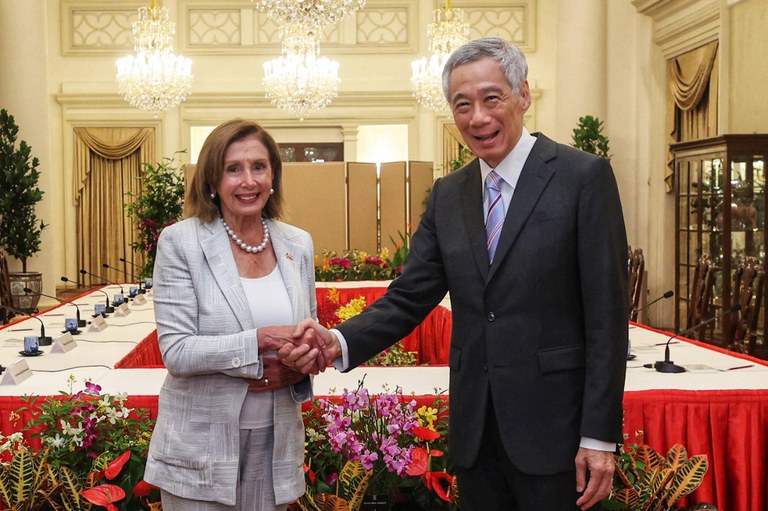
China ratcheted up its already strong response to U.S. House Speaker Nancy Pelosi’s plans to visit Taiwan, with the Ministry of Defense in Beijing threatening military action. Ministry spokesman, Sr. Col. Tan Kefei, told a media briefing on Tuesday that, should Pelosi insist on making the visit, “the Chinese military will never sit idly by, and will certainly take strong and resolute measures” to retaliate. The U.S. “must not arrange for Pelosi to visit the Taiwan region,” he said. China considers the self-governed democratic island a breakaway province and its reunification a matter of “national sovereignty and territorial integrity.” Britain’s Financial Times first reported on the planned visit last week, saying it would be part of a tour that will also include Japan, Singapore, Indonesia, and Malaysia. Pelosi and her entourage will also make a stopover in Hawaii to visit the headquarters of the U.S. Indo-Pacific Command, the paper said. It would be the first time since Newt Gingrich’s 1997 trip that a U.S. House speaker has visited the island. U.S. officials have not confirmed the news but President Joe Biden indicated that the military “did not think it was a good idea right now” for Pelosi to visit Taiwan.  The much talked about trip by the Speaker of the House of Representatives, the third most senior figure in the political system, has created a huge headache for U.S. policymakers. Biden is expected to discuss it, among other issues, with his Chinese counterpart Xi Jinping in a telephone call on Thursday. It would be the fifth such conversation since Biden became U.S. president in January 2021. ‘Fourth Taiwan crisis’ Before the defense ministry delivered its official response, the Chinese foreign ministry had already protested against the reported trip, saying the U.S. must be prepared to “assume full responsibility for any serious consequence arising.”  Analysts say with so much tension over the alleged visit, U.S.-China relations are entering a “perilous period.” Taylor Fravel, Director of the Security Studies Program at the Massachusetts Institute of Technology (MIT), wrote on Twitter that Pelosi’s visit seems likely “as other members of Congress cast her visit as a question of what China can or cannot ‘dictate’ to Congress.” This would “create even stronger incentives for a forceful response,” as Xi Jinping’s “policy, reputation and credibility will be seen to be at stake.” “We’re heading straight toward a Fourth Taiwan Strait crisis,” Fravel warned, referring to previous crises in the Taiwan Strait. The last one was in 1996 and ended after U.S. intervention. Some Taiwanese analysts disagree with the assessment, saying the possibility of a war is low. “This is not good timing for Xi to wage a fourth Taiwan crisis,” said Ming-Shih Shen, a senior expert at the Taiwan’s Institute for National Defense and Security Research (INDSR). There are only a few months left before the opening of China’s most important political event – the Chinese Communist Party’s Congress – where Xi is believed to be seeking an unprecedented third term. “The situation’s being exacerbated perhaps by those who oppose Xi’s leadership within the Party in order to create troubles [for him],” Shen said. To go or not to go? Despite China’s hawkish response, Pelosi should still make the visit, said the Taiwanese expert, adding that it would work for her domestically, too. Carl Schuster, a retired U.S. Navy captain and former director of operations at the U.S. Pacific Command’s Joint Intelligence Center, said that China’s coercion tactics “work only when countries allow them to do so” and the United States “should stand up to China.” “China’s economy is not in better shape than ours and China is not going to war over Pelosi’s visit,” he said. “Bowing down to Chinese bullying makes us look weak at a time when we need to appear strong. Weakness, like withdrawing our embassy and trainers, encouraged Putin to invade Ukraine. We can’t make that mistake twice,” Schuster added. “The current tensions over Speaker Pelosi’s putative visit to Taiwan puts the Biden Administration in a no-win situation,” said Carl Thayer, a veteran regional expert. “If Speaker Pelosi decides to visit Taiwan, Xi Jinping will have no recourse but to provoke a crisis to demonstrate China’s resolve. This will put further strain on U.S.-China relations and undermine efforts underway by Biden to find some common ground with China,” the Canberra-based analyst said. The Biden Administration, in his opinion, “has not yet had to respond to a major incident of Chinese bullying and also has not gone out of its way to provoke a confrontation with China.” “If Pelosi decides to go and China throws down the gauntlet, this will be the first test for President Biden to call China to account and push back against its bullying,” Thayer said.

Read More

Vietnamese police suspend incest and fraud investigation into Buddhist group

Police looking into accusations of incest, fraud and abusing democratic freedoms by a Buddhist sect in Vietnam say they are temporarily suspending their work. Monday’s announcement by the Investigation Security Agency of Long An province police follows a previous police announcement that Peng Lai Temple (Tinh That Bong Lai) leader Le Tung Van used the religion for years to benefit personally from charitable donations. At his trial, last week, Le Tung Van said the people who leveled accusations against him should be brought to justice. “I did not offend the Vietnamese Buddhist Church in Long An province, nor did I offend the Duc Hoa district police. On the contrary, [we] were victims of horrible humiliation and slander for a long time. Whoever accuses me of offending them should appear in court. [We should] stand up to confront them and make it clear, don’t deceive the court!” Six members of the religious group were sentenced to a combined 23 years and six months in prison last week on charges of “abusing democratic freedoms” under Article 331 of the Criminal Code. News site Thanh Nien reported that investigators said they decided to put their work on hold because they had received many accusations against Peng Lai, so they needed to be cautious and make separate studies into the differing claims. It said the agency is waiting for blood tests and genetic analysis before following up on incest allegations and will drop that line of investigation if the tests are negative. The Zing news site quoted an unnamed Long An police official as saying the Investigation Security Agency had received accusations on three separate issues against Peng Lai but had only looked into the claims of “abusing democratic freedom,” while ignoring claims of incest and fraud. He said police are preparing to resume investigations into those two claims. Monday’s announcement that police were suspending their investigation prompted lawyer Ngo Anh Tuan to write on Facebook: “From the very beginning, when I received information about the cases related to the Peng Lai Temple, I had a somewhat hostile view of them … Up to this point, through some information that the official newspapers have published, it seems that the accusations of incest in the Peng Lai Temple are inference, lacking solid scientific basis. This also means that my aversion to the people there is unfounded.” Earlier this year state media were accused of trying to influence public opinion with headlines such as “Police investigating incest at Peng Lai Temple,” and “Peng Lai retreat: When morality has gone and ignorance leads the way.” The six sentenced temple members were convicted after prosecutors said they posted videos on social networks, including one defaming Thich Nhat Tu of the Vietnamese Buddhist Church. The indictment said the six posted articles and clips on Facebook and YouTube from 2019 to 2021 containing lies, fabricated and distorted information, which insulted the Duc Hoa District Public Security Agency, offended Buddhism and harmed the honor and dignity of Thich Nhat Tu.

Read More