
Category: East Asia
Philippines joins US-led allies in multilateral maneuvers in South China Sea
The Philippines joined the United States, Australia and Canada in a two-day “maritime cooperative activity” from Wednesday to press for freedom of navigation and overflight in the South China Sea amid maritime tensions with China. The navies and air force units of the four nations will operate alongside each other to enhance “cooperation and interoperability” in the disputed waterway, a joint statement said. “We stand together to address common maritime challenges and underscore our shared dedication to upholding international law and the rules-based order,” it said. “The activity will be conducted in a manner that is consistent with international law and with due regard to the safety of navigation and the rights and interests of other States.” The statement was signed by Gen. Romeo Brawner, the military chief of the Philippines, U.S. Indo-Pacific Command chief Adm. Samuel Paparo, Australian Defence Force chief Admiral David Johnston and Gen. M. A. Jennie Cargian, the chief of Canada’s Defence Staff. “Australia, Canada, the Philippines, and the United States uphold the right to freedom of navigation and overflight, other lawful uses of the sea and international airspace, as well as respect for maritime rights under international law, as reflected in the U.N. Convention on the Law of the Sea (UNCLOS),” they said. The aim of the multilateral sail was to demonstrate a “collective commitment” to boosting international cooperation. The statement did not specifically say where the drills would be held, only that the maneuvers would take place “within the Philippines’ exclusive economic zone” in the South China Sea. The Philippines last week carried out similar joint sails with Japan and with the U.S. separately in Philippine areas of the South China Sea. Coast guards from the Philippines and Vietnam meanwhile are scheduled to hold their own joint drills on Friday. In related news, China on Wednesday conducted air and sea patrols near Scarborough Shoal, a flashpoint in territorial tensions between Beijing and Manila, according to a report by Agence France-Presse. Analysts praise multinational maneuvers Chester Cabalza, president of International Development and Security Cooperation, a Philippine think-tank, hailed the defense deals with various allies. He noted that prior to this, Manila had also signed a groundbreaking Reciprocal Access Agreement (RAA) with Japan, another country with a territorial dispute with China. That deal would allow the exchange of troops for joint training with each other. He said the multilateral sails this week show the “global recognition” of Manila’s international arbitration award in 2016 in its territorial dispute with China over Scarborough Shoal. “It shows the legitimacy of its sovereignty rights in the disputed maritime domains of the South China Sea,” Cabalza told BenarNews. “It reaffirms the bone of contention that China alone is not the sole owner of these important sea lanes of communications and trade,” he said. He said the joint sails should work to “solidify” the belief that countries should follow the rules-based order in the disputed sea region, a key shipping route where experts say more than 60% of global maritime trade passes. Geopolitical analyst, Don McClain Gill at the De La Salle University in Manila, said the joint sails affirm the 2016 ruling but he emphasized that such activities need to be done on a regular basis. “Patrols and exercises are very important in ensuring the freeness and openness of the maritime domain, but it must be supplemented by other activities as well, such as capacity building and more robust and permanent deterrence posture in our area in the West Philippine Sea,” Gill told BenarNews, referring to South China Sea waters within the Philippines’ exclusive economic zone. “This is a very good indication that like-minded countries, three of which are part of the exercise, recognize that the Philippines is legitimately entitled to its sovereign rights and sovereignty based on UNCLOS and the 2016 arbitral ruling,” Gill said, alluding to the U.N. Convention on the Law of the Sea. “This is significant in that regard and must be continued,” he said. “As we can see, the Philippines has become a fulcrum for maritime cooperation.” Countries such as Canada, which are far removed from the conflict, are also concerned because they are worried it may affect global trade and affect the stability in a “very critical maritime space,” he said. While global partnerships like the joint sail are important, he said this had not deterred Beijing from continuing with its activities in the South China Sea. But this should not be taken negatively by the Philippines, but rather as an “opportunity to explore what else could be done.” Last week, U.S. Defense Secretary Lloyd Austin and Secretary of State Antony Blinken met their Filipino counterparts in Manila and announced a U.S. $500 million infusion to help Manila defend its shores from threats posed by China. The funds would go towards strengthening Manila’s defenses in the South China Sea, and the monies came shortly after tensions and confrontations surrounding Ayungin Shoal or Second Thomas Shoal in the South China Sea. Manila maintains a rusting World War II-era ship in Ayungin, and a violent confrontation there in June saw a Filipino serviceman lose a thumb. Both sides have subsequently worked towards de-escalating the tensions, but it remains unclear how China would react to the joint sails this week. Jeoffrey Maitem contributed to this report from Manila. BenarNews is an RFA-affiliated online news organization.
North, South Korean boxers become first to medal in their sport on same day
It’s been a weird and wacky few days for North Korea at the Olympics as North and South Korean boxers both became the first Korean women to medal in their sport and a Kim Jong Un impersonator showed up to cheer the North Korean on. Additionally, it was revealed that North Korea had to negotiate Paris 2024 broadcast rights directly with the International Olympic Committee, rather than getting the feed from South Korea as usual. North Korean boxer Pang Chol Mi and her South Korean counterpart Im Ae-ji were both part of the Women’s 54-kilogram tournament, and they both won bronze by losing in their respective semifinals on Aug. 4. Boxing, like other fighting sports, awards two bronzes at the Olympics, but unlike judo or taekwondo, the bronzes are not won with victories in a “second chance” repechage tournament, but with losses in the semifinals. Technically, Pang is the first Korean woman to medal in boxing, because her semifinal was played earlier, but had both Pang and Im won, they would have faced each other in the finals. That fact was not lost on the athletes ahead of the semifinal, Im told reporters from South Korea’s Yonhap News. “I met Pang Chul Mi at the weight room in the athletes’ village and she said ‘fighting.’” said Im. South Korea’s Im Ae-ji celebrates after winning in the women’s 54kg preliminary round of 16 boxing match during the Paris 2024 Olympic Games at the North Paris Arena, in Villepinte, July 30, 2024. (Mohd Rasfan/AFP) The English word “fighting,” is a slang word meaning “do your best” in the variety of the Korean language spoken in South Korea. RFA reported in December 2023 that North Korean authorities were cracking down on citizens who use the word in text messages. “So, I told [Pang] to push hard together to meet each other in the finals, but we both lost,” said Im. Both boxers will recieve their bronze medals in a ceremony after the final on Aug. 8. Prior to the Olympics, Pang and Im faced each other at the Asian Games in Hangzhou, China in 2022. Pang emerged victorious from their early torunament bout and went on to win gold. Observers in South Korea told RFA they were worried upon hearing Im’s account of their encounter in Paris. “If it is true that Pang said ‘fighting,’ she could be pointed out as someone who watched a lot of South Korean dramas,” a North Korean who escaped the country in the second half of 2023, identifying himself by the pseudonym Ri Jong Sik for safety reasons, told RFA Korean. “I am concerned that she will be subject to punishment when she returns to North Korea,” said Ri. Lee Kyu-Chang, the director of the Human Rights Research Division at the Seoul-based Korea Institute for National Unification, told RFA that it was important to first determine how Pang’s words of encouragement were nuanced. “I’m not sure if there were any records, such as photos or videos taken,” said Lee. “But when considering only the word ‘fighting,’ I am concerned about the possibility of punishment after she returns.” Lee predicted that if it is confirmed that Pang cheered for the South Korean athlete it would be difficult for the North Korean authorities to approve such an act, given leader Kim Jong Un’s recent stance of hostility toward the South. Fake Kim photobombing North Korean leader Kim Jong Un was present during the semifinals, or at least his lookalike was. Howard X, a Hong Kong-born Australian who has gained notoriety online for impersonating Kim in public situations, was in the stands in costume when Pang lost to win bronze. He told RFA that he did not have the opportunity to shake hands with Pang or any other North Korean athlete at the games, but he stood behind Pang and her opponent, China’s Chang Yuan, when they were interviewed following their semifinal. Howard X, a Kim Jong Un impersonator at the 2024 Paris Olympics. (@KimJongUnDouble via X) “They were giving interviews. I was trying to meet them and I was right behind them, you can see.” he said. “I was standing there waving to the camera the whole time.” He wasn’t sure if the footage made it back to North Korea, but if it did, he imagined that the people there would be surprised. “I’m hoping by being there, you know, North Korea’ll go ‘Hey, how come Kim Jong is in the Olympics? He’s supposed to be looking after us with our floods,’” Howard X said, referring to the natural disaster that struck the country last week when heavy rains caused waters in the Yalu River to rise, damaging river towns and submerging inhabited islands. A Kim Jong-un impersonator holds a Korean unification flag during the Pyeongchang 2018 Winter Olympics at the Kwandong Hockey Centre, Gangneung, South Korea, Feb. 14, 2018. (Lucy Nicholson/Reuters) Paris is not Howard X’s first Olympics. He was spotted at the 2018 Pyeongchang Winter Olympics at a hockey match between Japan and a unified Korean team. When he tried to interact with the North Korean cheering squad, South Korean security guards dragged him away. Howard X’s brand of humor is not intended to make fun of North Koreans, he said. “We don’t have a problem with the people of North Korea. What we have a problem with is the government of North Korea,” he said, adding that he was there to remind people that North Korea is not a normal country, and that they use the games for propaganda. Befuddling broadcast rights North Korea this year acquired broadcast rights from the International Olympic Committee directly instead of negotiating broadcast rights with a South Korean outlet. South Korea’s Seoul Broadcasting System had been awarded the rights for the whole peninsula for the 2018, 2020, 2022 and 2024 Games, in an agreement inked in 2011. Normally, North Korea would simply use the South Korean feed, but an agreement was reached with the IOC this year to get the…
Myanmar rebels claim capture of town on road to China
An insurgent group fighting the Myanmar military has captured a northeastern town on a main road to China, seizing the last junta military bases after weeks of fighting, a senior official of the rebel group said on Tuesday. The Ta’ang National Liberation Army, or TNLA, is a member of the Three Brotherhood Alliance, which is battling the junta that seized power in a 2021 coup across Shan state. The group captured the headquarters of two junta battalions and the Operation Command Headquarters No. 1 in Kyaukme, a town on the road between the cities of Mandalay and Lashio on Monday, the TNLA official who wished to remain anonymous told Radio Free Asia. He said the TNLA now had complete control of Kyaukme. RFA tried to contact Shan state’s junta spokesperson, Khun Thein Maung, to ask about the situation in Kyaukme but he did not respond by the time of publication. If confirmed, the capture of Kyaukme by the TNLA would be another major setback for the forces of the junta, coming just days after another member of the insurgent alliance captured the headquarters of the military’s Northeast Regional Command in Lashio. Lashio is about half-way between Myanmar’s second city of Mandalay and the Chinese border. RELATED STORIES Myanmar rebel group vows to protect China’s interests Myanmar’s junta extends state of emergency for another six months China’s frustration with Myanmar junta’s incompetence is mounting Mines and bombs A Kyaukme resident who witnessed the fighting confirmed that the TNLA had captured the junta’s positions that were defended by trenches, bunkers and mine fields. “The junta dug trenches around all of the bases, including their Operation Command Headquarters, and built concrete bunkers everywhere,” said the resident, who declined to be identified, in fear of reprisals. TNLA fighters had used drones to drop bombs on the junta’s defenses, the resident said. “The whole hill has been turned into a bunker. The TNLA troops had to first clear mines slowly and the junta had the upper hand.” Neither the TNLA nor the junta released estimates of casualty figures. Kyaukme residents said junta forces had fled to a position about 6 km (4 miles) away. While some civilians who had fled earlier were returning to their homes, others were staying away in fear of junta airstrikes, said another resident. Junta forces have launched numerous airstrikes in Shan state and elsewhere, inflicting a heavy toll on civilians. “We can’t hear any shooting and the TNLA have been securing the area,” the resident said. “The morning market is even operating normally. The only thing people are worried about is airstrikes. Everyone is afraid, the whole country is afraid of planes.” The Three Brotherhood Alliance launched the second round of an offensive begun late last year, codenamed Operation 1027, in June after two China-brokered ceasefires between the junta and rebel groups broke down. Translated by RFA Burmese. Edited by Kiana Duncan and Mike Firn.
Resistance forces take control of two Chinese-backed joint ventures in Myanmar
An anti-junta militia seized two Chinese-invested joint ventures in two regions of Myanmar amid fighting between junta soldiers and resistance forces, throwing the future of the operations into uncertainty. In July, two separate People’s Defense Forces took control of the Alpha Cement factory in Mandalay region and the Tagaung Taung nickel mine in Sagaing region. Junta troops attacked the cement factory, about 30 kilometers (19 miles) north of the junta’s Central Command, and tried to burn down buildings inside the compound while fleeing a successful assault by the Mandalay People’s Defense Force militia, Myanmar Now reported. The military has conducted daily airstrikes on the cement plant, owned by Myanmar’s Myint Investment Group and and China’s Anhui Conch Cement Co., since militia forces capturing it, the report said. RELATED STORIES Myanmar rebel group vows to protect China’s interests Rebels vow to protect Chinese investment in Myanmar As China expands investment in Myanmar, experts warn of public backlash A People’s Defense Force in northwestern Myanmar’s Sagaing region took over a major Chinese-backed nickel-production plant from junta forces in July without a fight on the border between Mandalay region’s Thabeikkyin township and Sagaing region’s Tigyaing township, Myanmar Now said in another report. About 60 junta soldiers and police abandoned 64 weapons and ammunition at the Tagaung Taung mine compound and left, Nay Phone Latt, spokesman of the Prime Minister’s Office of the shadow National Unity Government, or NUG, told Radio Free Asia. The NUG is now responsible for the safety of the factory and its employees, he said. The seizure of the cement factory and nickel mine comes as the junta continues to lose ground to People’s Defense Forces, or PDFs, loyal to the NUG and allied ethnic armed groups — almost four years into a civil war that shows no sign of abating. A satellite image of the location of the Tagaung Taung nickel mine and processing plant in Tigyaing township, northwestern Myanmar’s Sagaing region, December 2019. (The Irrawaddy/Google Earth) The incidents also indicate that the junta cannot fully safeguard Chinese-invested projects in Myanmar and that increased discussions between Beijing and the NUG may be forthcoming, said political analyst Than Soe Naing. “China will need to decide whether to rely on the military council or the PDFs and ethnic armed forces to protect its interests in Myanmar,” he said. The NUG has not issued instructions for the two factories to cease operations, and they are able to continue normal operations, despite the fighting, said Nay Phone Latt. The Chinese Embassy in Myanmar said it may investigate the situation of the factories seized by the PDFs, but it did not respond to RFA’s request for comment. Chinese Foreign Ministry spokesperson Mao Ning told a regular press conference in Beijing on July 25 that conflicts in Myanmar should not interfere with domestic Chinese projects, businesses or the security of Chinese citizens. The Alpha Cement plant burns after being set ablaze by retreating junta troops in a screenshot from a video posted on July 14, 2024. (@mandalaypeopledefenceforce via Telegram) The NUG will not recognize businesses established under contracts signed with the State Administration Council, the formal name of the ruling junta, but will accept those that operated under contracts signed by previous governments, Nay Phone Latt said. International companies operating in Myanmar must pay taxes to the NUG instead of to the military council, he added. The NUG said its policy is to protect all legal foreign investments in Myanmar, not just those from China. Junta spokesman Maj. Gen. Zaw Min Tun and spokesmen for Mandalay and Sagaing regions did not respond to requests for comment. Translated by Kalyar Lwin by RFA Burmese. Edited by Roseanne Gerin and Matt Reed.
Top Myanmar army officers seized by rebels, junta says
A Myanmar insurgent group has captured senior army officers after seizing their headquarters, a military spokesperson announced on Monday, in a stunning setback for the embattled junta that seized power in a 2021 coup. The Myanmar National Democratic Alliance Army, or MNDAA, insurgent group said it captured the junta’s Northeast Regional Military Headquarters in the Shan state town of Lashio last week. It is the first such headquarters that rebels fighting to end military rule have captured. “We had communication with the senior officers until 6:30 in the evening on Aug. 3, but we’ve been out of contact until now,” junta spokesperson Maj. Gen. Zaw Min Tun said in a statement. “According to unconfirmed reports, some senior officers have been arrested by terrorist insurgents,” he said. The junta spokesperson did not say how many officers had been captured or give any names or ranks but media reported that the commander of the Northeast Regional Military Headquarters, Maj. Gen. Soe Tint, Regional Chief of Staff Brigadier General Thant Htin Soe and chief of the Kyaukme-based Operation and Command Headquarters, Brigadier General Myo Min Htwe were in MNDAA custody. Radio Free Asia tried to contact MNDAA spokesperson Li Kyar Win to confirm the reports but he did not respond. RELATED STORIES Myanmar insurgents free political prisoners in northern Shan state cityMyanmar rebel group vows to protect China’s interestsNorthern Myanmar cut off by state-wide communications blackout Myanmar has been in turmoil since the military overthrew an elected government led by Nobel Peace Prize laureate Aung San Suu Kyi in early 2021. Ethnic minority insurgents battling the military for decades have been joined by pro-democracy activists, and they’ve made significant gains in several parts of the country, particularly since large last year when several groups launched offensives. On Saturday evening, the MNDAA, a member of a three-party rebel alliance that has made big gains against the military, announced it had captured Lashio’s Northeast Regional Military Headquarters after a month of fighting. Myanmar has 14 such regional military command headquarters. The MNDAA did not mention the capture of senior officers but said more than 470 wounded junta soldiers and their family members had been evacuated from the headquarters’ hospital on Thursday. Neither side has announced casualty figures but at least nine civilians have been killed in the fighting and thousands of Lashio residents have fled from the battered city. The junta-backed Myanmar Alinn newspaper said on Monday that MNDAA fighters had attacked the military hospital, killing civilian patients, staff and relatives of junta troops. The junta commander-in-chief of the Defense Service Office also announced on Monday that several women serving in the junta’s police force had been killed in the battle, as well as many of their family members. Translated by RFA Burmese. Edited by Kiana Duncan and Mike Firn.
Taking over from the inside: China’s growing reach into local waters
On March 14, 2016, Argentina’s coast guard detected a Chinese vessel fishing illegally in national waters. When the ship attempted to ram the coast-guard cutter, the Argentinians opened fire on the vessel, which soon sank. The Lu Yan Yuan Yu 10 was one of eleven Chinese squid vessels that the Argentine navy has chased for suspected illegal fishing since 2010, according to the government. But one year after the incident, Argentina’s Fishing Council announced that it would grant fishing licenses to two vessels owned by the same Chinese operator that owned the ship the Argentine navy had chased the previous year. These ships would sail under the Argentine flag through a local front company. The decision seemed to violate Argentine regulations that not only forbid foreign-owned ships from flying Argentina’s flag or fishing in its waters but also prohibit granting licenses to operators with records of illegal fishing. The move may have been a contradiction, but it is an increasingly common one around the world. Over the past three decades, China has gained supremacy over global fishing by dominating the high seas with more than 6,000 distant-water ships. When it came to targeting other countries’ fishing grounds, Chinese fishing ships typically sat “on the outside,” in international waters along sea borders, running incursions across the line into domestic waters. In recent years, from South America to Africa to the far Pacific, China has increasingly taken a “softer” approach, gaining control from the inside through legal means by paying to flag in their ships so they can fish in domestic waters without the risk of political clashes, bad press, or sunken vessels. Infographic by The Outlaw Ocean Project This method typically involves going around prohibitions on foreign shipowners by partnering with local residents and giving them majority ownership stakes. Through these partnerships, Chinese companies can register their ships under the flag of another country, gaining permission to fish in that nation’s territorial waters. Sometimes Chinese companies sell or lease their ships to locals but retain control over decisions and profits. In other places, these companies pay fees to gain fishing rights through “access agreements.” From Micronesia to Iran Chinese companies now control nearly 250 flagged-in vessels in the waters of countries including Micronesia, Kenya, Ghana, Senegal, Morocco, and even Iran. Many of these companies have been tied to a variety of fishing crimes. Trade records show that some of the seafood caught on these vessels is exported to countries including the United States, Canada, Italy, and Spain. Mar del Plata is Argentina’s largest fishing port and the headquarters for many fishing companies. Many Argentine-owned fishing vessels have, however, been neglected in recent years. In some parts of Mar del Plata’s port, those vessels now sit neglected or sunken, unused and unsalvageable. (Pete McKenzie/The Outlaw Ocean Project) Most countries require ships to be owned locally to keep profits within the country and make it easier to enforce fishing regulations. “Flagging in” undermines those aims. And aside from the sovereignty and financial concerns, food security and local livelihoods are also undermined by the export of this vital source of affordable protein, often to Western consumers. In the Pacific Ocean, Chinese ships comb the waters of Fiji, the Solomon Islands, and Micronesia, according to a 2022 report by the U.S. Congressional Research Service. “Chinese fleets are active in waters far from China’s shores,” the report warned, “and the growth in their harvests threatens to worsen the already dire depletion in global fisheries.” The tactic of “flagging in” is not unique to the Chinese fleet. American and Icelandic fishing companies have also engaged in the practice. But as China has increased its control over global fishing, Western nations have jumped at the opportunity to focus attention on its misdeeds. Even frequent culprits can also be easy scapegoats. When criticized in the media, China pushes back, not without reason, by dismissing their criticism as politically motivated and by accusing its detractors of hypocrisy. Still, China has a well-documented reputation for violating international fishing laws and standards, intruding on the maritime territory of other countries and abusing its fishing workers. Two local men fish in Mar del Plata, Argentina, in March 2024. (Pete McKenzie/The Outlaw Ocean Project) History of misbehavior In the past six years, more than 50 ships flagged to a dozen different countries but controlled by Chinese companies have engaged in crimes such as illegal fishing and unauthorized transshipments, according to an investigation by the Outlaw Ocean Project. China’s sheer size, ubiquity and history of misbehavior is raising concerns. In Africa, Chinese companies operate flagged-in ships in the national waters of at least nine countries. In the Pacific, an inspection in 2024 by local police and the U.S. Coast Guard found that six Chinese flagged-in ships in the waters of Vanuatu had violated regulations requiring them to record their catch in logbooks. In August 2019, a reporting team inspected a Chinese fishing vessel off the coast of West Africa. (Fábio Nascimento/The Outlaw Ocean Project) China’s control over local resources is not constrained to domestic waters. In Argentina, China has provided billions of dollars in currency swaps, providing an economic lifeline amid domestic inflation and hesitancy from other lenders. China has also made or promised billion-dollar investments in Argentina’s railway system, hydroelectric dams, lithium mines, and solar and wind power plants. This money has bought Beijing the type of influence that intervened in the fate of the crew from the Lu Yan Yuan Yu 10. When the ship sank, most of the crew were scooped up by another Chinese fishing ship and returned to China. However, four of them, including the captain, were brought to shore, put under house arrest and charged with a range of crimes by a local judge who said the officials had endangered their own crew and the coast guard officers who chased them. China’s foreign ministry soon pushed back against the arrest. Three days later, Argentina’s foreign minister told reporters that the charges had “provoked a reaction of great concern…
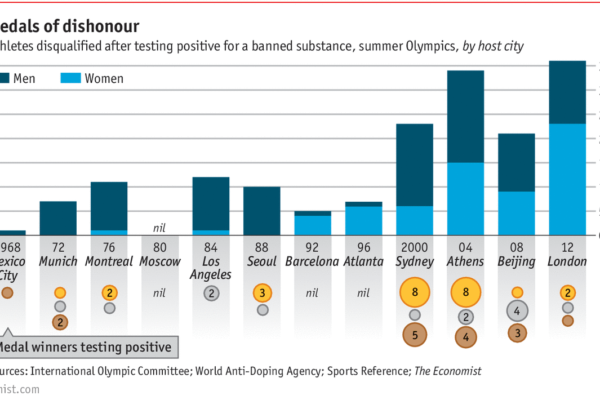
The Tarnished Glory: How Doping Has Undermined the Integrity of the Olympics
The Olympics have long stood as a beacon of human achievement, fair play, and international unity. Yet, over the years, the integrity of this prestigious event has been repeatedly tarnished by doping scandals. Athletes from various countries have resorted to performance-enhancing drugs (PEDs) to gain an unfair edge, compromising the spirit of fair competition and the honor associated with Olympic glory. Among the most notable offenders are China, the United States, and Russia, whose doping incidents have marred the history of the Games. The Chinese Doping Scandals China’s rise in the world of sports has been accompanied by a series of doping scandals that have cast a shadow over its achievements. The most significant of these incidents involved Chinese swimmers and weightlifters, who were found to have used banned substances to enhance their performance. Sun Yang, one of China’s most celebrated swimmers, faced multiple doping allegations. In 2014, he was suspended for three months after testing positive for the banned stimulant trimetazidine. Although he retained his Olympic medals, the incident raised serious questions about the legitimacy of his achievements. In 2020, Sun received an eight-year ban for refusing to cooperate with a doping test in 2018, further damaging his reputation and that of Chinese swimming. In weightlifting, Chinese athletes have also faced significant scrutiny. During the 2008 Beijing Olympics, three Chinese weightlifters, including gold medalists Liu Chunhong and Cao Lei, were stripped of their medals after reanalysis of their samples revealed the presence of banned substances. These cases highlighted the extent to which doping had infiltrated Chinese sports and led to increased calls for stricter anti-doping measures. The United States and High-Profile Doping Cases The United States, despite its leading position in global sports, has not been immune to doping controversies. High-profile cases involving athletes such as Marion Jones and Lance Armstrong have severely impacted the credibility of American sportsmanship. Marion Jones, once hailed as the fastest woman on earth, won five medals at the 2000 Sydney Olympics (three gold and two bronze). However, her career came crashing down when she admitted to using steroids supplied by the notorious BALCO laboratory. Jones was subsequently stripped of her medals, and her fall from grace served as a stark reminder of the pervasive nature of doping in athletics. Cycling legend Lance Armstrong also found himself at the center of a massive doping scandal. Armstrong, who won a bronze medal in the time trial at the 2000 Sydney Olympics, was later revealed to have used a sophisticated doping regimen involving EPO, human growth hormone, and blood transfusions. His systematic cheating led to him being stripped of his Olympic medal and seven Tour de France titles, profoundly shaking the world of professional cycling. The Russian Doping Cases Perhaps the most egregious example of doping in recent history involves Russia, whose state-sponsored doping program was exposed in a scandal that rocked the sports world. The scale and organization of the program, which aimed to dominate the Olympics through systematic cheating, were unprecedented. The 2012 London Olympics and the 2014 Sochi Winter Olympics were heavily affected by Russia’s doping scheme. An investigation by the World Anti-Doping Agency (WADA) revealed that Russian officials had manipulated test results and tampered with samples to ensure their athletes passed doping controls. As a result, numerous Russian athletes were stripped of their medals, and the country faced partial bans from subsequent Olympics. Notable athletes affected by the scandal include Anna Chicherova, who lost her bronze medal in high jump from the 2012 London Olympics, and Tatiana Lysenko, who was stripped of her gold medal in hammer throw from the same Games. The exposure of Russia’s state-sponsored doping program led to significant sanctions and highlighted the lengths to which some nations would go to achieve Olympic success. The Impact on Olympic Integrity The pervasive issue of doping has had a profound impact on the integrity of the Olympics. Each doping scandal not only undermines the achievements of those caught cheating but also casts doubt on the legitimacy of the competition as a whole. Clean athletes are robbed of their rightful victories, and the spirit of fair play is eroded. The International Olympic Committee (IOC) and WADA have intensified their efforts to combat doping, implementing more rigorous testing protocols and harsher penalties for offenders. However, the challenge remains daunting, as new substances and methods to evade detection continue to emerge. Conclusion Doping scandals involving countries like China, the United States, and Russia have significantly tarnished the Olympics’ reputation. These incidents serve as a sobering reminder of the ongoing battle against performance-enhancing drugs in sports. Upholding the integrity of the Olympics requires a collective commitment to fair play, stringent anti-doping measures, and a steadfast resolve to preserve the true spirit of athletic competition. Only through such efforts can the Olympics reclaim its standing as a true celebration of human potential and sportsmanship.
Cambodia’s Hun Dynasty stakes reputation on the Funan Techo Canal
Ground will be broken on the Funan Techo Canal on August 5 – strongman Hun Sen’s 72nd birthday. The waterway will be carved through the eastern regions of the country, eventually connecting the capital Phnom Penh to new deep-water ports in Sihanoukville and Kampot, on the Gulf of Thailand. The Cambodian government believes the $1.7 billion waterway will reduce Cambodia’s dependency on Vietnam, through whose ports much of Cambodia’s imports and exports are transported. They expect an economic boon for the country, with cheaper transportation making Cambodian goods more competitive, fostering overall economic growth. But the megaproject has been controversial, to say the least. Initially, much of the controversy centered on Vietnam’s apparent fear that Cambodia might allow its “ironclad friend” China military access to the canal. The security dimension was played up. Villager Sok Rom looks at excavators being used on the construction of the Funan Techo canal along the Prek Takeo channel in Kandal province, July 9, 2024. (Tang Chhin Sothy/AFP) However, there are more significant concerns. The first is environmental. There are genuine concerns, especially if you’re a Vietnamese resident of the Mekong Delta, about the potential ecological impact. Carving out the canal could lead to further intrusion of salt water into the Mekong’s distributaries and create a massive levee between Cambodia and Vietnam’s floodplains. As Brian Eyler of the Stimson Center has put it: “the canal will disconnect the floodplain, creating a dry zone to its south and a wetter zone to the north.” Much remains unknown since Phnom Penh hasn’t yet publicly released any environmental impact assessment on the canal. The second concern is economic, and this is a bit more hazy. David Brown, an economic analyst, argued recently that “there is no plausible economic argument for digging a canal.” I disagree. Economic logic There is some economic logic to the project if it’s done properly. It will make domestic transport of goods cheaper, benefiting consumers and make Cambodian exports more competitive in international markets. Yes, Cambodia has new expressways and wants to re-do its aged railways, but moving goods by water is many times cheaper than by road or rail. It will mean more business for Cambodia’s new ports in Sihanoukville and Kampot, boosting these local economies. It should bring some investment to the rural areas where the canal passes through. And it does make Cambodia more economically self-sufficient—no one can say with 100% certainty that Vietnam won’t in the future deny access to its ports, which would effectively mean an economic blockade for Cambodia. Residential homes along the Prek Ta Hing channel, where the proposed second phase of the Funan Techo canal is set to be built, in Kandal province, July 9, 2024. (Tang Chhin Sothy/AFP) None of this is to say that Phnom Penh has gone about this the right way. The entire process has lacked transparency. The government was too hubristic at the beginning, thinking that China would fund everything, and has over-egged the patriotic angle of the canal, choosing not to have a decent dialogue with the public about the complexity of the scheme. Indeed, Prime Minister Hun Manet, who inherited the premiership from his father Hun Sen last year, has presented it as a nationalistic project. As Hun Manet put it, the canal will give Cambodia “a nose to breathe through.” Of course, this rhetoric comes slightly unstuck once you recall that the China Road and Bridge Corporation will have a lengthy build-operate-transfer contract on the project, so it will only pass into Cambodian ownership sometime in the second half of this century. Even so, Phnom Penh’s propaganda machines are in full swing: anyone who criticizes the scheme is unpatriotic or despises Cambodia, and those who support it are the true adherents of national sovereignty. Legacy building The inherent problem is that the whole thing is essentially a vanity project. That doesn’t mean it’s entirely illogical or uneconomical. But you have to remember that this isn’t a normal project. It’s far more symbolic than the Phnom Penh-Sihanoukville Expressway, the country’s first proper motorway, or your bog-standard hydro dam. It’s a way for Hun Sen, who is still the kingpin despite resigning last year after nearly four decades in power, to give himself a physical legacy. The Hun dynasty is physically cutting an artery through the country, a landmark to the power of the Hun family that they hope will last for centuries. “Our ancestors built the Angkor Temple and other great monuments, but unfortunately we used to be divided. Now, we are once again united and we are building new achievements,” Hun Manet said earlier this year. Construction will begin on August 5, Hun Sen’s birthday. Kavi Chongkittavorn, a veteran Thai journalist, has called the Funan Techo Canal a “litmus test for Hun Manet’s leadership.” Another analyst put it: the government has to “complete it by all means, at all costs.” Workers dig the Funan Techo canal at Prek Takeo in Kandal province, July 9, 2024. (Tang Chhin Sothy/AFP) Indeed, the Hun family has staked its reputation, though not its power, on the project. When trying to defend the canal during a speech in May, Hun Sen, referring to himself in the third person, tried to reassure Cambodians: “Hun Sen has never made a wrong decision in the past 47 years”. (He has; many.) For Hun Manet, it offers an opportunity for drums, flags and loyalty-parades. His first year in power has been somewhat dull. He isn’t as bombastic, as in-your-face, as his father. His speeches aren’t as wild and rambling; his rhetoric is more measured and consensus-based. His focus is policy, often of the boring sort. The ruling party framed his succession as a technocratic shift, the transition from a generation of rulers who literally fought to save the country from genocide to a generation that will make slow, incremental improvements to the progress they inherited. Take a moment to read more Cambodian canal project to kick off on Hun Sen’s birthday Vietnam urges Cambodia to cooperate…
North Korea refused China’s rescue offer for Yalu River island residents
North Korea declined China’s offer to rescue residents on islands in the Yalu River–some of whom later died in flooding–because Pyongyang was afraid that those rescued would try to escape to China permanently, officials in the country told Radio Free Asia. As heavy rains caused rising waters in the Yalu River, which divides the two countries, it became apparent that opening floodgates at hydropower dams would be necessary. But doing so would submerge inhabited islands near the northwestern city of Sinuiju, which lies across the river from China’s Dandong. “The heavy flood damage in Sinuiju, which occurred between the noon of the 27th and the early morning of the 28th, occurred when the floodgates of the Taepyongman Hydropower Station were opened,” an official from Sinuiju’s surrounding province of North Pyongan told RFA Korean on condition of anonymity to speak freely. “An evacuation order was issued to Sinuiju residents before opening the floodgates around 2 a.m. on the 28th.” China’s ambassador to North Korea Wang Yajun led a delegation of over 40 people to pay respects at the Unsan Chinese People’s Volunteer Army Martyrs’ Cemetery amid pouring rain, July 25, 2024, in Unsan county, North Korea. (The Embassy of the People’s Republic of China in the Democratic People’s Republic of Korea via Reuters) By then, the waters were so high that people didn’t dare try to escape on their own, he said, adding that many people on one of the islands died when the floodgates were opened. A South Korean government official told reporters that up to 1,500 residents have died or are missing as a result of the floods. That number hasn’t been verified by North Korea. North Korean state media, meanwhile, reported that 4,100 homes and 7,000 acres of land have been submerged. State media has also used the disaster to boost the profile of the country’s leader Kim Jong Un by featuring him in photos that apparently show him personally leading rescue operations. The deaths could have been prevented, as China had offered to save the residents before the waters got too high, another North Pyongan official told RFA on condition of anonymity for security reasons. “The police in Dandong conveyed their intent to rescue the island residents to the North Pyongan Province’s Social Security Bureau,” he said. “However, Kim Jong Un refused China’s offer and so many residents who were stranded on the island became victims.” China’s ambassador to North Korea Wang Yajun led a delegation of over 40 people to pay respects at the Unsan Chinese People’s Volunteer Army Martyrs’ Cemetery amid pouring rain, July 25, 2024, in Unsan county, North Korea. (The Embassy of the People’s Republic of China in the Democratic People’s Republic of Korea via Reuters) On July 27, when heavy rains showed no signs of stopping soon, representatives from both cities discussed opening the floodgates, the official said. “They only open if China agrees,” he said. “It was obvious that if the water gates of the power plant were opened while the Yalu River was very swollen, the islands in the estuary would be submerged.” It was then that the Dandong police said that they could safely move the island residents to China, but were rejected by Kim, the official said. China’s ambassador to North Korea Wang Yajun led a delegation of over 40 people to pay respects at the Unsan Chinese People’s Volunteer Army Martyrs’ Cemetery amid pouring rain, July 25, 2024, in Unsan county, North Korea. (The Embassy of the People’s Republic of China in the Democratic People’s Republic of Korea via Reuters) “Kim Jong Un did not allow the islanders to evacuate to China under the pretext that they could flee to South Korea. Meanwhile, it got dark and a helicopter deployment became impossible,” he said, adding that North Korean rescue teams couldn’t start evacuations until the next day and they were staying at a nearby hotel. After the rescue was completed, Kim Jong Un arrived on the scene to lead and direct the rescue. “Kim Jong Un arrived in Sinuiju around 8 a.m. on the 28th. The rain had already stopped and the water in the Yalu River was decreasing.” South Korean outlet Yonhap News reported that Kim Jong Un told North Korean media that there were no casualties and accused South Korean media of “fabricating” the scale of flood damages. Translated by Claire S. Lee. Edited by Eugene Whong.
India pledges $300m loan to boost Vietnam’s maritime security
India has offered to provide Vietnam with US$300 million to strengthen its maritime security amid rising tensions in the Asia-Pacific region and increasing wariness in both countries about China’s growing military might and assertiveness. India’s pledge was made during a visit to India this week by Vietnamese Prime Minister Pham Minh Chinh, during which he and his host, Prime Minister Narendra Modi, virtually inaugurated a military software hub in the city of Nha Trang in central Vietnam. The Army Software Park is being developed with India’s assistance and is expected to produce software solutions as well as provide information technology services. Modi said at a welcome ceremony for Chinh at Hyderabad House on Thursday that Vietnam was an important partner in India’s Act East Policy and Indo-Pacific vision. The Act East Policy is a diplomatic initiative to promote economic, strategic and cultural relations with the vast Asia-Pacific region at different levels. Both countries would “continue cooperation for a free, open, rules-based and prosperous Indo-Pacific,” Modi said. This visit from July 30 to Aug. 1 was Chinh’s first trip to India as head of government. RELATED STORIES Vietnam’s PM visits India to reaffirm strategic partnership Vietnam mulls law that may open market to foreign arms firms Vietnam hosts its first international defense expo The leaders said in a joint communique at the end of the visit that Vietnam and India “agreed to strengthen further their defense cooperation based on common priorities and interests, and to contribute to the stability in the Indo-Pacific region.” A package of preferential loans worth US$300 million would be offered for two projects to improve Vietnam’s maritime security, they said. They did not specify details but Indian media said the money would be spent on procuring two types of patrol boats for the Vietnamese navy. In June 2023, India donated to Vietnam a missile corvette, the INS Kirpan, and also sold it 12 high-speed guard boats. Rule-based South China Sea Maritime security is seen as one of the most important elements of Vietnam-India bilateral relations and they have held regular maritime security dialogues since 2019. The joint communique emphasized the importance of “maintaining peace, stability, security and freedom of navigation and overflight in the South China Sea.” Both countries are committed to finding peaceful solutions to maritime disputes in accordance with international law, in particular the 1982 U.N. Convention on the Law of the Sea, or UNCLOS, they said. They stressed that UNCLOS is the legal framework for all maritime activities in the region and the basis for all claims over jurisdiction. Vietnam, together with other ASEAN countries, and China are negotiating a code of conduct for parties in the South China Sea. India and the United States are not involved in those talks but the two leaders called in their communique for a rule-based and effective code of conduct that “does not affect rights and jurisdictions of other countries, including those not taking part in the negotiation process.” China has warned against what it sees as the “intervention” of outside countries in South China Sea disputes. Edited by Taejun Kang.
