
Category: East Asia
Myanmar junta raids Shan state online scam center, detains hundreds
Read RFA coverage of this topic in Burmese. Myanmar junta authorities arrested nearly 750 people, including more than 240 Chinese nationals, in a raid on an online scam near Myanmar’s border with China, sources close to regional authorities told Radio Free Asia on Wednesday. China has been pressing authorities in Myanmar for the past year to crack down on the online fraud gangs, many of which target Chinese citizens, and the arrests in the Shan state border town of Muse follow recent Chinese efforts to help Myanmar’s junta quell armed opposition to its rule. A resident of Muse said junta forces raiding the scam center on Monday had clashed with guards there, members of a pro-junta militia who were apparently caught unaware by the raid. “A shootout between the junta’s local militia and junta soldiers erupted in Muse’s Mingalar neighborhood and many people were arrested, including Chinese nationals,” said the resident, who declined to be identified for security reasons. “Security control at the town’s gates has been tightened more than ever.” It was not clear if there were any casualties in the shooting but sources close to Myanmar authorities said junta troops had detained nearly 750 people and 247 Chinese nationals among them would be handed over to authorities in China. RFA called Myanmar military officials in Muse and Shan state’s junta spokesperson, Khun Thein Maung, for more information but neither responded by the time of publication. The Chinese embassy in Myanmar did not respond to inquiries from RFA by time of publication. Illegal casinos, online gambling and scam centers have proliferated along Myanmar’s borders with both China and Thailand, as well as in Laos and Cambodia, many run by Chinese gangsters, law enforcement organizations say. The operations often thrive on the labor of people tricked into thinking they’ve landed legitimate jobs but forced to adopt false identities online in what have become known as “pig-butchering” schemes, forming relationships with victims then tricking them into investing in fake schemes. University of Texas researchers estimated in a March report that scammers had tricked investors out of more than US$75 billion since January 2020. China has turned to both junta authorities and its insurgent enemies, who control increasingly large areas in Shan state, for help in tackling the gangs. Chinese media reported early this year that 44,000 telecom fraud suspects had been handed over to China including 2,908 “fugitives” but action against the scam centers appeared to dwindle later in the year as fighting intensified between the Myanmar military and anti-junta forces. Suspects detained in a raid on a scam center in Shan state town of Muse. Sept. 23, 2024 (Citizen photo) China is keen to see an end to the turmoil in Myanmar that threatens its economic interests, which include oil and natural gas pipelines from the Indian Ocean coast, and has in recent weeks pressed main insurgent forces in Shan state to agree to halt their offensives against the junta, although neither side appears ready to lay down their arms. Analysts say China is hoping that an election the junta has promised to hold next year can pave the way for a resolution of Myanmar’s conflict, and it has offered help to organize the vote and a census that the military said will be held soon. RELATED STORIES No limits to lawlessness of Myanmar’s predatory regime Myanmar border militia emerges as nexus in regional scam network ‘Most easily corrupted’ Cambodia, Laos and Myanmar form scam epicenter Translated by RFA Burmese. Edited by Kiana Duncan and Mike Firn. We are : Investigative Journalism Reportika Investigative Reports Daily Reports Interviews Surveys Reportika
Tibetan monk jailed for 18 months over Dalai Lama’s speech
Read RFA coverage of this story in Tibetan. A Tibetan monk has been sentenced to over 18 months in prison on charges of sharing a speech by Tibetan spiritual leader the Dalai Lama on social media, Tibetans living in exile told Radio Free Asia. Chinese authorities arrested Jampa Choephel of Penkar Thang Monastery in Rebkong county, Qinghai province, shortly after he shared a speech by the Dalai Lama on March 10, they said. The date marks Tibetan National Uprising Day, the start of a failed Tibetan rebellion against Chinese rule in 1959. Possessing or sharing photos or videos of the Dalai Lama, the Tibetan Buddhist spiritual leader who has resided in northern India since 1959, is considered an act of separatism and has been a punishable offense in Tibet for decades. Choephel’s case is part of a broader crackdown on Tibetan Buddhist clergy and intellectuals, many of whom are imprisoned in undisclosed locations for extended periods. Most have been arrested for expressing their views or sharing information about conditions in Tibetan areas under Chinese rule. The monk was held in the county’s Gurathang Prison until his “secret” trial in August when he was sentenced, said the sources, both of whom declined to be identified so they could speak freely without reprisal. Choephel’s family was not informed about the trial because Chinese authorities considered it politically sensitive, the first source said. Following the trial, Choephel was held for an additional month in the same jail, and the total six months he spent in detention were counted as part of his sentence, according to the sources. An aerial view of Rebkong county in western China’s Qinghai province, Oct. 26, 2017. (Eric Lafforgue/Art In All Of Us/Corbis via Getty Images) Authorities monitor family In the meantime, Chinese authorities are closely monitoring the monk’s family, the second source said. “This constant surveillance has created a climate of fear and anxiety for them, preventing them from inquiring about his well-being,” he said. On Sept. 22, Choephel was transferred to a prison in Xining, capital of Qinghai province, where he will serve the remainder of his sentence, the sources said. Chinese authorities tightly control Tibetans who live in Rebgong, called Tongren in Chinese, a restive area of Malho, or Huangnan, Tibetan Autonomous Prefecture, restricting their political activities and peaceful expressions of cultural and religious identity. Choephel, originally from Rebgong Medpa, went into exile in India in 1986. He spent 10 years studying at a Tibetan monastery in Dharamsala from which he graduated in 1996. Upon returning to Tibet, he resided at Penkar Thang Monastery in Rebgong, where he devoted himself to meditation. A master of Tibetan calligraphy, Choephel also taught writing and English. But he remained under constant surveillance by the Chinese authorities, with police frequently monitoring and issuing warnings around his residence during significant occasions. Additional reporting by Dechen Wangmo. Translated by Tenzin Dickyi and Dawa Dolma for RFA Tibetan. Edited by Roseanne Gerin and Joshua Lipes. We are : Investigative Journalism Reportika Investigative Reports Daily Reports Interviews Surveys Reportika
China angry on Biden’s comment on Chinese aggression during Quad
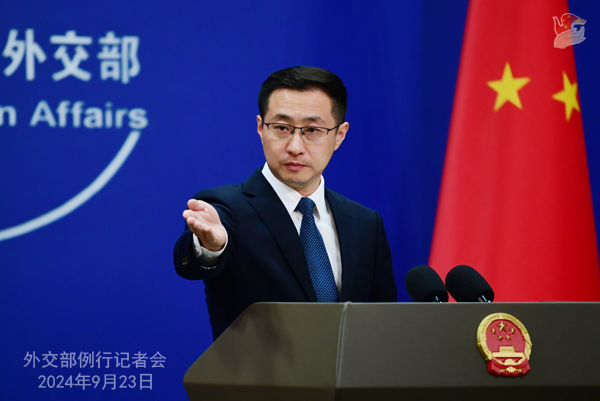
China has responded angrily to comments by Joe Biden, at a weekend summit of the QUAD Dialogue, about Chinese aggression, saying the grouping was a U.S. tool to ensure its hegemony.
Leaked audit of VW’s Xinjiang plant contains flaws: expert
Volkswagen’s audit of its joint venture plant in Xinjiang — where human rights groups accuse it of using Uyghur forced labor — contains flaws that make it unreliable, said an expert who obtained a leaked confidential copy of the audit. The German automaker had declared in December that the audit of the factory, a joint venture with Chinese state-owned SAIC Motor Corp., showed no signs of human rights violations. But after analyzing the leaked audit report, Adrian Zenz, senior fellow at the Victims of Communism Memorial Foundation in Washington, found that contrary to its claims, the audit failed to use international standards and was therefore “unsuited to meaningfully assess the presence or absence of forced labor at the factory.” “The methodology of the audit was extremely faulty and insufficient,” he told Radio Free Asia in an interview. Zenz also found problems with auditors themselves. Last year, Volkswagen hired the Berlin-based consultancy Löning-Human Rights & Responsible Business GmbH to perform the audit. Löning in turn commissioned the Shenzhen-based Laingma law firm, which has ties to the Chinese Communist Party, to conduct the actual examination. The Volkswagen-SAIC Motor joint venture plant is seen on the outskirts of Urumqi in northwestern China’s Xinjiang region, April 22, 2021. (Mark Schiefelbein/AP) But Zenz found that neither Liangma nor its expert, British national Clive Greenwood, had experience in performing social audits or SA8000 certifications based on internationally recognized standards of decent work. “Liangma’s audit did not conform to the SA8000 standard that it claimed to assess,” Zenz wrote in the 24-page report issued Thursday that was posted on the website of the Jamestown Foundation, a Washington–based conservative defense policy think tank. “Shortcomings in the audit’s method and implementation mean that it was not able to adequately assess forced labor risks,” he wrote. Inconsistencies Löning, which claimed the application of SA8000 auditing principles, neglected key aspects of this standard and ignored the region’s repressive political environment, Zenz found. Furthermore, Liangma’s website does not advertise auditing services or indicate that the firm has expertise in conducting them. And the audit did not assess all the indicators of possible forced labor, he later told RFA in a phone interview. Zenz also found that two Han Chinese lawyers and Greenwood conducted the audit, but did not ask employees questions about possible forced labor, and they didn’t follow standards for worker interviews, he said. An aerial view of Volkswagen cars to be loaded onto a ship at a port in Nanjing, in eastern China’s Jiangsu province, June 23, 2024. (AFP) The auditors live streamed interviews with workers back to their home office, thereby affording workers no confidentiality and risking intercepts via the internet by the Chinese government, he said. By reading the leaked audit document, one can “assess the discrepancy between Volkswagen’s final statement about the audit and what the audit itself actually said,” Zenz said. Volkswagen defended the audit, saying it “always adheres to the legal requirements in its communications,” a company spokesperson told RFA in an email, asking not to be identified by name. “At no time has there been any deception of investors or the public.” Calls to withdraw News of the leaked audit prompted the Inter-Parliamentary Alliance on China to issue a statement on Friday saying it was dismayed by its contents. “It is totally unacceptable for a major company like Volkswagen to continue operating a factory where assimilationist policies are promoted, and unacceptable that claims were made about the integrity of their supply chain due diligence which appear to be false,” said the statement issued by lawmakers from various democratic countries focused on relations with China. The group called on Volkswagen to withdraw from Xinjiang and provide a full explanation in response to reports about the audit. RELATED STORIES US lawmakers query credibility of Volkswagen forced labor audit Volkswagen reviews Xinjiang operations as abuse pressure mounts Volkswagen under fire after audit finds no evidence of Uyghur forced labor Protesters disrupt Volkswagen shareholder meeting over alleged Uyghur forced labor The audit also indicated that the factory held staff activities to promote “ethnic unity” and ensure “harmony,” though these activities are associated with forced assimilation, Zenz’s report notes. “This raises severe ethical concerns over Volkswagen’s continued presence in the region,” Zenz wrote. “A review of the audit shows that it did not attempt to assess forced labor according to international standards,” Zenz said. “It simply claims no forced labor based on a visual inspection of the factory and a review of worker contracts.” Furthermore, Greenwood, who joined Liangma in September 2023, shortly before the audit to participate in it, has publicly stated that SA8000 audits are worthless in China, the report said. “Mr. Greenwood’s enigmatic and in parts highly obscure background is marked by twists, turns, contradictions and obfuscation,” Zenz said in the report. ‘Profiting from exploitation’ Uyghur rights groups have repeatedly called for Volkswagen to withdraw its presence and supply chains from Xinjiang and to shut down its joint venture in Urumqi. The World Uyghur Congress, or WUC, headquartered in Germany, said Volkswagen had “long demonstrated its complicity in the Chinese government’s genocide of Uyghurs.” The Volkswagen-SAIC Motor plant is seen on the outskirts of Urumqi in northwestern China’s Xinjiang region, April 22, 2021. (Mark Schiefelbein/AP) “Credible and independent audits are not possible in a repressive environment, where millions of Uyghurs are under extensive surveillance, arbitrarily detained, and tortured for words or appearances that do not conform to Communist Party ideals,” Gheyyur Qurban, the group’s director of German Advocacy, said in a statement. “It is high time for VW to leave,” he said. Rushan Abbas, executive director of Campaign for Uyghurs, or CFU, said the leaked audit report pointed to “not mere oversight” but a “deliberate, cold-blooded betrayal of basic human dignity.” CFU said it received a copy of the leaked audit report in August and that its findings had been shared with Financial Times, Der Spiegel and German TV broadcaster ZDF. “Profiting from the exploitation and suffering of innocent people is the height of moral…
Did Kim Jong Un make a statement threatening Israel?
A claim has been repeatedly shared in social media posts that North Korean leader Kim Jong Un made a statement threatening Israel in support of Iran. But the claim is false. Keyword searches found no official statements or credible reports that back the claim. Experts dismissed the claim, saying there is little to gain for Kim in making such a statement. The claim was shared in a post on X, formerly known as Twitter, on Aug. 3, 2024, by a user called “SprinterFamily” who has previously spread false information about North Korea. The post cited Kim as saying: “We will always stand by Iran and will respond decisively to any threat to our ally. We warn the mercenary of global imperialism, namely Israel, not to make mistakes.” A screenshot of the false X post. The claim began to circulate amid growing fears of a regional war in the Middle East. The nearly 10-month-old war in Gaza between Israel and Hamas has led to regular low-level hostilities between Israel and Iran and Hezbollah, as well as other groups in the region that are aligned with Tehran. But after the killing of the top leaders of Hamas and Hezbollah in July, Iran and Hezbollah pledged to retaliate, with media reports saying they may attack Israel. North Korea has been a strategic partner of long standing for Iran, based on their subjection to extensive U.S. economic sanctions and other U.S. policies designed to counter the threats they pose to key U.S. partners. There have been media reports that North Korean-made weapons have been supplied to Palestinian militant groups such as Hamas through Iran. Some believe North Korea is indirectly involved in the conflicts in the Middle East, although it has never officially acknowledged or commented on any military support. But the claim about the North Korean leader’s threat against Israel is false. A review of North Korea’s state-run media outlets, which often carry statements from Kim, found no such statement or report. ‘Little to gain for Kim’ Harry Kazianis, senior director at the Center for the National Interest think tank, believes that if the statement was not recorded by North Korea’s official news agency, it should be assumed that the claim is false. Kazianis said North Korea had “other ways” to cause trouble for Israel, including sales of missile technology to Iran that could be used against Israel, citing U.S. and South Korean intelligence agencies. Makino Yoshihiro, a visiting professor at Hiroshima University and diplomatic correspondent for Japanese daily Asahi Shimbun, said there would be little to gain for Kim in making such a statement. “Iran is currently trying not to overly provoke the United States, and North Korea’s involvement would create confusion,” said Yoshihiro. Bruce Bennett, a senior researcher at the RAND Corporation, believes the claim about Kim’s statement on Israel may have originated from China or Russia, citing Russia’s attempts to build an anti-Western coalition. “Given that there was an attack in Iran that killed a major Hamas leader, and Kim Jong Un did nothing, it suggests that if he was really threatening to confront Israel, something would have already happened,” Bennett said, adding that Kim’s threats are primarily for propaganda purposes and are unlikely to be carried out in practice. Translated by Dukin Han. Edited by Taejun Kang. Asia Fact Check Lab (AFCL) was established to counter disinformation in today’s complex media environment. We publish fact-checks, media-watches and in-depth reports that aim to sharpen and deepen our readers’ understanding of current affairs and public issues. If you like our content, you can also follow us on Facebook, Instagram and X. We are : Investigative Journalism Reportika Investigative Reports Daily Reports Interviews Surveys Reportika
No limits to the lawlessness of Myanmar’s predatory military regime
Having illegally seized power and overthrown a democratically elected government, Myanmar’s military was never expected to hold itself up to the rule of law. But given their losses since a trio of rebel armies launched Operation 1027 nearly a year ago, the military has acted with an even greater degree of desperate and callous criminality. The U.N. The High Commissioner for Human Rights released a new report that recorded a 50% increase in civilian deaths from April 2023 to June 2024, year on year. In addition to the more than 2414 civilians killed, the report detailed the deaths of 1,326 people, including 88 children and 125 women who died in military custody since the February 2021 coup. Myat Thu Tun, a former reporter for the media outlet Democratic Voice of Burma, was one of seven people arrested and killed in Rakhine state’s Mrauk-U by Myanmar junta forces in early 2024. (RFA) The report documented executions, egregious sexual violence, and routine torture. Those who survived government custody described harrowing conditions in prisons and military detention facilities. Now there are leaked reports on pro-regime Telegram channels that the military government is preparing to execute five anti-regime activists as early as next week. That would follow the shocking executions of four, including Kyaw Min Yu (Ko Jimmy) and Phyo Zeya Thaw, in July 2022. There are at least 112 people who have been put on death row since the coup. And the regime wants to send a signal through the executions, both to domestic and foreign audiences, that it is still firmly in control, despite losses on the battlefield. War crimes are the strategy The world has become inured to the intentional bombing of civilians, the execution of POWs, and the mass arrests of citizens as a form of collective punishment. Over 27,000 people have been arrested since the coup. Junta troops torched more than 1,050 houses in retaliatory arson attacks in Sagaing, Magway and Mandalay regions in the first half of 2024 alone. Radio Free Asia has documented a stepped up aerial bombing campaign leading to increased civilian casualties. This should come as no surprise. The military’s counterinsurgency doctrine, known as the “Four Cuts” – stopping food, funds, information and recruitment to insurgents – is predicated on the intentional targeting of civilians as a deterrent for lending support to anti-regime forces. A man looks at homes destroyed after air and artillery strikes in Mung Lai Hkyet displacement camp, in Laiza, Myanmar, Oct. 10, 2023. (AP) War crimes have always been the milirary’s strategy, and troops are indoctrinated and encouraged to commit them, including rape. The military is fighting across six distinct battle grounds, and has suffered losses in all of them. It has lost control over 60% of the towns in northern Shan state alone. Opposition forces now control key roads and riparian ports, making the movement and resupply of troops difficult. The only way that the military can retaliate is through aerial bombardment and long-range artillery strikes. If they can’t kill the opposition forces, they will kill the populations that support them. Preying on their own The military’s forces have committed such egregious human rights abuses that it’s hard to feel sorry for them. But their predatory behavior starts with plundering the income of their own troops. Despite their paltry salaries, troops are compelled to make monthly contributions to the sprawling military-owned conglomerate Myanma Economic Holdings Ltd (MEHL). The amount differs based on rank, but all must pay. At the end of the year, MEHL is supposed to pay troops a dividend. Yet nothing has been paid since the coup, a result of nationwide boycotts of military-produced products and services. The military insurance plan is even more egregious. Established in late 2012, by Min Aung Hlaing’s son, Aung Pyae Sone, by 2015 the Aung Myint Moh Insurance company had secured a monopoly on selling life insurance to the military, supplanting the state-owned Myanma Insurance. It has an unclear degree of military ownership through MEHL. Even the lowest ranked soldiers are pressured to buy a minimum two-year policy costing some 500,000 kyats – $238 at the official, artificially low exchange rate – in addition to a monthly premium of 8,400 kyats. Elizabeth Throssell, Spokesperson for the Office of the United Nations High Commissioner for Human Rights (OHCHR). (Daniel Johnson/UN News) Amid recent battlefield losses, including a large number of the hastily trained five classes of conscripts since, the company has had to pay out more than it’s taking in. Its own capital reserves are thought to have flatlined in the overall poor economic climate and investment conditions. As one can expect from Min Aung Hlaing’s rapacious clan, the insurance company is cheating. The firm has labeled many dead soldiers as “missing in action”. In other cases, it has found loopholes in paperwork and nonpayment of monthly fees as justification for not honoring claims. The firm has pocketed the payments of the estimated 20,000 troops who have defected to the opposition. The junta is flat out stealing from the soldiers that they conscript just to line their own pockets. A well-armed extortion racket The abject criminality of the military is getting worse. Due to the military’s own economic incompetence, the economy has cratered. And with that has been a sharp decline in revenue needed to conduct the war. The opposition National Unity Government’s digital Spring Lottery has significantly cut into government sweepstakes income. The loss of territory on the battlefield has cut off revenue streams. Recent losses include four MOGE oil fields, coal, tin, lead and ruby mines. Intense fighting is underway in Hpakant in northern Kachin State for control of lucrative jadeite and rare earth mines. Take a moment to read more China’s frustration with the Myanmar junta’s incompetence is mounting As Myanmar junta falters, rival ethnic armies jostle in Shan state Caveat creditor: China offers a financial lifeline to Myanmar’s junta Debris and soot cover the floor of a middle school in Let Yet Kone village in Tabayin township in…
China targets high-ranking officials who read banned books
Read RFA’s coverage of this story in Chinese China’s Communist Party is clamping down on the secret hobby of some high-ranking officials: reading banned books, a series of state media reports suggest. Officials from glitzy Shanghai to poverty-stricken Guizhou have been accused in recent months of “privately possessing and reading banned books and periodicals,” according to state media reports, which typically surface when the officials are probed by the party’s disciplinary arm. Senior officials have traditionally enjoyed privileged access to materials banned as potentially subversive for the wider population, via the “neibu,” or internal, publishing system, former Communist Party officials told RFA Mandarin in recent interviews. Now it appears that President Xi Jinping is coming for their personal libraries and private browsing habits in a bid to instill the same ideas in all party members regardless of rank. A man walks past posters about Chinese political books displayed at the Hong Kong Book Fair in Hong Kong, July 18, 2012. (Philippe Lopez/AFP) During the 1966-76 Cultural Revolution, any foreign book could be considered a “poisonous weed that promotes the bourgeois lifestyle.” Books banned since 2000 have typically been works about recent Chinese history or inside scoops on senior leaders, including memoirs from Mao Zedong’s personal physician, late ousted premier Zhao Ziyang and a book about the later years of Mao’s trusted premier Zhou Enlai. Overseas publications are often banned or tightly controlled in China, either online, or via a complex process of political vetting by the authorities, including a 2017 requirement that anyone selling foreign publications in China must have a special license. Wider knowledge makes better leaders Former Party School professor Cai Xia said officials were generally allowed to read whatever they liked until the turn of the century. The arrangement encouraged officials to broaden their perspective, making them better leaders. “Politics, like art, requires imagination,” Cai said. “Because experience shows that the more single-minded and closed-off the thinking of the Communist Party, especially the senior cadres, the narrower their vision and the poorer their thinking, and the harder it is for them to grasp the complex phenomena and situations that have emerged in China’s rapid development,” she told Radio Free Asia. Wider reading encourages deeper thought, which helps China “to move forward,” she said. Masks, goggles and books collected from the Occupy zone are seen on the table at guesthouse in Hong Kong Dec. 30, 2014. (Tyrone Siu/Reuters) Du Wen, former executive director of the Legal Advisory Office of the Inner Mongolia Autonomous Region government, said the purge of readers of banned publications is worrying. “This phenomenon is so scary, because it sends the message that there is no independence in the ranks of the Chinese Communist Party,” Du said. “Even dialectical materialism and critical thinking have become evidence of guilt.” Nearly 20 officials have been accused of similar infractions, Du said, basing the number on his observation of media reports. Officials have been tight-lipped about the names of the books and periodicals these officials were reading, yet the accusations keep coming. Those targeted In November 2023, the party launched a probe into former Zhejiang provincial Vice Gov. Zhu Congjiu, accusing him of losing his way ideologically. In addition to making off-message comments in public, Zhu had “privately brought banned books into the country and read them over a long period of time,” according to media reports at the time. In June 2023, the Beijing branch of the Central Commission for Discipline Inspection expelled former state assets supervisory official Zhang Guilin for “possessing and reading books and periodicals with serious political issues,” alongside a slew of other alleged offenses including “engaging in power-for-sex and money-for-sex transactions.” Many of those targeted have been in the state-controlled financial system, while some have been concentrated in the central province of Hunan and the southwestern megacity of Chongqing, according to political commentator Yu Jie. A vendor attends to a customer next to images and statues depicting late Chinese chairman Mao Zedong, at the secondhand books section of Panjiayuan antique market in Beijing, China, Aug. 3, 2024. (Florence Lo/Reuters) “Interestingly, a lot of officials in the political and legal system, national security and prison systems, which are responsible for maintaining stability and persecuting dissidents, are also keen on reading banned books,” Yu wrote in a recent commentary for RFA Mandarin, citing the case of former state security police political commissar Li Bin. In Hubei province, the commission went after one of their own in party secretary Wang Baoping, accusing him of “buying and reading books that distorted and attacked the 18th Party Congress.” “Monitoring what people are reading shows the authoritarian system’s determination and ability to maintain its power and to destroy any resources that could be subversive and any doubts about the legitimacy of the authorities’ rule,” Yu wrote in a Chinese-language commentary on May 28. “Xi Jinping’s … goal is to turn more than 80 million party members into marionettes or zombies, and follow him, like the Pied Piper, in a mighty procession that leads to hell,” he said. Categories Zhang Huiqing, a former editor at the People’s Publishing House, told RFA Mandarin that “gray” books were allowed to be published under the watchful eye of the party’s Central Propaganda Department, which also reviewed and vetted foreign-published books for translation into Chinese, for distribution as “neibu” reading material. Divided into categories A, B and C, where A was restricted to the smallest number of officials, “reactionary” books were those that could potentially cause people to challenge the party leadership, and they were once distributed in a highly controlled manner, Zhang said. Du Wen said that while he was an official in the Inner Mongolia Autonomous Region government, he had access to a slew of foreign news outlets not usually sold on the streets of Chinese cities, including Bloomberg, The New York Times, The Washington Post and newspapers published in democratic Taiwan. “These were all allowed because if you want to do research, you have to understand what’s going on overseas,”…
The Era of Proxy Wars: How Major Powers Wage Indirect Wars
The world is indeed experiencing a resurgence of proxy conflicts, where major powers exert influence indirectly through smaller, often less stable, nations. This is part of a broader geopolitical strategy, allowing these big powers to avoid direct confrontation while still advancing their global interests.
North Koreans are getting sick of propaganda song “Friendly Father”
North Koreans are growing weary of being bombarded by “Friendly Father,” an upbeat propaganda song praising leader Kim Jong Un that has been blanketing the country for months now, sources in the country tell Radio Free Asia. People are forced to sing it before every public event and a loudspeaker car drives through cities blaring it, said a resident of Ryanggang province in the north on condition of anonymity for security reasons. “He is holding his 10 million children in his arms and taking care of us with all his heart,” go the lyrics. “The love you give me is like the sea. The trust you give me is like the sky,” says verse two. “You are always by our side, and make all our wishes come true.” The Ryanggang resident said that he has heard the song every day since it was introduced in April, except for a three-day break in early May due to the death of a high-ranking official. “Every factory, company, school, work unit, and neighborhood-watch unit in the province has both children and adults sing this song whenever the opportunity arises.” he said. Music video The government created a high-quality music video for the song depicting people from all walks of life enthusiastically singing along to it. Friendly Father was inspired by an earlier propaganda song called “Friendly Name” that sung the praises of Kim’s father and predecessor Kim Jong Il. The melody is different but many of the lyrics in “Friendly Father” are callbacks to the earlier song, which most North Koreans know by heart. North Korean students sing in music class at the Pyongyang Orphans’ Secondary School in Pyongyang, North Korea, Sept. 1, 2016. (Jon Chol Jin/AP) The order to promote the song comes from the Central Party of the ruling Korean Workers’ Party, the Ryanggang resident said. It’s gotten to the point where people actively avoid places where the song is played publicly if they can help it, he said. Deserted park For example, in the city of Hyesan, on the border with China, there is a park where retired people gather to spend their free time by talking, singing, dancing, playing games or exercising. But when the park turned off their music and began playing “Friendly Father” over the park’s public address system, the senior citizens went home, according to the resident. “The manager forced them to stop dancing to a folk song but to dance in praise of the marshal instead,” he said, referring to Kim by his military rank. RELATED RFA CONTENT RFA Insider podcast Episode 6 (Timecode 13:50) Upbeat video casts Kim Jong Un as North Korea’s father figure North Korea bans karaoke, saying it smacks of ‘rotten’ capitalist culture North Korea bans more than 100 patriotic songs that refer to reunification “The elderly people stopped dancing and began to return home. The song … rang out in the empty park where everyone had left one by one … until it was deserted.” The park, which used to teem with old folks from sunrise to sunset, is now empty almost every day, he said. Respect thy elder Another problem with the song stems from Korea’s Confucian culture. Often complete strangers are expected to grant older people a certain amount of respect simply because they are older, with the promise that they will receive the same respect from the young when they reach the same age. However, “people in their 70s and 80s are being forced to call Kim Jong Un, who is only in his 40s and is about the same age as their sons, their ‘friendly father,’” the resident said. North Koreans sing at a picnic gathering at a park in Pyongyang, April 18, 2012, a national holiday celebrating the birthday period of the late leader Kim Il Sung. (Vincent Yu/AP) The government’s push of “Friendly Father” is even more aggressive than its efforts to promote songs from the reigns of Kim Jong Un’s father and grandfather, a resident of the northeastern province of North Hamgyong told RFA who also asked not to be identified. “Back then, their songs were sometimes played on broadcasting cars, but they did not make people sing at the start of every learning session or lecture session, nor was it forced upon the elderly, as they are doing right now,” he said. People scoff at the notion that Kim Jong Un could be their “friendly father,” because they do not trust his leadership abilities, the second resident said. “They have no hope in their leader, but they are forced to familiarize their eyes, ears, and mouths with the image of him as their friendly father through the song,” he said. It seems that the propaganda efforts are getting bigger and louder as people’s dissatisfaction with society increases, he said. Translated by Claire S. Lee and Leejin J. Chung. Edited by Eugene Whong and Malcolm Foster. We are : Investigative Journalism Reportika Investigative Reports Daily Reports Interviews Surveys Reportika
Has China not launched a war since 1949?
A claim emerged in Chinese-language social media posts that China has not launched a war since 1949. But the claim is misleading as it is a one-sided historical interpretation. A review of events shows that China has been involved in several major conflicts since 1949, and there are different views about how much of a role it played in starting them. The claim was shared on X, formerly known as Twitter, on Aug. 24, 2024. “While the U.S. has launched 469 conflicts since 1789, China has launched none since 1949,” the claim reads in part. Multiple Chinese accounts on X have reposted an infographic comparing the number of wars initiated by the U.S. and China. (Screenshots/X) The claim has also been shared by several Chinese diplomats on X. Even Chinese President Xi Jinping said during a telephone call with U.S. President Joe Biden in 2021 that his country had not started a conflict since the founding of the People’s Republic of China in 1949. Several Chinese diplomats also reposted the image and further spread on the narrative of the U.S. as a warhawk (Screenshots/X) But the claim is misleading as it is a one-sided historical interpretation. A review of historical events shows that China has been involved in several major conflicts since 1949 and there are different views about how much of a role Beijing played in starting them. Below is what AFCL found. The Sino-Indian War The month-long Sino-Indian War of 1962 was a conflict rooted in disputes with India over China’s attempts to build a military road linking its Xinjiang region with Tibet after China occupied the Tibet area in 1950, according to Encyclopædia Britannica, the world’s oldest continuously published encyclopedia. The road was scheduled to pass through Aksai Chin, an area that overlaps parts of Tibet and Xinjiang but is also claimed by India as part of its northern Ladakh region. The war was preceded by intermittent skirmishes beginning in 1959, which culminated in an attack by Chinese forces against the region on Oct. 20, 1962. But some scholars, including Wang Hongwei, a Chinese academic expert on South Asia, said that the campaign originated from an arbitrary border demarcation by India’s government in 1961. Wang listed the advance of India’s army into territory that China claimed, attacks on Chinese posts, the killing of Chinese border guards and a 1962 Indian order for its forces to expel the Chinese from the North-East Border Special Region as evidence that the war was imposed on China. China has officially described the conflict as a war of self-defense ever since. The Sino-Vietnamese War Internationally known as the Sino-Vietnamese War, the conflict that broke out when 220,000 Chinese soldiers struck along the 800-mile border with Vietnam early on Feb. 17, 1979. While at the time both neighbors had communist political systems, Vietnam’s decision to sign a mutual defense pact with the Soviet Union in 1978 provoked the ire of many Chinese leaders, given that at the time Beijing and Moscow were struggling for leadership of the global communist movement. This tension was later exacerbated by Vietnam’s invasion of neighboring Cambodia at the end of 1978 and the overthrow of the Beijing-backed Khmer Rouge government, an event that served as the catalyst for the conflict between Beijing and Hanoi. The conflict has been called an aggressive war launched by China by scholars such as Miles Yu, the director of the Hudson Institute’s China Center, who emphasized that the conflict is portrayed completely differently in Vietnam and in China. Vietnam portrays the conflict as a struggle against Chinese expansion, while China frames it as a war of self-defense. In line with this interpretation, a Chinese government webpage commemorating soldiers killed in the conflict, lists several actions by Vietnam in the mid-1970s – implementing discriminatory policies against Chinese minorities in Vietnam and conducting provocative border raids in which several Chinese citizens were wounded – as evidence that Vietnam came to view China as an enemy and gradually adopted a warlike posture towards it. However, Hsiao-Huang Shu, a scholar of Chinese military tactics at Taiwan’s Tamkang University, told AFCL that while the official Chinese government position paints the war as a punitive conflict rather than as an “invasion,” the war was clearly initiated by China. Sino-Soviet border clashes In March 1969, Chinese and Soviet forces engaged in a series of clashes on an island called Zhenbao on a border river. Subsequent border skirmishes in the months following the conflict resulted in an unknown number of casualties. In order to end the dispute, Moscow adopted a carrot-and-stick approach, proposing negotiations on the border dispute while at the same time threatening military action if Beijing did not cooperate. The Soviet Union said that an initial ambush by Chinese army units of Soviet border guards on March 2 was followed by a larger clash on March 15. However, an article published by China’s state-run CCP Review said that the initial skirmish broke out when a Chinese patrol was obstructed and later shot at by Soviet troops. But according to the noted historian of Sino-Soviet relations, Li Danhui, Chinese soldiers initially stabbed and fired upon a Soviet patrol on the day fighting broke out. He cited statements by Chen Xilian, the Chinese commander at Zhenbao, as evidence. Michael S. Gerson, a former analyst at the U.S. Center for Naval Analyses, published a study of the incident, saying that territorial disputes over the strategically unimportant island largely arose as a byproduct of the larger Sino-Soviet ideological split in the 1960s. As part of the split, China said that the Soviet Union’s control of the island was a direct result of unequal treaties China had been coerced to sign, while the Soviet Union argued that China had no legal claim to the island. ‘Illogical comparison’ Michael Szonyi, a professor of Chinese history at Harvard University, told AFCL that while the U.S. has been involved in several wars around the world, the notion that China had “never started a war” was “absurd,”…
