
Category: East Asia
North Korea swaps soybean-based doenjang paste with wheat-based imitation
Read a version of this story in Korean North Korean authorities are providing the public with “foul tasting” wheat paste as a substitute for doenjang, the fermented bean paste that is a staple in Korean cuisine, residents told Radio Free Asia. Something magic happens in the traditional making of soy sauce: when the salty liquid is siphoned off the top, the urn it’s been fermenting in still holds a treasure. It is the pungent paste of legend, doenjang – a key ingredient in Korean soups, stews, sauces and even snack foods. Doenjang is the subject of South Korean rap songs and tops ice cream dishes served at the Biden White House. The paste has been made on the Korean peninsula for millenia. But North Korea, which has been suffering from food shortages, recently boosted wheat production at the expense of other crops. Packaged gochujang and bara gochujang sold at Pyongyang department stores and markets. Gochujang is a spicy red chili paste made with meju, fermented blocks of mashed boiled soybeans, a precursor to doenjang and soy sauce. (RFA) The result has been an excess of wheat and a shortage of soybeans, leading to the unlikely production of doenjang using the former. But people find it disgusting, a resident of the eastern province of South Hamgyong told RFA Korean on condition of anonymity for security reasons. “Starting this year, wheat-based doenjang is being supplied to residents in the city of Sinpo instead of soybean-based doenjang,” she said, adding that most residents are saying they can’t eat it. “They say it is because the white color of the paste is unsightly and the taste is foul compared to the soybean-based doenjang which was previously supplied.” She said the wheat paste’s quality is poor because the production process leaves part of the wheat husk in the final product. “The eater ends up chewing on the husk and smelling a strange, sourish odor.” She said that even after a deadly famine in the 1990s, when the government had almost no food to give to the people, supplies of doenjang never completely ran out. But now, the situation is so dire that the government is trying to pass off an inferior substitute. Because it is a fermented food, doenjang has a very long shelf life. An urn can be buried in the ground and used for several years. So in 2000, North Korea upscaled production, putting doenjang factories in every province and major city. But there’s a shortage of soybeans these days, the resident said. “The doenjang you could get in the grocery stores up until last year was not 100% soybeans. It was mixed with corn,” she said. But even the corn-soybean mix doenjang was better than the wheat substitute, she said. Wheat-based doenjang is unpalatable, a resident of the northeastern city of Rason told RFA on condition of anonymity to speak freely. A lemon bar ice cream with fresh berries, mint ginger snap cookie crumble and doenjang caramel dessert dish is displayed during a media preview, Monday, April 24, 2023, in advance of Wednesday’s State Dinner with South Korea’s President Yoon Suk Yeol at the White House in Washington. (AP Photo/Susan Walsh) She said that the municipal government did give out soybean-based doenjang to residents, but only as a gift on the four major North Korean holidays–New Year’s Day, the two birth anniversaries of leader Kim Jong Un’s late father and grandfather, who were his predecessors, on Feb. 16 and April 15, and the founding day of the ruling Korean Workers’ Party on Oct. 10. Additionally on holidays, residents of Rason “sometimes got small amounts of soy sauce,” she said. While the government-supplied doenjang was made with soybeans, it wasn’t as good as homemade varieties, “it was still good enough to eat.” “Many families, who cannot make their own doenjang or buy it homemade from others, had relied on soybean doenjang supplied by grocery stores,” she said. The wheat doenjang is a poor substitute, they say. “Many people say it is too salty and stinks because it is not stored properly,” she said. “They wish that they could just get doenjang made from soybeans.” Translated by Claire S. Lee. Edited by Eugene Whong. We are : Investigative Journalism Reportika Investigative Reports Daily Reports Interviews Surveys Reportika
South Korea unveils missile that can hit the North’s bunkers
South Korea unveiled its latest domestically produced ballistic missile, the Hyunmoo-5, on Tuesday as President Yoon Suk Yeol warned North Korea that it would face the end of its regime if it attempted to use nuclear weapons. Dubbed the “monster missile,” reflecting a destructive capacity that South Korean media says is comparable to that of a nuclear weapon, the Hyunmoo-5 can carry a warhead weighing up to 9 tons and is capable of striking deeply buried command centers. It incorporates an advanced cold-launch system, which uses compressed gas to propel the missile from its launcher before ignition, minimizing damage to the launcher and increasing operational stability, South Korean media has reported. Media have drawn parallels between the Hyunmoo-5 and China’s Dongfeng-31 intercontinental ballistic missile, with the former estimated to have a range of 5,000 kilometers (3,107 miles), capable of targeting critical infrastructure in North Korea and beyond. The new missile is a centerpiece of the Korea Massive Punishment and Retaliation plan, designed to respond to damage caused by a North Korean nuclear weapon by targeting its leadership and military headquarters in a retaliatory strike. “Our military will immediately retaliate against North Korea’s provocations based on its robust combat capabilities and solid readiness posture,” Yoon said at a ceremony to mark the 76th founding anniversary of the founding of South Korea’s armed forces, where the new missile was showcased for the first time. South Korean President Yoon Suk Yeol speaks during a celebration to mark the 76th anniversary of Korea Armed Forces Day, in Seongnam, South Korea, Oct. 1, 2024. (Kim Hong-Ji/Pool/Reuters) “If North Korea attempts to use nuclear weapons, it will face the resolute and overwhelming response of our military and the South Korea-U.S. alliance. That day will be the end of the North Korean regime,” Yoon added. Denouncing North Korea for threatening the South with its nuclear weapons and missiles, as well as other provocations, Yoon urged the North to abandon “delusions” that nuclear weapons could guarantee its security “False peace, based on the enemy’s goodwill, is nothing but a mirage. History has proven that the only way to safeguard peace is by strengthening our power so the enemy cannot dare challenge us,” he added, vowing to build a strong military and strengthen security based on the strong alliance with the U.S., as well as trilateral cooperation involving Japan. The South Korean military would reportedly aim to use dozens of Hyunmoo-5s to destroy the North Korean military command’s underground bunkers and devastate Pyongyang in the event of an emergency. RELATED STORIES INTERVIEW: Former ‘Office 39’ official on how North Korea finances nukes North Korea may conduct nuclear test after US election: South’s spy agency Satellite photos show expansion of suspected North Korean uranium enrichment site ‘Never bargain’ Some 5,000 troops and 340 pieces of military equipment, including the Hyunmoo-5, K9 self-propelled howitzers and four-legged robots, were mobilized for an anniversary ceremony parade that began at Seoul Air Base in the city of Seongnam, according to the South’s defense ministry. The ministry said the event was organized to show South Korea’s “overwhelming” capabilities to powerfully retaliate against enemy provocations. The showcasing of the Hyunmoo-5 came amid growing concern in South Korea as North Korea has intensified its nuclear posturing with the first public disclosure of its uranium enrichment facility last month. North Korea’s envoy to the U.N., Kim Song, said on Monday that the North would never bargain over its “national prestige,” reaffirming the isolated country’s adherence to its nuclear weapons program. “When it comes to the right to self-defense, a legitimate right of a sovereign state, we will never go back to the point in the far-off past,” he said during a general debate at the U.N. General Assembly, repeating North Korea’s accusations of America’s “hostility” and claiming that its nuclear weapons were “just made and exist to defend itself.” “When it comes to national prestige, we will never bargain over it with anyone for it was gained through the bloody struggle of the entire Korean people,” he added. The ambassador also said that no matter who wins the U.S. presidential election in November, North Korea would only deal with “the state entity called the U.S., not the mere administration.” “Likewise, any U.S. administration will have to face the DPRK which is different from what the U.S. used to think,” he said, using the acronym of the North’s official name, the Democratic People’s Republic of Korea, without elaborating. Edited by Mike Firn. We are : Investigative Journalism Reportika Investigative Reports Daily Reports Interviews Surveys Reportika
A Myanmar revolutionary battles an old enemy with new allies
This story is the fourth in a five-part series exploring the war in Myanmar and what might come if the fighting stops. Read this story in Burmese. Tall, square-jawed and with a facial expression set to stern, Saw Kaw looks every bit the rebel commander that he is. But as he sits in a secret camp of Myawaddy township in Kayin (Karen) state, strumming his guitar and singing songs he learned in church, it’s easy to wonder what shape the 37-year-old’s life might have taken had circumstances allowed. As it was, Saw Kaw was born in a small village in eastern Myanmar and into one of the longest running insurgencies in the world. Almost ever since Burma gained independence from Great Britain in 1948, ethnic Karen forces from small villages in the mountainous areas near Thailand have battled successive military juntas for greater autonomy. Among them was Saw Kaw’s father, who was a member of the Karen National Union, or KNU. When Saw Kaw was seven, soldiers raided his village in search of his father, who wasn’t there at the time. Saw Kaw said they found and beat his uncles and an elderly grandfather instead, sending his mother, seven months pregnant at the time, fleeing into the surrounding jungle. An illustration shows seven-year-old Saw Kaw watching soldiers — who were looking for his father, a resistance fighter — torturing his relatives. (Rebel Pepper/RFA) For safety reasons, he said the family has remained fractured ever since, constantly on guard that the military or their supporters could use one to get to another. “Hello, Mom, how are you,” Saw Kaw sings, playing one of his favorite songs. “I miss you so much. Please pardon me as I cannot come back to you.” A long struggle The Karen are among the largest minority groups in Myanmar, which is thought to have more than 130 different ethnicities with various relationships with the Burman majority that has held the reins of power in the country. The complicated ethnic make-up is seen as a barrier to lasting peace. In-roads other armies have made against junta forces to the north and west don’t necessarily indicate the country can emerge from its complicated civil war whole. But the KNU has committed itself to the idea of a federation in which it and other groups have a high degree of authority over their own affairs but participate in a larger, national government. They are allied with the National Unity Government, a group of exiled former government officials helping to fund resistance movements and build a lasting peace should the military collapse. Cobra Column commander Saw Kaw stands on Asia Road, near the site of what was formerly the Myanmar junta’s Battalion 356, July 12, 2024. (Chan Aung/RFA) As a military commander, Saw Kaw doesn’t have time to weigh all the possible political dynamics. But the force he controls – Cobra Column – is an unusual joint effort of seasoned fighters from ethnic armies and young, largely Burman revolutionaries who no longer wish to be governed by the junta. It is an NUG force, not a KNU one. “I cannot precisely predict when this significant event will conclude, but I firmly believe that this war must come to an end,” he said. “It is not solely an arm revolution; the entire populace is involved.” In the shared tragedy, he hopes a lasting cohesion can be formed. READ MORE IN THIS SERIES A new generation in Myanmar risks their lives for change Love and struggle: A new generation in Myanmar’s civil war For Burmese journalist, an uneasy safety in Thailand A coup, then civil war Many of the Karen are Christian due to a history of missionaries operating in the area during colonial rule, and Saw Kaw learned to play the guitar in his church. Whatever early musical aptitude he demonstrated didn’t much matter. He always knew what his future held – fighting for his people. After attending college in Thailand he returned home to join the Karen National Liberation Army, or KNLA. His life has seen peace, however. In 2015, the KNU and the Myanmar military negotiated a ceasefire in the capital of Naypyidaw. Saw Kaw was part of the delegation. In this Sept. 9, 2015, photo, Myanmar President Thein Sein greets representatives of armed ethnic groups at the Nationwide Ceasefire Agreement (NCA) meeting in Naypyidaw. (Gemunu Amarasinghe/AP) By then, Myanmar’s military leaders began to open the country up to the world after decades of isolation. The agreement fell apart, though, in 2021 when Senior Gen. Min Aung Hlaing led a coup that pushed out the civilian government of the National League for Democracy, claiming election irregularities that it has yet to prove. Some of the NLD members fled to Lay Kay Kaw, a town established with the help of the Japanese as a refuge for Karen displaced in the region’s long-simmering conflict. The city, which was known as a “peace town” symbolizing the new detente between the military and rebel forces, became instead a locus where People’s Defense Forces (PDFs) sought training from people like Saw Kaw. “With deep sympathy, I don’t want anyone else to suffer as we have,” he said in an interview from his camp, not far from the front line where rebels are trying to hold off a large collection of government troops. “If people in other places experienced what’s happening in this country, they wouldn’t be able to endure it. It’s truly unbearable.” Cobra Column commander Saw Kaw near the front line in Myawaddy district, Karen state, May 8, 2023. (Courtesy of Saw Kaw) Hunting former NLD members, the military attacked Lay Kay Kaw in December 2021, triggering a return of hostilities with the KNU and its armed units. Fighting escalated throughout 2022 and 2023, spreading to towns and villages in the Myawaddy, Kawkareik and Kyainseikgyi districts. Initially, Saw Kaw said the fledgling PDF units tried to hold off the onslaught with old Tumi guns, flintlock rifles used against the British more than…
Indian border fence cutting off crucial supply route to Myanmar’s Sagaing region
Read RFA coverage of this topic in Burmese India is erecting a fence along its border with Myanmar, which residents of Myanmar’s Sagaing region say is cutting off trade routes and driving up the price of goods. More than 1.6 million people have been displaced by conflict in Myanmar since February 2021, when the military seized power in a coup d’etat, according to the United Nations, with more than 50% of them – an estimated 821,000 people – from the Sagaing region. Many of the displaced there rely on cross-border trade from India for goods and medicine. Trade at the Tamu-Moreh border gate connecting India’s Manipur state to Sagaing was suspended in 2021 but area residents have continued to exchange goods through informal routes. India began construction of its border fence in Manipur state in June 2022 amid an influx of refugees from Myanmar, and Indian Union Government Home Affairs Minister Amit Shah said last week that around 30 km (20 miles) of the barrier have since been completed. Meanwhile, the junta has blocked roads leading to the checkpoint on the Myanmar side, and ethnic Chin commentator R. Lakher told RFA Burmese that India’s fence will make it difficult for residents in Sagaing to obtain goods and medicine from across the border. “The price of commodities has already significantly increased [because of the project],” he said. “This border area is relying on India for all its basic commodities and medical treatments. The local populace will surely suffer a lot of difficulties if the border fencing is completed.” A resident of Sagaing region who, like others interviewed for this report, spoke on condition of anonymity due to security concerns, told RFA that those who need to cross the border are already being forced to do so at unfenced areas, where they must pay higher fees for transportation. “If the border fencing is completed … residents who have close relatives on both sides will face various difficulties,” he said. RELATED STORIES Closed borders with India cause food, fuel shortages in western Myanmar Food shortages reported in rebel-controlled areas of Myanmar’s Chin state Jailed Myanmar activists in India in danger of deportation: rights groups India shares a 1,643-km (1,020-mile) border with Myanmar, 398 km (250 miles) of which are located along Manipur state. The Indian government has earmarked US$3.7 billion to build the border fence, which will also cover 520 km (325 miles) in Arunachal Pradesh, 215 km (135 miles) in Nagaland and 510 km (320 miles) in Mizoram. Another resident of Sagaing told RFA that the border fence will impact people on both sides. “Not only the people of Myanmar, but also the people of India will suffer difficulties because people from both sides already have a long history of crossing the border,” he said. Rihkhawdar- Zokhawthar border gate bridge connecting Rihkhawdar town in Chin state and Mizoram state in India on February 10, 2024. (RFA) Salai Dokhar, the co-founder of aid agency India for Myanmar, said that the Manipur government is urgently erecting the fence because Myanmar’s anti-junta forces have gained control over its border areas. “As Myanmar rebel forces are in control of border areas close to India, the Indian government will have to deal with them, which I believe it does not want to do,” he said. Invitation to rebel forces While the Indian government conducts bilateral negotiations with Myanmar’s junta, it made overtures last week to the country’s rebel forces for the first time since the coup, according to a report by Reuters news agency. The report said that India extended invitations to Myanmar’s shadow National Unity Government, or NUG, as well as to the China National Front, the Kachin Independence Army and the Arakan Army to attend a seminar by the government-funded Indian Council of World Affairs. A source with knowledge of the issue told RFA that Indian Foreign Minister S. Jaishankar is leading the preparation for the event, the theme of which will be “Constitutionalism and Federalism.” The source said that only the Chin National Front had confirmed their registration to attend the seminar, while the other three groups have yet to respond. Observers welcomed the move, which they called “pragmatic,” given the junta’s weakening grip on power in Myanmar’s border regions. “All the Indian borders [with Myanmar] are close to areas under the control of these [anti-junta] forces, and this shows that India has adopted more pragmatic strategies suitable for the situation on the ground,” said an ethnic affairs analyst, who also declined to be named due to fear of reprisal. Attempts by RFA to reach the Indian Embassy in Yangon and the Myanmar Embassy in New Delhi about the border fence went unanswered Friday, as did attempts to contact junta spokesperson Major General Zaw Min Tun for comment on India’s invitation to anti-junta groups. Indian Foreign Minister S. Jaishankar told his junta counterpart Than Swe in New Delhi on July 26 that his government is open to engaging with all stakeholders in resolving Myanmar’s crisis. Translated by Aung Naing. Edited by Joshua Lipes and Malcolm Foster. We are : Investigative Journalism Reportika Investigative Reports Daily Reports Interviews Surveys Reportika
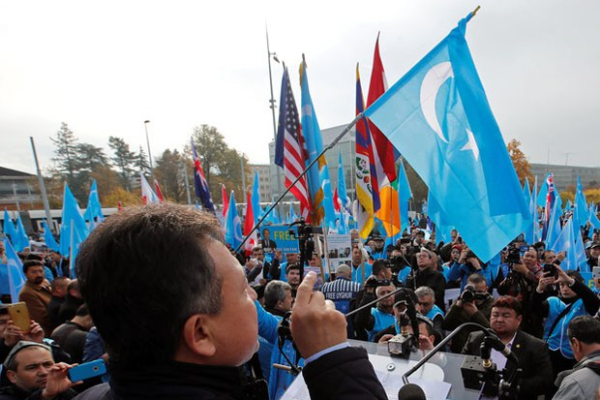
Uyghur Democratic Reform Movement Calls for Global Unity and Support Ahead of Pivotal Congress
Uyghur scholars and intellectuals urge global unity and support for the Uyghur cause ahead of the 2024 World Uyghur Congress General Assembly in Sarajevo. The movement seeks to strengthen democratic reforms, counter Chinese repression, and build international alliances.
China investigates US company for refusing to buy Xinjiang cotton
Read RFA coverage of this story in Uyghur. China has launched an investigation into PVH Corp., the U.S. parent company of fashion brands Calvin Klein and Tommy Hilfiger, for suspected discriminatory measures by refusing to purchase cotton and other products from its northwestern region of Xinjiang, home to 12 million Uyghurs. Analysts said the measure appears to be a retaliatory response by Beijing against companies complying with U.S. laws that ban the import of materials and products from Xinjiang suspected of using Uyghur forced labor. “China is attempting to retaliate against U.S. sanctions on Xinjiang region by imposing its own sanctions on companies that follow U.S. sanctions,” said Anders Corr, principal of the New York-based political risk firm Corr Analytics. “It’s a very bad idea.” “Beijing is trying to tell Calvin Klein not to follow U.S. law but to follow Chinese law,” he said. China’s Ministry of Commerce said Tuesday that PVH Corp. must provide documentation and evidence within 30 days to show it did not engage in discriminatory practices over the past three years. “The U.S. PVH Group is suspected of violating normal market trading principles and unreasonably boycotting Xinjiang cotton and other products without factual basis, seriously damaging the legitimate rights and interests of relevant Chinese companies and endangering China’s sovereignty, security and development interests,” the ministry said in a statement. Earlier this month, China adopted a resolution condemning a series of U.S. sanctions against the Xinjiang Uyghur Autonomous Region and providing support for affected companies. RELATED STORIES China introduces resolution opposing US sanctions on Xinjiang Uyghur rights advocates applaud addition of Chinese companies to US blacklist Uyghur forced labor bill heads to Biden’s desk after unanimous House, Senate votes In response to the measure, Alison Rappaport, PVH’s vice president of external communications, said the company maintains strict compliance with relevant laws and regulations in the countries and regions where it operates. “We are in communication with the Chinese Ministry of Commerce and will respond in accordance with the relevant regulations,” she said, without further comment. Genocide In 2021, the U.S. government declared that China’s repression of Uyghurs and other Muslims in Xinjiang, including mass detentions, the sterilization of women, forced labor and cultural and religious erasure, amounted to genocide and crimes against humanity. Legislatures in several Western countries passed similar declarations. To punish China and get it to change its policies, the United States and other countries have banned the import of products from Xinjiang produced by Uyghur labor. About 90% of China’s cotton is produced in Xinjiang, most of which is exported. Since June 2022, the U.S. government has blacklisted companies in China that make products linked to forced labor in Xinjiang under the Uyghur Forced Labor Prevention Act, or UFLPA. The law also authorizes sanctions on foreign individuals and entities found responsible for human rights abuses in the northwestern region. More than 80 companies are now on the entity list. This May, the U.S. Homeland Security Department added 26 Chinese textile companies to the entity list under the act, restricting them from entering the U.S. market. Consequences Henryk Szadziewski, research director at the Uyghur Human Rights Project, said China is using the measure to lash back over criticism of its policies in Xinjiang. “This is very much a message to multinational corporations that they should not comply with sanctions and other kinds of bans placed on entities operating in Xinjiang,” he said. “It definitely is a countermeasure to what is being done outside of China.” Nevertheless, multinational companies that adhere to U.S. sanctions and exclude forced labor products from their supply chains could face repercussions in China, Szadziewski said. “If you do want to operate in China, you really have to operate by their rules and not by the rules of elsewhere,” he said. Translated by RFA Uyghur. Edited by Roseanne Gerin and Malcom Foster. We are : Investigative Journalism Reportika Investigative Reports Daily Reports Interviews Surveys Reportika
Chinese nuclear submarine sank at dock: media
A Chinese nuclear submarine of the latest generation sank in late May or early June during construction at a shipyard in Wuhan province, U.S. media quoted defense officials as saying. The Wall Street Journal first reported on the suspected sinking of the sub at Wuchang shipyard, which had been believed only to build conventional diesel-powered submarines for the Chinese military. The newspaper said that the vessel that sank was the first of a new class of Chinese nuclear-powered submarines, called the Zhou class, which features a distinctive X-shaped stern. It was undergoing the final stage of construction when it sank. The incident would indicate that the construction of nuclear submarines is moving to Wuchang from a previously known shipyard in Huludao, Liaoning province. Open source investigators reported unusual movements and activities at the shipyard on the Yangtze River in early June, when floating cranes were seen working to supposedly salvage the sub. Unidentified U.S. officials quoted by American media outlets said that China was trying to conceal the accident, which was a major setback for its submarine program. ‘No information’ It is unclear whether the submarine had nuclear fuel on board when it sank and there are no indications of nuclear rescue efforts in the area in the following months. The Chinese embassy in Washington told news agencies that it “has no information to provide.” Taiwan, which closely monitors Chinese military activity, said it was aware of the reports. Defense Minister Wellington Koo said on Friday that authorities “have a grasp of the situation through multiple intelligence and surveillance methods,” the Reuters news agency reported, echoing words he used in June when Taiwanese media reported that a Chinese submarine had been spotted in the Taiwan Strait. RELATED STORIES Did the Chinese submarine accident happen? Singapore commissions 2 new submarines US denies coverup over sub collision in South China Sea China has the largest number of naval ships in the world – approximately 370 surface ships and submarines – according to the Pentagon’s 2023 China Military Power Report. Among them are six nuclear-powered ballistic missile submarines, six nuclear-powered attack submarines and 48 diesel-powered attack submarines. China’s submarine force is expected to grow to 65 by 2025 and to 80 by 2035. Cadets demonstrate flag signals during a media tour to an open day at the People’s Liberation Army Naval Submarine Academy in Qingdao, Shandong province, China, April 21, 2024. (Reuters/Florence Lo) The suspected sinking of the Zhou-class submarine has provoked questions among Chinese military watchers. Some say that the waters of the Yangtze River around Wuhan are too shallow for new nuclear submarines. “We must, of course, accommodate the possibility of a mistaken intel,” said Collin Koh, a regional military expert. “It’s more likely this episode will end like the earlier news about a Chinese nuclear boat having met a mishap in the Yellow Sea or Bohai Gulf,” Koh said, referring to reports of an accident on a Chinese Shang-class nuclear submarine in August last year. British media at that time, citing leaked intelligence, said the Chinese attack submarine with hull number 417 was “caught in a trap intended to ensnare British sub-surface vessels in the Yellow Sea.” This resulted in systems failures that took six hours to repair and surface the vessel, resulting in the deaths of 55 sailors, the Daily Mail and the Times said. The Chinese military has never spoken about the incident and questions remain unanswered. Edited by Mike Firn. We are : Investigative Journalism Reportika Investigative Reports Daily Reports Interviews Surveys Reportika
Chinese truck convoys crowd main bridge to North Korea
Read a version of this story in Korean The main bridge connecting North Korea has been packed bumper-to-bumper with Chinese trucks over the past week, indicating that relations between Pyongyang and Beijing are warming up and that trade is picking up swiftly, residents in China told Radio Free Asia. The Sino-Korean Friendship Bridge spans the Yalu River border, connecting the Chinese city of Dandong with North Korea’s Sinuiju. Most, if not all, official overland trade between the two countries transits this bridge. A resident of Dandong told RFA that over the past few days more than 100 trucks crossed the bridge each day. “The frozen relationship between China and North Korea seems to be gradually thawing,” he said. “You can see that by looking at the number of vehicles traveling between North Korea and China through the Sino-Korean Friendship Bridge.” Over the past few months, North Korea has been opportunistically cleaving to Russia, which needs all the allies it can get as Moscow’s war with Ukraine isolates it from the rest of the international community. North Korea’s relations with China have thus taken somewhat of a backseat. But economically, North Korea depends heavily on China. The large daily convoys are drawing spectators who enjoy watching such a massive number of trucks cross the bridge all at once, the resident said. “The reason why the truck movement has increased these days is because fabrics, materials, and equipment are being transported to North Korea to produce clothing,” he said. “This used to be produced in China. This is newly developed news that I learned through a Chinese businessman who has ties to North Korean officials.” He said the trucks go out in the daytime and unload about 40 tons of cargo each. They then return at nighttime. Flood recovery efforts A lot of the goods being transported are needed in flood recovery efforts, another Dandong resident said. In late July and August, heavy rains caused the Yalu River to overflow its banks, damaging communities and even submerging several inhabited islands. “Most of the items loaded on the vehicles are construction materials needed to restore areas affected by recent floods,” he said. “Additionally, there are lots of raw materials being brought in so that North Koreans can make products that were previously made by North Korean workers in China.” Previously North Korea would send large numbers of workers into China to earn foreign currency for the cash-strapped regime. But all North Korean workers were supposed to have returned home by 2019 according to international nuclear sanctions. The second resident said that the same kind of work is being done, just in North Korea instead of in China. “In the past, some Chinese companies with a legal address in Pyongyang produced clothing and electronic products in North Korea using Chinese materials and then changed them into Chinese products,” he said. In addition to sanctions deterring dispatched workers, the mood inside North Korea is also changing, according to the second resident. The North Korean government is also cautious to send workers abroad because it exposes them to the outside world and makes them less easy to control as they learn about life outside the top-down controlled North Korean society. The second resident said that it is difficult to export products labeled as made in North Korea due to sanctions against North Korea, so products made to order in North Korea are converted to products made in China. “It is impossible to count the number of vehicles lined up on the Sino-Korean Friendship Bridge, but at one glance, more than 100 vehicles are transporting goods to North Korea every day,” he said. “This is the result of both North Korea and China agreeing on various exchanges from the standpoint of mutual interest.” Translated by Claire S. Lee and Leejin J. Chung. Edited by Eugene Whong and Malcolm Foster. We are : Investigative Journalism Reportika Investigative Reports Daily Reports Interviews Surveys Reportika
Myanmar junta airstrike kills civilians sheltering in rebel territory
Read RFA coverage of this topic in Burmese. Myanmar junta jets bombed a shelter for displaced people in a rebel-held town in Rakhine state on Thursday killing 14 civilians and wounding 25, an insurgent force official told Radio Free Asia. The Arakan Army, or AA, has made significant gains in its battle for self-determination over the past year, capturing 10 of the 17 townships and major military bases in Myanmar’s westernmost state but the junta has been hitting back, in particular with its air power. Air force jets bombed the coastal town of Thandwe early on Thursday, hitting public administration offices where people displaced by the fighting have been staying, said the AA spokesperson. “Two jets came in and dropped two bombs each on the city hall and the environmental preservation office. More than 200 displaced people were sheltering in the office,” said the spokesperson, Khaing Thu Kha. “The injured were sent to hospital. Most were elderly people and children.” RFA tried to contact Rakhine state’s junta spokesperson Hla Thein for information on the airstrikes but he did not answer telephone calls. A Thandwe resident said he believed the jets had deliberately targeted civilians, though there was no particular evidence for that. “The people sheltering there are mainly from Thandwe township and Gyeik Taw village,” said the resident who declined to be identified for safety reasons. Residents and members of the AA say junta attacks in Rakhine state have increasingly targeted schools, monasteries, residential areas and government buildings that the AA has captured. The junta has denied targeting civilians though human rights investigators also say civilians in rebel-held areas are increasingly being killed in airstrikes. On Wednesday, junta attacks on nearby Myebon township’s Kan Htaunt Gyi village killed two women villagers and wounded seven people, residents said. The military has launched an offensive in Shan state, on northeastern Myanmar’s border with China, aiming to recapture lost territory there from two main insurgent forces allied with the AA. On Sept. 2, the junta designated all three members of the alliance “terrorist groups”. According to RFA data, junta airstrikes and heavy weapons attacks killed nearly 2,000 civilians and injured nearly 4,000 between the military’s February 2021 coup d’etat and May 2024. RELATED STORIES Myanmar junta arrests dozens for sending supplies to rebel zone A new generation in Myanmar risks their lives for change Myanmar junta airstrike kills dozens, including prisoners Translated by RFA Burmese. Edited by Kiana Duncan and Mike Firn. We are : Investigative Journalism Reportika Investigative Reports Daily Reports Interviews Surveys Reportika
Biden meets Vietnam’s president in New York
U.S. President Joe Biden and his Vietnamese counterpart, To Lam, met on the sidelines of the U.N. General Assembly in New York on Wednesday, with the pair praising rapidly warming bilateral relations nearly half a century after the end of the Vietnam War. It marked the end of a whirlwind trip to New York for Lam, who in May became president – typically considered the second-most powerful office in Vietnam – and then ascended to the top role of general secretary of the Communist Party of Vietnam last month. Lam earlier met with U.S. business executives on Monday and delivered a concise – and mostly circumspect – inaugural speech as Vietnam’s president to the U.N. General Assembly on Tuesday. He also met with Ukrainian President Volodymyr Zelensky on Tuesday and with U.N. Secretary-General Antonio Guterres on Wednesday. Meeting at the InterContinental New York Barclay hotel three blocks from the U.N. Headquarters, Lam thanked Biden for sending condolences upon the passing of his predecessor as general secretary, Nguyen Phu Trong, who died aged 80 after 13 years in office. Vietnam’s President and ruling Communist Party Chief To Lam meets with U.S. President Joe Biden (not pictured) on the sidelines of the 79th session of the United National General Assembly (UNGA) in New York City, U.S., Sept. 25, 2024. (Elizabeth Frantz/Reuters) “Even during his lifetime, the late general secretary often spoke of you with fond memories and sincere appreciation,” Lam said to Biden in his remarks in front of reporters prior to the closed-door meeting. “His historic visit to the U.S. in 2015 followed by your visit to Vietnam in September last year were historic milestones,” he added, “and have significantly advanced the growth of the Vietnam-U.S. relations, resulting in the higher level of the relations that we enjoy today.” “We appreciate very much your fondness for Vietnam, and your historic contributions have been pivotal in elevating our bilateral relations.” ‘Unprecedented cooperation’ Reading from notes, Biden noted that he and Vietnam’s leadership elevated bilateral ties to the “highest level possible” during his trip to Hanoi last year, which commentators at the time said was driven by the countries’ mutual distrust of Beijing’s growing power. “Since then, we’ve been very proud of the progress we’ve made,” Biden said, pointing to U.S. investments in microchips and supply chains in Vietnam and the countries’ “unprecedented cooperation” on cybersecurity as areas where the relationship was blossoming. U.S. President Joe Biden meets with Vietnam’s President and ruling Communist Party Chief To Lam (not pictured) on the sidelines of the 79th session of the United National General Assembly (UNGA) in New York City, U.S., Sept. 25, 2024. (Elizabeth Frantz/Reuters) Neither leader directly mentioned China in their remarks, with the Vietnamese government seeking to carefully balance its growing ties with America with productive relations with its northern neighbor. However, Biden said Hanoi and Washington were united in efforts to build “a more open and secure Indian Ocean, committed to freedom of navigation and the rule of law” – an apparent gaffe meant to refer to the Indo-Pacific region, which U.S. officials use for the vast region stretching from India through the Pacific to America’s west coast. “We continue our path breaking work to heal the wounds of war,” he added. “There’s nothing beyond our capacity to work together.” A senior administration official who spoke to reporters on condition of anonymity after the talks said it was “an extremely warm meeting” and that the pair had also discussed “stability in the South China Sea.” Earlier on Wednesday, Lam met with Guterres, the U.N. secretary general, and discussed “the importance of multilateralism, the work of the U.N., international law including the Convention on the Law of the Sea,” according to a readout released by the United Nations. Vietnamese Foreign Minister Bui Thanh Son also met with his Laotian and Cambodian counterparts, Saleumxay Kommasith and Sok Chenda Sophea, to affirm continuing cooperation in the wake of Cambodia’s recent decision to withdraw from a three-country development pact. US business leaders Lam was not only in New York for diplomatic meetings, though. His meeting with U.S. executives at a forum on the sidelines of the U.N. General Assembly on Monday was a productive one, according to Vietnamese state media, which reported that numerous cooperation deals were signed by Vietnamese and American businesses. Vietnam’s President To Lam addresses the 79th United Nations General Assembly at U.N. headquarters in New York, 24, 2024. (Eduardo Munoz/Reuters) Former British Deputy Prime Minister Nick Clegg, who is now the president of global affairs for Facebook parent company Meta, told Lam during their talks that the company planned to manufacture its Metaverse virtual reality glasses in Vietnam, the reports said. A separate meeting with Nick Ammann, Apple’s vice president in charge of global government affairs, produced an agreement to create an Apple research and development center at the National Innovation Center in Hanoi, including scholarships for Vietnamese students to study artificial intelligence and “the internet of things.” Vietnamese tycoon Nguyen Thi Phuong Thao’s Vietjet Group also signed a $1.1 billion cooperation agreement with Maryland-based Honeywell Aerospace Technologies to provide avionics and aviation technical services for Vietjet’s aircraft fleet, the reports said. Deals on liquid natural gas and data center development were also signed during the forum, according to the state media reports. After five days in New York, Lam is scheduled to fly to Cuba on Wednesday night for meetings with his country’s old communist allies in Havana. He is scheduled to return to Vietnam on Friday. We are : Investigative Journalism Reportika Investigative Reports Daily Reports Interviews Surveys Reportika
