

Category: East Asia
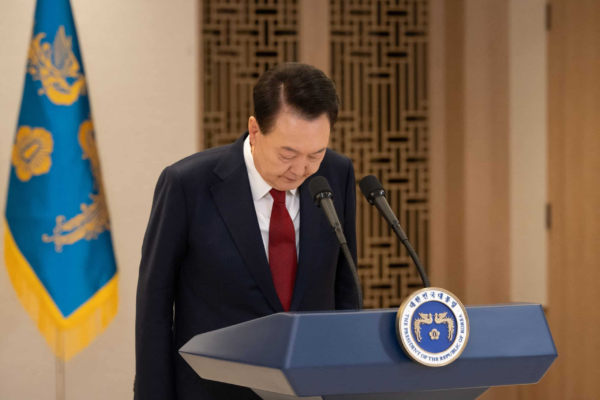
South Korea votes to impeach President Yoon over failed martial law bid
South Korea’s National Assembly voted on Saturday to impeach President Yoon Suk Yeol over his failed bid to impose martial law, to the delight of a huge crowd of anti-Yoon protesters outside the legislature.
Hong Kong verdict against Yuen Long attack victims prompts widespread criticism
The verdict by a Hong Kong court has generated widespread criticism after it found seven people — including former lawmaker Lam Cheuk-ting — guilty of “rioting” when they tried to stop white-clad men wielding sticks from attacking passengers at a subway station in 2019. Exiled former pro-democracy lawmaker Ted Hui, who like Lam is a member of the Democratic Party, accusing authorities of “rewriting history.” “It’s a false accusation and part of a totally fabricated version of history that Hong Kong people don’t recognize,” Hui told RFA Cantonese after the verdict was announced on Dec. 12. “How does the court see the people of Hong Kong?” he asked. “How can they act like they live in two separate worlds?” The District Court found Lam and six others guilty of “taking part in a riot” by as dozens of thugs in white T-shirts rained blows down on the heads of unarmed passengers — including their own — using rattan canes and wooden poles at Yuen Long station on July 21, 2019. Lam, one of the defendants in the subversion trial of 47 activists for holding a democratic primary, is also currently serving a 6-years-and-9-month prison sentence for “conspiracy to subvert state power.” Wearing a cycle helmet, Galileo, a pseudonym, left, tries to protect Stand journalist Gwyneth Ho, right, during attacks by thugs at Yuen Long MTR, July 21, 2019 in Hong Kong. “I was panicky and scared, and my instinct was to protect myself and others,” he said. According to Galileo, Lam’s actions likely protected others from also being attacked. “I felt that his presence made everyone feel calmer, because he was a member of the Legislative Council at the time,” he said of Lam’s role in the incident. “He kept saying the police were coming, and everyone believed him, so they waited, but the police never came.” Police were inundated with emergency calls from the start of the attacks, according to multiple contemporary reports, but didn’t move in until 39 minutes after the attacks began. In a recent book about the protests, former Washington Post Hong Kong correspondent Shibani Mahtani and The Atlantic writer Timothy McLaughlin wrote that the Hong Kong authorities knew about the attacks in advance. Members of Hong Kong’s criminal underworld “triad” organizations had been discussing the planned attack for days on a WhatsApp group that was being monitored by a detective sergeant from the Organized Crime and Triad Bureau, the book said. Chased and beaten According to multiple accounts from the time, Lam first went to Mei Foo MTR station to warn people not to travel north to Yuen Long, after dozens of white-clad thugs were spotted assembling at a nearby chicken market. When live footage of beatings started to emerge, Lam called the local community police sergeant and asked him to dispatch officers to the scene as soon as possible, before setting off himself for Yuen Long to monitor the situation in person. On arrival, he warned some of the attackers not to “do anything,” and told people he had called the police. Eventually, the attackers charged, and Lam and others were chased and beaten all the way onto a train. One of the people shown in that early social media footage was chef Calvin So, who displayed red welts across his back following beatings by the white-clad attackers. So told RFA Cantonese on Friday: “The guys in white were really beating people, and injured some people … I don’t understand because Lam Cheuk-ting’s side were spraying water at them and telling people to leave.” He described the verdict as “ridiculous,” adding: “But ridiculous things happen every day in Hong Kong nowadays.” Erosion of judicial independence In a recent report on the erosion of Hong Kong judicial independence amid an ongoing crackdown on dissent that followed the 2019 protests, law experts at Georgetown University said the city’s courts now have to “tread carefully” now that the ruling Chinese Communist Party has explicitly rejected the liberal values the legal system was built on. RELATED STORIES EXPLAINED: What is the Article 23 security law in Hong Kong? Hong Kong police ‘knew about’ Yuen Long mob attacks beforehand EXPLAINED: Who are the Hong Kong 47? Nowadays, Hong Kong’s once-independent courts tend to find along pro-Beijing lines, particularly in politically sensitive cases, according to the December 2024 report, which focused on the impact of a High Court injunction against the banned protest anthem “Glory to Hong Kong.” “In our view, at least some judges are issuing pro-regime verdicts in order to advance their careers,” said the report, authored by Eric Lai, Lokman Tsui and Thomas Kellogg. “The government’s aggressive implementation of the National Security Law has sent a clear signal to individual judges that their professional advancement depends on toeing the government’s ideological line, and delivering a steady stream of guilty verdicts.” Translated with additional reporting by Luisetta Mudie. We are : Investigative Journalism Reportika Investigative Reports Daily Reports Interviews Surveys Reportika
Myanmar border with China in northern rebel zone to reopen – group says
Read RFA coverage of this topic in Burmese. The border between Myanmar and China in an area controlled on the Myanmar side by ethnic minority guerrillas is to reopen, the rebel group said on Friday, allowing for a resumption of trade including the export to China or rare earth minerals. Myanmar’s Kachin Independence Army, or KIA, and authorities in China have both closed the border in Myanmar’s northern-most state in recent weeks, as the insurgents have seized crossing points from the Myanmar military and Chinese authorities have banned cross-border movements in the hope of stopping the fighting. Representatives of the ethnic Kachin insurgent force, one of the most powerful groups fighting the Myanmar junta that seized power in 2021, met officials in the Chinese city of Kunming on Thursday to discuss the border, said a KIA spokesman. “It’s true that the border gates are being opened,” KIA Information Officer Naw Bu told Radio Free Asia, adding that he did not have details of the talks in Kunming. Residents on the border said that while gates on both sides had been opened, vehicles had yet to resume crossing and it was not clear when they would. The Chinese embassy in Myanmar did not respond to inquiries from RFA. RELATED STORIES Kachin, Shan residents face hardships as China and Myanmar block trade China undermines its interests by boosting support for Myanmar’s faltering junta Myanmar rebels capture border base near Chinese rare-earth mining hub The KIA seized five major crossing points from junta forces in recent weeks, taking full control of the border with China in its areas of operations after capturing important rare-earth and jade-mining centers, which export their output to China. Residents of Kachin state, on the other hand, import a wide range of consumer goods and essentials from China, including fuel, and border closures have brought hardships. China is pressing insurgent groups in northern and northeastern Myanmar to make peace with the military and it has closed its border in places controlled by insurgents on the Myanmar side to press them into talks. In October, China refused to let civilians fleeing fighting take refuge on its side of the border. The KIA responded with its own border closure, stopping the export of rare earths. Hla Kyaw Zaw, a Myanmar political analyst based in China, later told RFA that businessmen with interests in Kachin state’s mines had appealed to Chinese authorities to get the border open again. Two insurgent forces in Shan state, to the southeast of Kachin state, have agreed to ceasefires and negotiations with the junta in recent days but the KIA is locked in fierce fighting to capture the major Kachin state town of Bhamo from junta forces. A resident of the Kachin state border town of Pang War said the crossing with China was open but vehicle traffic had yet to resume. “The gates on both sides have been opened,” said the resident, who declined to be identified for security reasons. “But so far today they haven’t let cars pass. Let’s see what happens tomorrow.” Translated by Kiana Duncan. Edited by RFA Staff. We are : Investigative Journalism Reportika Investigative Reports Daily Reports Interviews Surveys Reportika
EXPLAINED: Why are leaflets protesting North Korea dropped in Japan?
Read a version of this story in Korean An organization dedicated to advocating for South Koreans abducted by North Korea plans to air-drop anti-North Korean leaflets in Tokyo on this week. Specifically, the group plans to use drones to drop the leaflets — containing photos and stories of some of the 516 South Koreans kidnapped by North Korea over the years — over the headquarters of the General Association of Korean Residents in Japan, which many regard as Pyongyang’s de facto embassy there. North Korea doesn’t have an embassy in Japan because the two countries don’t have formal diplomatic ties. What’s the goal of this tactic? The group is doing this because staffers at the headquarters of the pro-North Korean organization — also, abbreviated to Chongryon (in Korean) or Chosen Soren (in Japanese) — refused to accept a hand-delivered list of abductees, according to Choi Sung-ryong, the head of the South Korea-based Association of the Families of Those Abducted by North Korea. Choi said that dropping the leaflets on Chongryon headquarters is like sending them directly to North Korean leader Kim Jong Un — and he hopes that his efforts can prompt Pyongyang to acknowledge that it has abducted many South Koreans over the years. Choi said he would continue to distribute leaflets until this happens. “The leaflets include a request to quickly confirm whether the abductees are alive or dead,” said Choi. “We are asking Kim Jong Un to quickly confirm the fate of 516 family members. That’s why we’re protesting.” Zainichi Koreans in Japan pray for the late North Korean leader Kim Jong Il during a memorial service at a Korean cultural center in Tokyo on Dec. 29, 2011, shortly after his death. Its rival organization is the South Korea-aligned Korean Residents Union in Japan, referred to colloquially in Japanese and Korean using the abbreviation Mindan. Both organizations advocate for Zainichi Koreans living in Japan — which for most of the second half of the 20th century was the largest minority in the country, and is now the third largest. What does Zainichi mean exactly? In Japanese, it literally means “staying in Japan.” Today, there are hundreds of thousands of zainichi Koreans who live in Japan — they have been living there for generations, but for one reason or another they have not acquired Japanese citizenship. The history behind this is that when World War II ended in 1945, there were around 2.4 million Koreans in Japan, and while most of them returned to Korea over the next few months, around 640,000 stayed behind. A group of Japanese and zainichi Koreans stage a protest against Tokyo Governor Shintaro Ishihara’s anti-foreigner remarks, in front of the Tokyo metropolitan government office April 12, 2000. Japan became party to several international human rights covenants in the 1980s and since the post-war period there has been a general change in mainstream Japanese attitudes towards minorities. But for much of the early postwar period, the community struggled economically, and community organizations emerged to counter discrimination against Zainichi. The Chosen Soren and Mindan groups have advocated for their rights in Japanese society and preservation of Korean culture and language among the community, including by securing funds from the South and North Korean governments to run schools for Zainichi children. Today, while there is greater acceptance of zainichi Koreans in Japanese society, they still face discrimination. Translated by Leejin J. Chung. Edited by Eugene Whong and Malcolm Foster. We are : Investigative Journalism Reportika Investigative Reports Daily Reports Interviews Surveys Reportika
Xi Jinping calls for wider use of Mandarin in China’s border areas
TAIPEI, Taiwan – Chinese President Xi Jinping said common Chinese language, or Mandarin, should be “spoken more broadly” in border regions, adding to longstanding concerns about the impact on China’s ethnic minority languages, which some of their speakers say are struggling to survive. China’s borderlands, spanning five provinces and four autonomous regions, including Tibet, Xinjiang Uygur and Inner Mongolia, are culturally and linguistically diverse and have seen opposition to Beijing’s efforts to assimilate ethnic minorities into the majority Han culture. While Mandarin is China’s official language, efforts to promote it have sparked controversy, with critics warning of harm to ethnic languages and cultural identities. “We should continue to deepen efforts on ethnic unity and progress, actively build an integrated social structure and community environment, and promote the unity of all ethnic groups – like pomegranate seeds tightly held together,” said Xi, addressing a Politburo study session on Monday. Xi also said Mandarin, colloquially known as Putonghua, and its writing system should be comprehensively popularized in border regions, and the use of national textbooks compiled under central guidance should be fully implemented, the state-run People’s Daily newspaper reported. He told members of the ruling party’s top policymaking body that it was necessary to guide all ethnic groups in border regions to “continuously enhance their recognition of the Chinese nation, Chinese culture and the Communist Party”. The Chinese leader added that maintaining security and stability was the “baseline requirement” for border governance, noting that efforts should be made to improve social governance, infrastructure and “the overall ability to defend the country and safeguard the border”. China’s Politburo regularly holds sessions, with discussion usually led by an academic – Monday’s session was led by Li Guoqiang, vice-president of the Chinese Academy of History. RELATED STORIES Tibetan language rights advocate under surveillance after release from detention Mandarin speech contests in Tibet are attempts to erase native language, experts say 4 Tibetan teens detained for resisting going to Chinese schools Xi’s latest remarks come amid a broader push in recent years by authorities to promote Mandarin-language education as part of a nationwide effort to assimilate ethnic minorities into the majority Han culture. In Inner Mongolia, the 2020 introduction of Mandarin as the primary language of instruction for core subjects led to widespread protests, school boycotts, and demonstrations by ethnic Mongolians, who fear the erosion of their native language and identity. Similarly, in Tibet, the increasing use of boarding schools where children are taught primarily in Mandarin has been condemned by rights groups as a strategy to weaken Tibetan cultural ties and instill loyalty to Beijing. In Xinjiang, the strict enforcement of Mandarin education has been linked to broader campaigns targeting Uyghur Muslims, including reports of mass detentions and forced assimilation – which Beijing denies – raising alarm over the systematic suppression of Uyghur language and traditions. On Dec. 28, 2021, China’s Ministry of Education, the National Rural Revitalization Bureau and the National Language Commission issued a plan to promote Mandarin. By 2025, it aims for Mandarin to be spoken and understood in 85% of the country as a whole and in 80% of rural areas. Edited by RFA Staff. We are : Investigative Journalism Reportika Investigative Reports Daily Reports Interviews Surveys Reportika
China demolishes prominent Xinjiang building owned by Uyghur activist in US
A symbolically important building in Xinjiang’s capital that was instrumental in the emergence of Uyghur entrepreneurs and businesspeople in the 1990s has been demolished, Radio Free Asia has learned. Authorities destroyed the Rebiya Kadeer Trade Center in Urumqi on Nov. 29, said Zumret Dawut, a Uyghur internment camp survivor now in the United States, citing sources from inside China’s far-western region of Xinjiang. The building had been shuttered for 15 years. Other sources in Xinjiang, including police officers and a tourism worker, confirmed the demolition, and satellite photos show debris where the building once stood on a corner of downtown Urumqi, near the Grand Bazaar. Built in 1990, the seven-story Rebiya Kadeer Trade Center, including the adjacent Akida Trade Center, was a 30,000-square-meter (323,000-square-foot) space with over 600 shops, conference rooms, wedding halls, classrooms and hotel rooms. Besides promoting the development of Uyghur entrepreneurs, the center became a meeting place for intellectuals, a training ground for young researchers and a starting point for philanthropists. The red arrow points to the Rebiya Kadeer Trade Center in Urumqi, capital of northwestern China’s Xinjiang Uyghur Autonomous Region, Sept. 9, 2009. Dawut’s sources told her that the building was imploded. She also said she closely monitored Chinese state media and social media platforms, including Douyin, China’s version of TikTok, for more information or videos, but found nothing. Strict security measures were implemented the day the building was torn down, Dawut learned from her sources, and the road where the trade center was located and surrounding streets were placed under surveillance. Before authorities destroyed the trade center, they distributed notices about closing nearby shops and buildings and restricted access to tourist sites. “I was told that the store owners were instructed to keep their shops closed on the day of the demolition, and no one was allowed in the area,” she said. When RFA contacted police and other officials in Urumqi about the building’s fate, most warned that the topic was sensitive and declined to answer questions when Kadeer’s name was mentioned. ‘Sensitive topic’ A police officer at the Urumqi Ghalibiyat Police Station said the situation was normal and that foreign tourists could visit the area around the Grand Bazaar, but he did not deny the building’s demolition. RELATED STORIES Sister of Uyghur Rights Advocate Rebiya Kadeer Confirmed to Have Died After Release From Detention ‘More Than 30’ Relatives of Uyghur Exile Leader Rebiya Kadeer Detained in Xinjiang Uyghur Leader’s Family Evicted World Cannot Turn a Blind Eye: Rebiya Kadeer China Frees Rebiya Kadeer “The Grand Bazaar can still be toured, and the museums are open for visits,” the officer said. “However, there is no longer a Rebiya Trade Center. You can’t refer to it by that name at this moment. It’s a sensitive topic.” When asked why the building was demolished, the officer said she and others at the police station had heard something about it but could not provide details because of the topic’s sensitivity. A duty officer at the city police’s external affairs department said the Kadeer building was demolished on Nov. 29 by municipal construction workers. But she said she did not have further information. A staff member from a tourism agency in Urumqi also confirmed the center’s destruction. “The Rebiya Kadeer Trade Center has already been demolished,” she said. “I haven’t been there since it’s in ruins, and everything is a mess.” A government worker in Urumqi who declined to give his name said authorities tried to carry out the demolition as quietly as possible, but the sound of the building imploding and police presence on surrounding streets created more fear in the already uneasy city. A view of the facade of the Rebiya Kadeer Trade Center in Urumqi, capital of northwestern China’s Xinjiang Uyghur Autonomous Region, Sept. 9, 2009. An officer from the Nanhu Police Station near the Kadeer building who was on duty around the Grand Bazaar on Nov. 29 suggested that others’ accounts were exaggerated and noted that few policemen were needed during the demolition because Urumqi’s streets are filled with surveillance cameras. “The demolition was carried out without causing any panic,” she said. 1999 arrest When Kadeer lived in Xinjiang, she was politically active and held positions in China’s National People’s Congress in Beijing and in other political bodies prior to her arrest in Urumqi in 1999 while en route to a meeting with a U.S. Congressional staff delegation. Chinese authorities accused her of sending confidential internal reports to her husband, who at the time worked as a broadcaster for Radio Free Asia and Voice of America in the U.S. Kadeer was released on medical parole in 2005 and fled to the United States, where she took on leadership positions in overseas Uyghur organizations, including the World Uyghur Congress. After deadly unrest between Muslim Uyghurs and Han Chinese in Urumqi in July 2009, Chinese authorities accused Kadeer, who was not present at the time, of being an instigator of the turmoil, and permanently shuttered her trade center. Translated by RFA Uyghur. Edited by Roseanne Gerin and Malcolm Foster. We are : Investigative Journalism Reportika Investigative Reports Daily Reports Interviews Surveys Reportika
Did a Chinese tabloid publish a front-page story about Bashar al-Assad’s fall?
A photo of what appears to be a front page of a newspaper emerged in Chinese-language social media posts that claim it shows coverage of Syrian leader Bashar al-Assad by China’s state-run tabloid, the Global Times. But the claim is false. The photo has been digitally doctored. The original photo shows a Global Times report about former Iraqi president Saddam Hussein published in 2003. The photo was shared online about Syria on Dec. 7, citing a statement from the Syrian Presidential Palace denying claims that Assad had left Damascus. The phrase “Why Bashar is not alarmed” was not used in the article’s title or body. Translated by Shen Ke. Edited by Taejun Kang. Asia Fact Check Lab (AFCL) was established to counter disinformation in today’s complex media environment. We publish fact-checks, media-watches and in-depth reports that aim to sharpen and deepen our readers’ understanding of current affairs and public issues. If you like our content, you can also follow us on Facebook, Instagram and X. We are : Investigative Journalism Reportika Investigative Reports Daily Reports Interviews Surveys Reportika
Arakan Army takes fight to Myanmar’s western command in bid to control Rakhine state
Read RFA coverage of this topic in Burmese. Arakan rebels are fighting within the borders of the junta’s Western Military Command headquarters in Myanmar’s Rakhine state after having taken control of nearby Ann township last week, residents said Tuesday. The Arakan Army, or AA, is fighting for self-determination in Myanmar’s western-most state and has made unprecedented progress over the past year, pushing forces loyal to the junta that seized power in 2021 into a few pockets of territory. On Nov. 30, the AA seized the junta’s last military posts in Ann’s Myo Thit, Lay Yin Kwin, Aut Ywar and Ah Hta Ka neighborhoods, taking complete control of the town, which lies 220 kilometers (135 miles) west of Myanmar’s capital Naypyidaw. By Tuesday, AA fighters had penetrated the headquarters of the junta in Rakhine state and the military has responded with aerial strikes and troop reinforcements, a resident of Ann told RFA Burmese. “The AA is now able to break into the western command headquarters and is calling on the remaining troops in the junta’s western command to surrender,” said the resident who, like others interviewed for this report, spoke on condition of anonymity due to security concerns. RELATED STORIES Myanmar’s Arakan Army captures Ann town, focus now on army HQ EXPLAINED: What is Myanmar’s Arakan Army? A year after offensive, rebels control most of Myanmar’s Rakhine state Another resident, who is familiar with the ongoing conflict and also declined to be named, told RFA that junta troops were advancing to the headquarters along the 150-kilometer (93-mile) road connecting Ann northeast to Minbu township “in large numbers,” and had taken up defensive positions along Chinese infrastructure projects. On Nov. 20, the AA captured the town of Toungup in the center of the state, which is on a road hub including a link to the the Kyaukpyu economic zone on the coast, where China is funding a deep-sea port, and has energy facilities including natural gas and oil pipelines running to southern China. Beijing threw its support behind the junta shortly after the 2021 coup and Senior General Min Aung Hlaing’s regime has vowed to protect Chinese interests in Myanmar amid the country’s nearly four-year civil war. Reinforcements en route Meanwhile, residents said that a junta column of about 200 troops is advancing west towards Ann along the road that links it to neighboring Magway region’s Padan township. All the while, the military has been resupplying its troops in the Western Command headquarters with weapons and other supplies by air, they said. Last week, when the AA took control of Ann, sources told RFA that only a few residents had remained in the township and the AA had taken them to safety, leaving the town empty. Attempts by RFA to contact Hla Thein, the junta’s attorney general for Rakhine state, about the fighting in Ann township went unanswered Tuesday, as did efforts to reach AA spokesperson Khaing Thu Kha. The AA, which largely draws its support from Rakhine’s Buddhist majority, has made steady advances over the past year, from the state’s far north on the border with Bangladesh, through central areas to its far south, and it now controls about 80% of it. On Dec. 6, the AA announced that it had taken control of all of the junta’s more than 30 camps in Rakhine, except for the Western Military Command headquarters. Translated by Aung Naing. Edited by Joshua Lipes and Malcolm Foster. We are : Investigative Journalism Reportika Investigative Reports Daily Reports Interviews Surveys Reportika

What’s Wrong with the Reports? (Part 1)
Explore Investigative Journalism Reportika’s comprehensive analysis of global indices and reports, including the World Press Freedom Index, Corruption Perceptions Index, Global Hunger Index, and more. Delve into critical sections such as methodological flaws, unexpected discrepancies, cultural biases, data limitations, and controversies. Our reports challenge assumptions, reveal hidden inaccuracies, and offer insights to foster informed debate.

What’s Wrong with the World Happiness Report
The World Happiness Report faces several criticisms, including issues with the Gallup World Poll, which serves as a primary data source. Concerns have been raised about the subjectivity bias in self-reported responses, where people’s perception of happiness can be influenced by cultural norms and expectations.
