Buddha hair relic raises questions about authenticity

A Vietnamese pagoda has quietly returned a supposed Buddhist relic – eight hairs said to be from Sidartha Gautma, the founder of Buddhism – to Myanmar after questions arose over its authenticity. The relic was on display at the Ba Vang Pagoda in northern Vietnam from Dec. 23-27, receiving huge press in the country at the time of its arrival. The pagoda made a big deal about receiving the relic with a large ceremony to receive what it was calling one of Myanmar’s “national treasures.” But when RFA Vietnamese asked RFA Burmese to verify the story with religious experts in Myanmar, they said there was little if any archaeological or historical evidence to authenticate the relic. If it were widely believed to be legitimate, the relic would be far more well-known in Myanmar, a country that is 87% Buddhist.  After doubts about the relic appeared on social media, the pagoda returned it to its owners. Many objects believed to be sacred relics have dubious origins, a Buddhist monk who is a member of Myanmar’s highest State Buddhist Sangha Council, told RFA Burmese on condition of anonymity for security reasons due to commenting on sensitive religious issues.  “Any relics that we have today are due to [people] over-believing in something unreasonable,” he said. “People should use their own reasoning [to determine] whether [something like this] could be possible or not.”  RFA attempted to discuss the matter with the Myanmar military junta’s Religious Affairs Department, but both spokesmen declined to comment or were unavailable. A gift from the enlightened According to legend, the eight hairs were given to two Burmese merchants by the Buddha himself, who lived in the sixth and fifth centuries B.C. Ba Vang Pagoda and its abbot, the Most Venerable Thich Truc Thai Minh, said they had borrowed the relic for display from Parami Monastery and Parami International Buddha Relics Museum in Myanmar.  If genuine, it would mean that the relic was passed down through the generations from the two merchants until the museum became its steward.  RFA confirmed that both the monastery and the museum exist. They are both located in Yangon, but could not reach the spokesperson or a responsible representative of either. Although the story about the relic went viral on social and mainstream media in Vietnam, Myanmar’s media has had no coverage regarding the lending of its “national treasure” to Vietnam for exhibition, as had been reported in Vietnam. The reckoning The Giác Ngộ online newspaper under the Vietnam Buddhist Sangha, or VBS, reported that at its meeting on Jan. 4, 2023, the standing board of VBS’ Northern Executive Council discussed disciplinary action against the abbot Minh for being involved in the display of the Buddha hair relic. According to the Most Venerable Thich Duc Thien, the vice-chairman and secretary-general of the Executive Council, the Minh admitted fault in front of monks, nuns and Buddhist followers for the display that provoked public controversy and damaged the reputation of the sangha. The VBS accepted his penance, asking him and the pagoda not to organize any international exchanges at the pagoda over the next year, Thien told RFA. Translated by RFA Burmese and Vietnamese. Edited by Eugene Whong and Malcolm Foster.

Read More

Myanmar’s junta threatens to raze villages to bolster army numbers

Myanmar’s military junta is recruiting villagers across more than 50 townships in the country’s central areas, locals told Radio Free Asia on Monday. Up to 50 residents per village are required to serve in the regime’s militia in Bago region chosen through a raffle system, they added.  The junta is recruiting civilians between the ages of 18 and 60 heavily from western and eastern Bago. Twenty villages in eastern Bago and 28 villages in western Bago have already been targeted, residents said. Village administration appointed by the regime has required eligible members of each household to enter a raffle system, where those selected must attend a month-long military training course.  If villagers don’t cooperate, soldiers have threatened to burn down their villages, said a resident in western Bago region who wished to remain anonymous for security reasons. To be excused from service, they must pay between 800,000 kyat [US$380] and one million kyat [$476]. “The [junta] ordered one person per household to enlist. If not, the village will be burned down. When [soldiers] say something like that, people are afraid because they are villagers. They cannot afford to give people from every single house,” he said. “People did not want their village to be burnt, so they agreed with the raffle system. Also, a soldier changed the requirement later to only 10 people from every single village who had to serve for the militia. But people who got selected by the raffle system to serve also do not want to join the militia.” To be exempt from the raffle, residents are required to pay 100,000 kyat [$47] per household, they said.  The military junta began asking for 50 people per village in eastern Bago starting from Friday, said a man from Hpa Yar Gyi village.  “The [junta] is asking for between 50 and 60 people from our area. Let’s say there are 10 people in this village’s section – if two people are selected to join, they must go when the junta calls, whether they are at work or not,” he told RFA. “They have to join militia training. The junta just says joining training, but they have to go to the frontline after.” The military has advertised that those who join the militia will be paid 120,000 kyat [$ 57] and provided a bag of rice per month, residents said.  The junta started to implement the scheme after a meeting between military chiefs and pro-junta political parties on Jan 6. Bago’s junta spokesperson Tin Oo told RFA Thursday that this method allows locals to protect their communities, adding that participating would help increase stability and public security.  “No one wants terrorism,” he said. “[Serving in the militia] allows them to defend their homes and that depends on them preventing People’s Defense Force terrorists from getting into their villages.” Translated by RFA Burmese. Edited by Mike Firn.

Read More

Cambodians need consumer rights NGOs in an era of scams and scandals

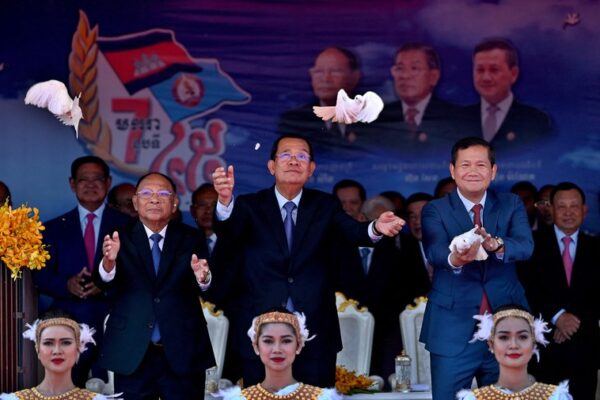
Long gone is the heyday of Cambodia’s civil society, which a decade ago was the most vibrant and rumbustious in Southeast Asia.  The authoritarian Cambodian People’s Party (CPP), in power since 1979 and now firmly in control of a one-party state, saw it as a threat and has systematically crushed the public sphere since 2013. Some NGOs still exist and are performing brave work, but they have been greatly defanged and are petrified of lawsuits or dissolution by the ruling party.  Despite decades of tens of millions of dollars being pumped into Cambodia’s NGO sector, mainly from foreign governments, there has never been an association created that specifically represents the interests of consumers. There is apparently an NGO registered as the Cambodian Consumer Association, but it has no website and good luck trying to find out anything about its activity.  Leader of Cambodian People’s Party Hun Sen and his son Prime Minister Hun Manet release pigeons during a ceremony to mark the 45th anniversary of the fall of the Khmer Rouge regime in Phnom Penh on Jan. 7, 2024. (Tang Chhin Sothy/AFP) Consumers International, a global organization for consumer groups, has no affiliate in Cambodia, according to its website. “Without consumer protection associations,” a report on Cambodia stated, “there will be an imbalance of bargaining power between consumers, and producers and sellers of products and services. As a result, consumers’ rights are not fully protected.”  Indeed, on the one hand, consumption is increasing and habits are changing. Household final consumption expenditure rose to $18.1 billion in 2021, up from around $10 billion in 2011 and just $3.3 billion in 2001, according to World Bank figures. Cambodia’s e-commerce sector, difficult to regulate, is expected to surge in value to $1.78 billion in 2025, more than double what it was worth in 2020.  ‘Scam-state’ Yet, there remain major concerns about the quality of products being sold, especially by traders on Facebook, and other consumer protection issues. Certainly not helping the situation, Cambodia has gotten a damaging reputation as a country of scammers—a “scam-state”, if you like. More and more Cambodians are also becoming consumers of government services, including the expanding healthcare sector, and contributors to the state through growing taxation collection.  On the other hand, business groups, foreign corporations and the country’s powerful tycoons, many of whom have married into the political aristocracy, are increasingly calling the shots. A Cambodian protest against a controversial law regulating non-governmental organizations in Phnom Penh, July 24, 2015. (Tang Chhin Sothy/AFP) Hun Manet, who took over as prime minister from his long-serving father in August, has pitched himself as a friend to the capitalist class. His young government spent months preparing for its first Government-Private Sector Forum in November, at which Hun Manet stressed: “Today’s forum is also a testament to the close cooperation and culture of dialogue between the government and the private sector to jointly address the problems and concerns of investors in order to promote private sector development in Cambodia”.  The claim made by the CPP throughout the decades is that economic freedom is more important than political freedom. Yet rather unequal freedom when one side (the businesses and producers) has vast institutional power and the ear of the premier, yet there are no comparable groups defending the interests of consumers.  Cambodia only adopted a Law on Consumer Protection in November 2019, and the commerce ministry created a National Programme on Consumer Protection last year. A lengthy report published in late 2021 by the Konrad-Adenauer-Stiftung, titled Law in the Digital Age: Protection of Consumer Rights, noted that the “actual implementation of [the Law on Consumer Protection] in promoting and protecting consumer rights is questionable.”  Southeast Asian examples Chapter Seven of this report, titled “Legal and Practical Considerations for Establishing a Consumer Association in Cambodia,”  is an interesting read on this topic. The report recommended that “civil society and nongovernmental institutions need to play an outstanding role as check and balance agents in overseeing consumer rights promotion and protection in both traditional and electronic commerce. Civil society and NGOs shall urge, support, and join the establishment of consumer associations in different sectors to ensure that consumer rights to safety, rights to information, rights to choose, rights to be heard of concerns, and rights to redress are guaranteed.” Cambodian security officers detain protesters in prisoner uniforms as they demonstrate against a controversial law regulating non-governmental organizations outside the National Assembly building in Phnom Penh, July 26, 2015. (Tang Chhin Sothy/AFP) There are good examples across Southeast Asia. One is the Consumers Association of Singapore, a non-profit, non-governmental organization. It runs comparison websites that provide consumers with information on prices charged by companies for everyday necessities and energy. It operates an Accredited Businesses List so that consumers can check if companies are reputable. Importantly, consumers can also submit complaints on its websites which are then investigated.  Elsewhere in Southeast Asia, there is also the Federation of Malaysian Consumers Associations, the Myanmar Consumers’ Union, a Foundation for Consumers in Thailand and a Coalition for Consumer Protection and Welfare in the Philippines.  An overarching “Consumers Association of Cambodia” would be a welcome addition to the public sphere and, with the right funding, including from foreign donors, could engage in the same roles as the Singaporean counterpart. Yet, more targeted associations would also be needed.  Using public money One area could be in tax. In 2013, domestic tax revenue was just $900 million, or around $60 per capita. By 2022, it had spiked to $3.45 billion, or $206 per capita. As such, most Cambodians have become taxpayers as well as consumers of government services in recent years. The National Social Security Fund, a national healthcare insurance, has expanded rapidly in recent years and  Hun Manet vows to expand it further. State expenditure has increased from $409 million (13 percent of GDP) in 2013 to $7.9 billion (27 percent of GDP) in 2022. Yet there remains no “Taxpayers Alliance of Cambodia”. Such an association would lobby the government to…

Read More

Time is not on Myanmar junta’s side, almost 3 years after coup

In his televised New Year’s address to the country, Myanmar’s junta leader Min Aung Hlaing vowed to prioritize economic growth in 2024, apportioning all the blame for the country’s sharp economic contraction on the opposition his coup ousted almost three years ago.   Min Aung Hlaing made no mention of the military’s setbacks since the Three Brotherhood Alliance of ethnic armies in northern Myanmar launched their offensive on October 27, 2023. And while the losses, which include over 30 towns and the surrender of over 3,000 troops are real, the continued economic crisis remains the junta’s single largest vulnerability. Smoke rises from a burning Myanmar military compound amid clashes with armed group Ta’ang National Liberation Army in northern Shan State, Dec. 13, 2023. (AFP Photo) The economy has shrunk by 10-12 percent since the Feb. 1,  2021 coup that deposed the National League For Democracy-led government.  In a recent report, the World Bank predicted the country would only see 1% growth in 2024, given the “broad-based slowdown across productive sectors including agriculture, manufacturing, and trade.”  Over half the population is living beneath the poverty line, while the World Bank found that 40% of surveyed families saw a decline in income in 2023 compared to 2022. The kyat currency has lost half of its value since the coup and it now appears that the State Administrative Council (SAC), as the junta is formally known, has given up any hope of controlling it.  Forex woes In early December 2023, the Central Bank of Myanmar announced that it would no longer fix the exchange rate, allowing the currency to trade at market prices.  This was a tacit acknowledgement that the gap between the official rate of 2,100 kyat per U.S. dollar  and black market rate of 3,500 kyat per greenback was too large to ignore, and that the regime no longer had foreign exchange reserves to prop up the declining kyat.  The shortage of dollars also portends a further energy crisis. Electric black- and brown-outs have been common throughout the country, even in Naypyidaw. And shortages of gasoline and diesel increased in late-2023.  Fighters of Ta’ang National Liberation Army search a building after running over a compound belonging to Myanmar junta military in Shan State, Dec. 12, 2023. (AFP Photo) The SAC had subsidized energy imports by making dollars available to politically-connected energy importers at below market rates in order to ensure a steady supply of fuel. The junta no longer can afford that.  In late December, there were reports of tankers refusing to unload in Yangon’s Thaliwa port until they were paid, indicating a dire shortage of dollars. The regime has been encouraging border trade with China and Thailand, which is conducted in Chinese yuan or Thai baht. But the loss of key border areas is hampering that.  While SAC forces still control the border city of Muse, which handles almost 90% of border trade with China, the Three Brotherhood Alliance now controls the Mile 105 Trade Zone as well as a host of smaller border crossings, such as Chin Shwe Haw. Muse and Lashio are the only towns in northern Shan State that are still under junta control. Ethnic armies on the march The Three Brotherhood Alliance – Arakan Army, Myanmar National Democratic Alliance Army, and Ta’ang National Liberation Army – now controls almost all towns along highways 3 and 34, to the border.  Ta’ang National Liberation Army forces captured a military camp as far west as Nawnghkio, which is only 15 miles from Pyin Oo Lwin, home of the Defense Services Academy, though the Air Force has intensified airstrikes to retake the town.  Among advances by other ethnic armies, Karenni forces now control much of the state including the trade routes to Mae Hong Son in Thailand. The Karen National Union has been consolidating its position along the Thai border.  Fuel prices, delays at the border and increased transportation costs resulted in some $500 million in lost border trade in the two months following the launch of Operation 1027 in northern Shan State. Border trade accounts for 40% of exports and 21% of imports.  Myanmar Now, citing Commerce Ministry figures, found that exports to Thailand and China in the last 9 months of 2023 fell by $178 and $157 million, respectively. Residents of an improvised neighborhood gather to receive rice distributed by the World Food on the outskirts of Yangon, May 21, 2021. Over half the population in Myanmar live beneath the poverty line. (AFP Photo) Sector after sector have been hit hard.  In late November, the SAC stopped supplying fuel to industrial estates, calling on factory owners to negotiate their own energy purchases. In the key garment sector, 271 of 817 factories (33%) have shut down since the coup – due to shortages of foreign exchange to pay for raw materials, high energy prices, and the loss contracts and foreign investor unease with the human rights situation. Even Chinese-owned firms are closing. For those still employed, wages are stagnant and being eaten up by inflation, which remains high at 29%. Prices of staples, including rice, eggs, and cooking oil, have soared.  The junta refused to increase the minimum wage for workers, instead offering a 1,000-kyat (US$0.20) daily allowance. The current minimum wage was set in 2018. Myanmar Kyat notes are seen in a donation coffer at a Buddhist pagoda in Yangon, April 17, 2017. (Roberto Schmidt/AFP) The agriculture sector has been impacted by changing weather patterns and shortages of imported fertilizers and pesticides. While the cost of production has soared for farmers, in mid-September 2023, the junta imposed price ceilings on wholesale rice trade to stabilize prices for urban consumers. U.S.-imposed sanctions on the Myanma Investment and Commercial Bank and Myanmar Foreign Trade Bank, which were responsible for most of the U.S. dollar transactions, have crippled foreign trade. Singapore’s United Overseas Bank has been quietly closing Myanmar-linked accounts, further hampering their international transactions. In December 2023, three Myanmar nationals, including Kyaw Min Oo, the CEO of Sky Aviator, were…

Read More

Ex-junta official says Shan state ceasefire is ‘not sustainable’

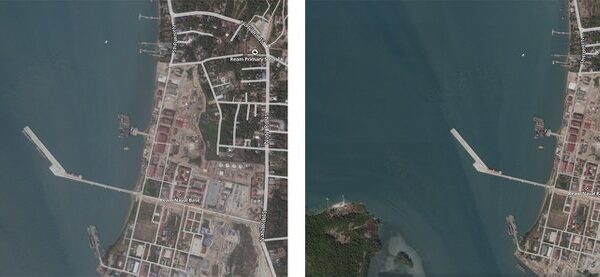
Junta officials and a resistance alliance agreed to a temporary ceasefire during talks in China, a person attending the meeting told Radio Free Asia on Friday morning. The Three Brotherhood Alliance and regime representatives reached the decision during peace talks in China’s Kunming on Thursday. The agreement was signed into effect at 10 p.m., the anonymous source said, asking RFA not to disclose his name because he was not authorized to talk to the media.  As a result of the discussion, the allied Arakan Army, Myanmar National Democratic Alliance Army, and Ta’ang National Liberation Army agreed to cease capturing cities and military camps in northern Shan state. Junta officials agreed not to instigate aerial attacks and operate heavy weaponry. China’s border with Myanmar would be re-opened after renegotiation among the three northern alliances, junta officials and China when the area is more stable, the meeting attendee said.  This decision is a result of Chinese pressure and would not be sustainable in the long run, said an ex-military official, who asked RFA to protect his identity for safety reasons.   “This ceasefire is due to pressure from China. China definitely put pressure on both sides, because Yunnan’s industrial products are affected. Because of this, a ceasefire agreement was reached before the resolution was clear,” he said.  “This halt is a breather for the junta council. The Three Brotherhood Alliance also breathed a sigh of relief. And China also breathes a sigh of relief. But I want to say that this is not a long-term, stable situation.” Neither party could deny it was a result of Chinese pressure, said Dr. Hla Kyaw Zaw, a political and military analyst based in China. “There are pros and cons. Some say this could set back the Spring Revolution. I don’t think so. As for the northern group, they still need to rest in order to prepare their armies in peace, and the ceasefire is temporary,” she told RFA.  “It’s a good thing to stop temporarily and politically discuss. They also need to be free to discuss. There may be some consideration for what China wants [from the Three Brotherhood Alliance] when China intervenes.” Chinese foreign ministry spokesperson Mao Ning voiced Beijing’s support for the ceasefire at a regular news conference Friday. “China hopes the relevant parties in Myanmar can conscientiously implement the agreement, exercise maximum restraint toward each other and solve the issues through dialogue and consultations,” she said, adding that the ceasefire was also in China’s interests. “The two sides promised not to undermine the safety of Chinese people living in the border area and Chinese projects and personnel in Myanmar,” she said. A previously reported cease-fire was not honored by either side. The result of this discussion is only for northern Shan state and would not apply to Rakhine state, added the meeting attendee. The Arakan Army’s attacks have also impacted Chinese development projects in Rakhine. On Monday morning, the Arakan Army launched an offensive on a junta naval base in a Chinese special economic zone.  Representatives from the Myanmar National Democratic Alliance Army, Arakan Army, and Ta’ang Liberation Army attended the meeting, said the anonymous source. Lt. Gen. Min Naing and five members from the military council also attended, he added, as well as China’s special representative Deng Xin Jun. Since Operation 1027 launched on October 27, 2023, 15 out of 22 townships in northern Shan state have been occupied by northern resistance groups, according to data compiled by RFA.  Combined troops from Karenni National Defense Force, People’s Liberation Army, Bamar People’s Liberation Army have captured six cities across Shan state, including Chinshwehaw, Kunlong and Hsenwi.  The United Wa State Army has since captured Hopang and Pan Lon cities.  The Ta’ang Liberation Army also seized Namhsan and Manton, in addition to other cities in Ta’ang Self-Administered Zone, including Namhkam, Mongngawt, and Namtu cities. Translated by RFA Burmese. Edited by Mike Firn.

Read More

Kokang handover of towns to Wa rebels seen as boon to Myanmar resistance

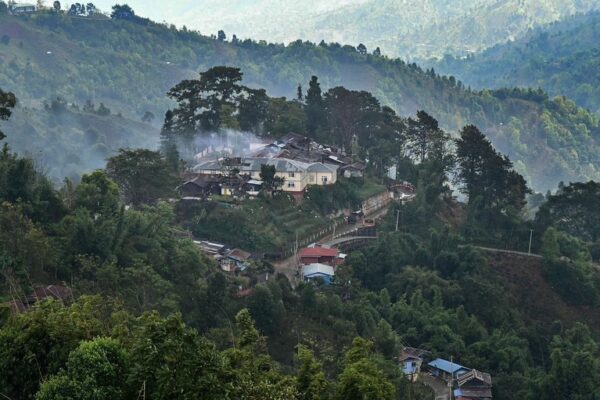
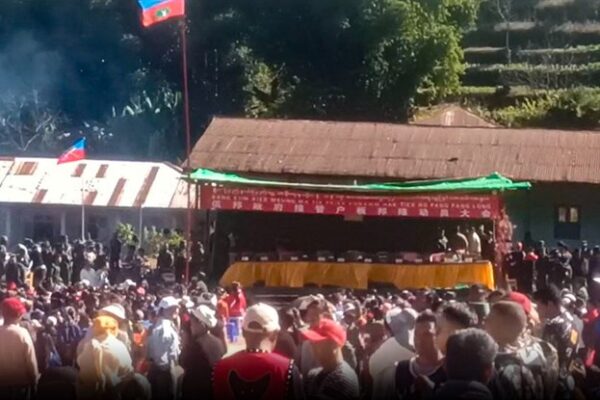
The handover to ethnic Wa fighters of two towns seized from the military by Kokang rebels last week is likely part of a bid to elicit their support in the fight against the junta and deals a blow to the regime’s hold on power in northern Myanmar, observers said Thursday. On Jan. 4, fighters with the Myanmar National Democratic Alliance Army, or MNDAA, stormed the junta’s Kokang regional command center in Laukkaing township – the largest base in northern Shan state near the Chinese border – prompting soldiers in the facility to lay down their arms, despite the military’s attempt to defend the facility from afar with artillery fire and airstrikes. A day later, the MNDAA seized the towns of Pang Long and Hopang from the military in the Wa Self-Administered Region’s Hopang township, located around 6.5 kilometers (4 miles) away from Laukkaing’s town of Chinshwehaw. Under MNDAA protection, armed troops with the United Wa State Army, or UWSA, later entered the townships as some 700 junta troops and their family members retreated to the Wa region town of Lashio. A military analyst, who spoke to RFA Burmese on condition of anonymity due to security reasons, noted that the MNDAA and UWSA are former allies and said the MNDAA made the handover to ensure relations between the two groups remain on good terms. “[The MNDAA] will not maintain friendship with the Wa if [they] establish an administrative system by themselves [in Hopang and Pang Long] as they did in Chinshwehaw and [nearby] Kunlong after seizing those towns,” the analyst said. Hopang and Pang Long are part of an area formerly controlled by the UWSA that was handed over to the then-military regime, the State Law and Order Restoration Council, as part of a negotiated ceasefire agreement. “So it was expected that the [MNDAA] would attack Hopang and Pang Long and hand them to the Wa, even though the Wa were not involved in the fight to occupy them,” the analyst said. The MNDAA had taken control of Chinshwehaw after the start of Operation 1027, an offensive it launched along with the Ta’ang National Liberation Army and the Arakan Army as part of the so-called Three Brotherhood Alliance of ethnic armies in late October that has since reportedly captured 10 townships in northern Shan state and seized control of more than 200 junta camps. Wa assumes control On Wednesday, the MNDAA handed over Pang Long and Hopang to the UWSA, which controls territory connected to the two townships, in a formal ceremony, according to residents and UWSA officials. The UWSA is Myanmar’s largest ethnic army, and in November had vowed to remain neutral amid Operation 1027. Myint Than, a resident of Hopang, told RFA that the UWSA “greeted locals cordially” during the handover and noted that while junta troops and their families had left, “it is not true that the [ethnic majority] Bamars were driven out.” “The Bamars have been operating clothing stores, all of which have been allowed to reopen,” she said. “It is likely that those who have joined the [anti-junta] Civil Disobedience Movement [boycotting state jobs under the military regime] will be re-employed.” The handover ceremony for the Myanmar towns of Hopang and Panglong on Jan. 10, 2024 drew a crowd. (Citizen journalist) The 2008 constitution designated the six townships of Hopang, Mongmao, Pangwaun, Narphan, Matman, and Pangsang/Pangkham of northeastern Shan state as the Wa Self-Administered Region. With the handover of Hopang township, the junta only controls Matman township, while the UWSA now controls the remaining five townships. Residents told RFA that the UWSA informed them they will be issued residential permits, which will allow them to travel freely within the entire Wa region. Handover ‘a positive’ for resistance A former military officer, who also declined to be named for fear of reprisal, said the junta is likely incensed by the handover, as Pang Long was home to a military base and a key part of its territory in northern Shan state. “To be frank, [the UWSA] managed to outwit them by taking those towns without a fight,” the officer said. “The military will not be pleased. The Wa have broken the status quo by taking these two towns.” Hla Kyaw Zaw, a political and military observer based in China, said that the UWSA’s occupation of Hopang and Pang Long would be good for the resistance. “I see the gradual unity of ethnic groups as a positive [for anti-junta forces],” she said. “The Wa focus on the interests of their own people and the MNDAA has said that its main goal is to regain the [ethnic] Kokang region and form a special region again. They realize that it would be impossible for them to do so only by freeing their own people.” “Since they understand that the whole country needs to be free from the military dictatorship, I believe they will assist the resistance, which will benefit the revolution,” she added. Translated by Htin Aung Kyaw. Edited by Joshua Lipes and Malcolm Foster.

Read More

China helps world achieve record renewable energy growth

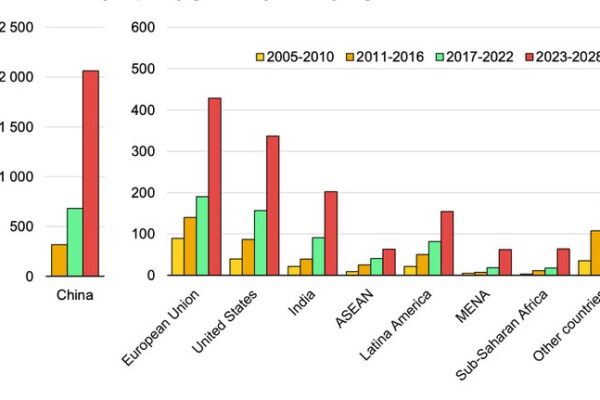
China’s “extraordinary” acceleration in renewable energy capacity propelled 2023 to witness the fastest global growth rate in over twenty years, the International Energy Agency (IEA) said in a new report on Thursday. The world’s annual additions to renewable electricity generation capacity soared by nearly 50%, reaching approximately 510 gigawatts (GW) – marking the 22nd consecutive year of setting new records in renewable capacity growth, the Paris-based IEA said in its Renewables 2023 report.  According to the report, China’s deployment of solar PV (photovoltaic) in 2023 increased by 116%, matching the global total of 2022, while its wind power installations increased by 66% compared to the previous year. The report predicted that the next five years will see the fastest growth yet, but warned the lack of financing for emerging and developing economies is a vital issue. The current expansion of renewable power has made the COP28 goal of tripling global capacity to at least 11,000 GW by 2030, which more than 130 governments agreed to during the climate change conference last month in Dubai. China, India, and Indonesia did not join the pledge due to its accompanying anti-coal stance and the more demanding goal of doubling the average annual rate of energy efficiency improvements to 4%. “Onshore wind and solar PV are cheaper today than new fossil fuel plants almost everywhere and cheaper than existing fossil fuel plants in most countries,” IEA’s executive director Fatih Birol said. “For me, the most important challenge for the international community is rapidly scaling up financing and deployment of renewables in most emerging and developing economies, many of which are being left behind in the new energy economy.” “Success in meeting the tripling goal will hinge on this.” This infographic shows renewable electricity capacity growth by country/region between 2005 and 2028. (IEA) Under existing policies and market conditions, global renewable power capacity is expected to grow to 7,300 GW by 2028, with renewables overtaking coal to become the largest source of global electricity generation by early 2025, according to IEA projection. The growth trajectory is about 2.5 times its current level, which is still short of the tripling goal by 2030. Asia-Pacific progress report The world’s second-biggest economy, China, has a renewable energy capacity to triple the previous five years’ increase of 2,000 GW in the next five years, making up 56% of the global increase, IEA said. From 2023 to 2028, China will add almost four times more renewable capacity than the European Union and five times more than the US, the second and third-largest growth market.  According to IEA’s forecast, the world’s renewables “powerhouse” is expected to reach its national 2030 target for wind and solar PV installations – 1,200 GW – this year, six years ahead of schedule. By 2028, almost half of China’s electricity generation will come from renewable energy sources. A solar farm operates next to Donggou village near Shijiazhuang city in northern China’s Hebei province, Nov. 10, 2023. (Ng Han Guan/AP) Apart from China, the rest of Asia will see renewable capacity grow by 430 GW by 2028, a 73% increase from 2022 levels, with India driving half of the regional growth and ASEAN adding 14%.  India is projected to add 205 GW by 2028, doubling its 2022 capacity, and is poised to become the third-largest global market for renewables.  The 10-member Association of Southeast Asian Nations (ASEAN) is expected to increase renewable capacity by a combined 63 GW by 2028, IEA said. Southeast Asia has the potential to offer one of the highest global renewable growth possibilities, the IEA said, but would require “more ambitious renewable energy targets and prompt implementation of long-term, transparent, and competitive support policies.” In major Southeast Asian economies such as Indonesia, Vietnam, and Thailand, regulations and policy support gaps hinder renewable energy growth and project development. The overcapacity of young, contract-bound fossil fuel power plants, particularly coal and gas, impedes the transition to renewable energy by financially disincentivizing utilities from investing in new renewable projects.  Vietnam’s rapid solar PV boom, with installations reaching 20 GW in 2019-2020, has led to challenges in integration, with a pressing need for more investment in transmission and distribution infrastructure. Last year, Vietnam and Indonesia signed into the Just Energy Transition Programme in a shift towards reassessing and potentially retiring older conventional plants, aided by international financial support to alleviate government budget pressures. Edited by Mike Firn and Taejun Kang.

Read More

World Bank urges Laos to raise VAT tax and taxes on tobacco, alcohol

Laos should raise its value-added tax rate and also increase taxes on cigarettes and alcohol as part of efforts to address high inflation and currency depreciation, the World Bank said. The government should also spend more money on health care and education to lay a foundation for future development, the bank’s representative in Laos, Alex Kremer, said in a report released last month. But the World Bank’s tax recommendations were mostly aimed at tackling Lao’s current troubled economy, which has struggled with rapidly rising prices, low foreign investment and public debt that could grow to 125 percent of GDP this year. The massive amount of debt, which reached US$18.7 billion at the end of 2022, has destabilized the country’s macroeconomy and slowed economic growth, Kremer said in the report. Just over half of the debt is owed to China, which helped Laos build the US$6 billion Lao-China High Speed Railway as part of its Belt and Road Initiative. Other major Chinese investments include roads and hydropower dams. Mining projects and local jobs Meanwhile, the government approved 192 concession projects last year worth almost US$5 billion in 2023, more than double the number from the previous year, according to the Ministry of Planning and Investment. Most of the investors are from China and Vietnam who are focused on the country’s mining, energy and agricultural sectors, the ministry said in a report. Projects approved by the government in 2022 were worth US$2.3 billion, according to the ministry. Most of the projects are in the mining sector, which could create more jobs for local people as companies seek to extract gold, ore and other minerals, according to an official who is familiar with the country’s planning and investment sector . “Of course, there are some impacts but they are not big problems,” he said. “There will be damage to local roads, but the investing companies are responsible for that. Some local people will have opportunities to work as daily workers.” Debt servicing Service payments on the country’s debt – the regular payments required by loan issuers that include interest and principal – could rise to 39 percent of GDP, the World Bank said. Laos’ currency, the kip, depreciated 29% against the Thai baht and 21% against the U.S. dollar last year. The main cause of the depreciation was a shortage of foreign currencies needed to pay down the debt and fund development projects, according to the World Bank. Similar to a sales tax, the value-added tax, or VAT, is added to the price of a product or service at each stage of production. Raising it from 7% to 10% and bringing in more revenue from tobacco and alcohol sales would help stabilize the government’s finances, Kremer said.  The Lao government has also been cracking down on corruption, selling government assets and eliminating ineffective state enterprises. New import-export requirements An official from Laos’ national bank, the Bank of the Lao PDR, told Radio Free Asia that other measures to get inflation under control, such as mandating exchange rates and enforcing the law on foreign currency management, haven’t been working. “We’ve failed to control exchange rates, even after we shut down all money exchange outlets,” he said, requesting anonymity for safety reasons like other sources in this report. “But we can’t inspect everything and everywhere.”  The Lao Ministry of Industry and Trade on Dec. 29 unveiled a new rule that requires all import-export companies to register with the government and to conduct all foreign transactions only through banks in Laos.  “We want the companies to make payments through the banks in Laos so that more foreign currencies will be in the system,” an official from the Lao Ministry of Finance said. Most commercial banks in Laos aren’t able to sell foreign currencies to customers, according to an official of the Joint Development Bank’s Luang Prabang branch. “We only buy foreign currencies,” he said. “If customers really need foreign currencies, they can write a formal letter requesting to buy foreign currencies from any banks.” Because of the government enforcement on foreign currency, business people in Laos have turned to the black market for foreign currency, an employee of an import-export company that brings in goods from Thailand told RFA. Translated by Phouvong. Edited by Matt Reed.

Read More

World Bank urges Laos to raise VAT tax and taxes on tobacco, alcohol

Laos should raise its value-added tax rate and also increase taxes on cigarettes and alcohol as part of efforts to address high inflation and currency depreciation, the World Bank said. The government should also spend more money on health care and education to lay a foundation for future development, the bank’s representative in Laos, Alex Kremer, said in a report released last month. But the World Bank’s tax recommendations were mostly aimed at tackling Lao’s current troubled economy, which has struggled with rapidly rising prices, low foreign investment and public debt that could grow to 125 percent of GDP this year. The massive amount of debt, which reached US$18.7 billion at the end of 2022, has destabilized the country’s macroeconomy and slowed economic growth, Kremer said in the report. Just over half of the debt is owed to China, which helped Laos build the US$6 billion Lao-China High Speed Railway as part of its Belt and Road Initiative. Other major Chinese investments include roads and hydropower dams. Mining projects and local jobs Meanwhile, the government approved 192 concession projects last year worth almost US$5 billion in 2023, more than double the number from the previous year, according to the Ministry of Planning and Investment. Most of the investors are from China and Vietnam who are focused on the country’s mining, energy and agricultural sectors, the ministry said in a report. Projects approved by the government in 2022 were worth US$2.3 billion, according to the ministry. Most of the projects are in the mining sector, which could create more jobs for local people as companies seek to extract gold, ore and other minerals, according to an official who is familiar with the country’s planning and investment sector . “Of course, there are some impacts but they are not big problems,” he said. “There will be damage to local roads, but the investing companies are responsible for that. Some local people will have opportunities to work as daily workers.” Debt servicing Service payments on the country’s debt – the regular payments required by loan issuers that include interest and principal – could rise to 39 percent of GDP, the World Bank said. Laos’ currency, the kip, depreciated 29% against the Thai baht and 21% against the U.S. dollar last year. The main cause of the depreciation was a shortage of foreign currencies needed to pay down the debt and fund development projects, according to the World Bank. Similar to a sales tax, the value-added tax, or VAT, is added to the price of a product or service at each stage of production. Raising it from 7% to 10% and bringing in more revenue from tobacco and alcohol sales would help stabilize the government’s finances, Kremer said.  The Lao government has also been cracking down on corruption, selling government assets and eliminating ineffective state enterprises. New import-export requirements An official from Laos’ national bank, the Bank of the Lao PDR, told Radio Free Asia that other measures to get inflation under control, such as mandating exchange rates and enforcing the law on foreign currency management, haven’t been working. “We’ve failed to control exchange rates, even after we shut down all money exchange outlets,” he said, requesting anonymity for safety reasons like other sources in this report. “But we can’t inspect everything and everywhere.”  The Lao Ministry of Industry and Trade on Dec. 29 unveiled a new rule that requires all import-export companies to register with the government and to conduct all foreign transactions only through banks in Laos.  “We want the companies to make payments through the banks in Laos so that more foreign currencies will be in the system,” an official from the Lao Ministry of Finance said. Most commercial banks in Laos aren’t able to sell foreign currencies to customers, according to an official of the Joint Development Bank’s Luang Prabang branch. “We only buy foreign currencies,” he said. “If customers really need foreign currencies, they can write a formal letter requesting to buy foreign currencies from any banks.” Because of the government enforcement on foreign currency, business people in Laos have turned to the black market for foreign currency, an employee of an import-export company that brings in goods from Thailand told RFA. Translated by Phouvong. Edited by Matt Reed.

Read More

Fighting across western Myanmar kills 4 and displaces 45,000

At least three battles raged between Myanmar’s junta and the Arakan Army across three western townships on Wednesday, locals told Radio Free Asia.  One civilian died during attacks on Wednesday and three others were injured across Rakhine state’s Minbya and Kyauktaw townships, with 25,000 people forced to flee, residents said. The injuries and death occurred when heavy artillery from the junta landed in Kyauktaw township’s Ah Pauk Wa village.  Dak Maung, a man from Ah Pauk Wa, died instantly, while three others, including Ah Tun Che, Aung Tun Mya and Aung Mya Thar, were injured, locals said. On Wednesday, a Kyauktaw-based junta artillery battalion shelled the village with heavy weapons at random, a resident who wished to remain anonymous for security reasons told RFA. “They started shooting around 4:30 a.m. More than 10 heavy shells were fired by Battalion 377,” he said. “They shot at the village although there was no fight.” Almost all 5,000 people from Ah Pauk Wa have fled to safety, he added. Fighting in Minbya township’s capital, Minbya town, also continued into Wednesday after raging through the night, residents said. Villagers said they learned that the Arakan Army initiated the attack by firing at military camps in Minbya on Tuesday evening. The army retaliated on the ground and by air using fighter jets.  “We have been hearing the sounds of heavy artillery being fired since Tuesday evening. This morning we heard the sound of small arms being exchanged,” said one resident on Wednesday, declining to be named for fear of reprisals.  “We came to know that the Arakan Army has attacked military battalions 379, 380 and 541 at a junta camp in Minbya’s Kyein Taung. Two jet fighters are shooting now.” More than 20,000 residents from Minbya and nearby villages have fled to safety due to the battles, locals said. Some local residents were injured by the junta’s shelling, but details regarding injuries and casualties have not been released about this attack yet.  However, to Minbya’s north, at least 15 junta soldiers were killed in a battle between the Arakan Army and regime soldiers, according to a statement released by the Arakan Army Tuesday night.  In Rakhine’s Mrauk-U, fighting erupted on Tuesday and junta soldiers from infantry battalion 540 captured three civilians. While walking into the city of Mrauk-U, soldiers shot the civilians and killed them, the statement added. RFA contacted Arakan Army spokesperson Khaing Thukha for further details on the battles in Kyauktaw, Mrauk-U, and Minbya townships, but did receive a response by the time of publication. Calls to Rakhine state’s junta spokesperson Hla Thein by RFA also went unanswered. Fighting in Rakhine during the last two months has intensified, resulting in more civilian deaths each day, residents told RFA.  According to data compiled by RFA, 55 civilians have been killed and more than 140 have been injured when fighting resumed after a year-long ceasefire from Nov. 13, 2023 to Wednesday.  Translated by RFA Burmese. Edited by Mike Firn.

Read More