Episode 5: Flashpoint Myawaddy

Podcast Free Asia RFA Insider is five episodes old, a developmental milestone that Eugene and Amy receive with joy! For reference a 10-week-old baby would be kicking and punching, and a 10-week-old fetus would start getting fingernails. A 10-week-old piece of bread, meanwhile, would be all moldy… um… probably. Corrections this week are short and sweet: on last episode’s discussion of matching couple outfits, Eugene clarifies that the North Korean government does not require everyone to wear the same clothes. Instead, citizens are held to clothing restrictions that prohibit items like tight pants and t-shirts with foreign words, leaving them with limited style choices. The Rundown The Mandarin Service recently reported that China’s internet censors removed more than 700 videos of online micro-dramas for “exaggerating” spousal and familial conflicts. Micro-dramas, binge-able online shows whose episodes are only a few minutes long, are most popular among young women in China – the same group that President Xi called upon in October to focus on raising families. This censorship comes at a time when China’s birth and marriage rates continue to plummet, as more young people are delaying marriage to focus on work, education or buying property. In North Korea, coffee is gaining a foothold as a trendy beverage and a bribe. The Korean Service reported that coffee shops, once only seen in hotels for foreign tourists, have begun to appear in Pyongyang and other cities. While only the elite can afford to enjoy a cup on the regular, the interest in coffee culture, acquired through illegal foreign movies, transcends class. Some more health-conscious officials have even begun asking for coffee over the traditional bribe of cigarettes – residents told RFA that they have treated officials to a coffee with sugar and gifted South American coffee beans in exchange for favors.  How It’s Made Kyaw Min Htun, deputy director of the Burmese Service, joins us to address the recent tug-of-war between the Myanmar military and various ethnic armies for control of Myawaddy, a trading town bordering Thailand. He offers some insight into why opposition forces withdrew from Myawaddy days after taking control and the ways in which neighboring countries’ interests have influenced Myanmar’s current situation. With the country embroiled in civil war since the 2021 military coup, Kyaw Min Htun offers a much-needed explainer of the “who” and “why” of the current conflict, what the international community can do to help and his thoughts on a post-war future. Special thanks to Kiana Duncan for this awesome report that explained the situation at the time of recording. Since then she’s filed another with an update:  Back to main

Read More

Myanmar closes border checkpoint amidst conflict

Myanmar shut a main border crossing with Thailand early on Friday as junta forces carried out airstrikes in nearby areas, Thai officials and residents of the area told Radio Free Asia.  Insurgent forces captured most of the eastern border town Myawaddy this month but they were forced to withdraw days later under the threat of junta airstrikes. Junta troops re-gained control of a main battalion headquarters  in the town on Wednesday.  Residents of the Thai town of Mae Sot, over a border river from Myawaddy, said they heard explosions early on Friday, apparently coming from junta  airstrikes to the south of Myawaddy. A turboprop aircraft was heard flying over Palu, to the south of Myawaddy, and nearly 10 explosions were heard, according to residents on the Thai side. Separately, a Thai immigration official said crossings from Myanmar over the main border bridge had stopped and it was not clear who was in control on the Myawaddy side. “People from Myanmar can not come yet but they can cross back from here,” said the official, who declined to be identified. Trucks that normally deliver goods to Myanmar via a second bridge, which is used mainly for  cargo, have been unloading their shipments at small river crossings instead. A Karen militia force commander with extensive business interests and a history of close ties with the junta helped free about 200 junta troops who had been cut off by insurgent Karen National Liberation Army troops in the fighting this month, Thai media reported.  The commander, Col. Saw Chit Thu, who broke away from the main Karen guerrilla organization in the 1990s, has close ties with Chinese investors who have funded casinos and online scamming rackets on the Myanmar side of the border. The United Kingdom imposed sanctions on him in 2023 linked to suspicions of involvement in human trafficking and other rights violations. Saw Chit Thu, who denies wrongdoing, had this month raised doubts about his alliance with the junta, saying he was no longer supporting junta forces, but according to media reports, he had acted to protect his business interests in helping junta forces re-take control of Myawaddy.  Democracy and rights activists have long denounced Saw Chit Thu and his militia, the Karen National Army. “Saw Chit Thu is a rights-abusing militia commander who has gotten rich via a horrid mix of abuses of deported migrants, human trafficking of persons to scam centers, gambling, sexual exploitation and prostitution, and worse,” said Phil Robertson, deputy director for Human Rights Watch in Asia.  “I think no one should be surprised that he suddenly betrayed the [Karen National Liberation Army] by rushing back into the arms of his [State Authority Council] junta overlords who have been complicit in Chit Thu’s massive profits at the expense of the Karen people.” Edited by Kiana Duncan and Taejun Kang.

Read More

Junta recruits another 300 Rohingya in new round of conscription

More than 300 Rohingya men from villages near Rakhine state’s capital have been forced by junta troops to attend mandatory training for Myanmar’s military over the last few days, residents told Radio Free Asia on Thursday.  The latest round of compulsory conscription among the stateless Muslim minority comes a month after about 1,000 Rohingya from elsewhere in Rakhine were made to join the military in March.  More broadly, more than 100,000 young men have fled their homes since the military announced in February it would implement a draft to shore up its ranks after a series of battlefield defeats, according to a report released by the Burmese Affairs and Conflict Study. Myanmar has been wracked by civil war ever since the military overthrew the civilian-led government in a 2021 coup. Amid the battlefield setbacks over the past six months, the military has said it plans to conscript 50,000 young men and women each year – and is forcibly recruiting Rohingya in Rakhine state to meet quotas. State Administration Council members hand out leaflets explaining the law of militia service on Feb. 29, 2024, in Kyun Hla City, Myanmar. (State Administration Council) The effort comes in a state where just seven years ago, the military tortured, raped and killed thousands of Rohingya and sent nearly 1 million fleeing into neighboring Bangladesh. The 300 Rohingya recruits were taken this week from more than 30 villages in Sittwe township and were all between 18- to 30-years-old, a Rohingya village administrator who wished to remain anonymous for fear of reprisals told RFA. They were taken by police cars to the military’s Regional Command Headquarters in Sittwe to prepare for training, he said. Soldiers are now pressing those who remain in a patchwork of villages and internally displaced camps into service to prop up their struggling military campaign in the state against the ethnic Arakan Army.  In exchange for their service, the junta has promised would-be Rohingya fighters freedom of movement as well as small amounts of food and money.  ‘Worrying around the clock’ Junta officials have communicated through village elders and administrators during the conscription process, according to a Rohingya woman who lives in Sittwe who requested not to be named for security reasons.  “The officials entice the locals with national identity cards and salary,” she said. “They forced village elders to provide young Rohingya to protect the country. But as Rohingya youth are fishermen, they are not suitable for military service.” State Administration Council members hand out leaflets explaining the law of militia service on Feb. 29, 2024 in Kyun Hla City, Myanmar. (State Administration Council) None of the recruits are willing to undergo military training, but they face arrest and beatings if they refuse, she said. “People in Rakhine state are worrying around the clock about the recruitment for military training,” the village administrator said. “Some people have fled from their homes to other places.” The 1,000 Rohingya who were recruited in March were put through a two-week training. Afterward, some were deployed to the battlefields while others were sent back to their villages or IDP camps as reserves, residents told RFA. RFA attempted to contact Attorney General Hla Thein, the junta spokesman for Rakhine state, to ask about this week’s recruitment, but he didn’t answer phone calls. Pressed into service Since Myanmar’s conscription law was announced by Senior Gen. Min Aung Hlaing on Feb. 10, troops nationwide have attempted to press-gang large numbers into the dwindling military.  It requires men and women aged 18 to 35 to serve in the junta’s armed forces for two years – prompting more than 100,000 to flee their homes to avoid the draft, the Burmese Affairs and Conflict Study found. The junta has carried out operations to enforce the military service law in 224 townships across the country, the report said. Approximately 5,000 young men were sent to 15 military training sites by the end of March, it said.  Rohingya Muslims are seen in military uniform during a training session in Rakhine state on March 10, 2024. (Citizen journalist) In addition, more than 2,000 people from 40 townships across Myanmar have been enlisted as militia – a number that includes the Rohingya who were recruited in March, the report found. A resident of Mandalay said people are anxiously watching for the recruitment process to begin again, now that the recent Thingyan water festival holiday has concluded. “It is anticipated that they will start it in May,” he said. “People are curious about what will happen following Thingyan.” Eventually, the new recruits will be called on for frontline combat operations, according to former military officer Lin Htet Aung, who participated in the non-violent Civil Disobedience Movement after the coup. “When the regular army no longer possesses the capacity to execute these tasks, it becomes evident that this deliberate strategy aims to rely solely on the youth of the populace as their military force,” he told RFA. Translated by Aung Naing and Kalyar Lwin. Edited by Matt Reed and Malcolm Foster.

Read More

Myanmar insurgents capture junta base in south

Insurgents have captured another base from Myanmar’s junta forces, this time in the far south of the country, in the latest in a string of setbacks for the military that overthrew an elected government in 2021, officials from anti-junta forces told Radio Free Asia on Thursday.  Ethnic minority Karen fighters have in recent weeks seized several camps from junta forces in eastern Myanmar, mostly notably in a major trade town near the Thai border. On Wednesday, ethnic minority Karen insurgents, together with pro-democracy allies, captured the junta’s Maw Hta camp in the Tanintharyi region’s Dawei township. Thirty weapons were seized in the camp, where about 40 junta soldiers had been stationed, said one official from the Karen National Union (KNU), who declined to be identified for security reasons.  “It took only a moment to capture the camp because junta troops were scared and fled,” the official said. The shadow civilian National Unity Government’s Tanintharyi region office confirmed that the Karen National Liberation Army (KNLA), the armed wing of the KNU, and members of allied People’s Defense Forces seized the area near the Thai border. “A border station has been captured by Karen National Liberation Army and People’s Defense Force joint forces. At present, there are still things that need to be confirmed,” said the Tanintharyi information officer, who also declined to be identified. RFA contacted Tanintharyi region’s junta spokesperson, Thet Naing, for more information, but he did not respond. Myanmar has faced violent turmoil since the military overthrew a government led by Nobel Peace Prize laureate Aung San Suu Kyi in early 2021. The fighting in recent days has prompted warnings from Thailand to Mynamar’s rivals to avoid any spillover across the border.  In January, rebel forces captured Kyauk Htu camp in Dawei.  On April 16, they captured Myeik, a major Tanintharyi town, and then announced the launch of military operations in two nearby townships. Of Tanintharyi’s 10 townships, only Bokpyin and Kawthoung are free from major conflict. Translated by RFA Burmese. Edited by Kiana Duncan and Mike Firn.

Read More

2 teachers jailed for criticizing authorities on social media

Two Vietnamese teachers were sentenced to prison on Wednesday in separate cases for criticizing authorities on social media under vague statutes often used to stifle dissent, people with knowledge of the situation said.  They are the latest examples of how Vietnam systematically suppresses basic freedoms and civil rights.  Duong Tuan Ngoc, 39, was sentenced by the Lam Dong People’s Court to seven years in prison and three years of probation under Article 117 of the country’s Penal Code for disseminating anti-state propaganda and “smearing senior leaders” on his social media accounts. Retired teacher Nguyen Thu Hang, 62, received a two-year sentence under Article 331 for abusing democratic freedom that violated the interests of the state, rights and the legal interests of organizations and individuals. She was convicted by the Dong Hoi People’s Court for using personal Facebook accounts to defame a judge who had presided over the land dispute case in which she was involved. She was also accused of streaming such video clips at various provincial offices. Under the one-party rule of the Communist Party of Vietnam, the government severely restricts rights to freedom of expression, religion, association, peaceful assembly and movement, according to human rights and civil society groups. “No one should be targeted for comments made on social media criticizing the government,” Josef Benedict, a researcher covering the Asia Pacific region for the CIVICUS Monitor, told RFA via text message. Health videos Ngoc, jailed since July 15, 2023, was an online teacher who specialized in macrobiotic diets, which aim to avoid foods containing toxins. He used to post articles and livestream videos about education, health and social issues on his Facebook and YouTube pages. Police in Lam Dong province in southern Vietnam summoned him and his wife, Bui Thanh Diem Ngoc, on July 10, 2023, to question them about anonymous reports that Ngoc used his Facebook account to sell drugs. But after Ngoc proved he was innocent, the police initiated a new probe on the charge of distributing anti-state propaganda and arrested him five days later. Vietnamese teacher Duong Tuan Ngoc in a video screenshot. Authorities accused the teacher of posting and sharing articles and videos on his Facebook and YouTube accounts that mocked, defamed and criticized the government and the party’s policies, and smeared senior party and state leaders, according to notices Lam Dong Police gave to Ngoc’s family. A relative, who requested anonymity for safety reasons, told Radio Free Asia that Ngoc’s first-instance trial, which his wife and lawyer were allowed to attend, lasted about two hours on Wednesday morning. “The defense lawyer did not make a defense case for him but requested sentence litigation, saying that he had a clean criminal record and had performed many charity activities before his arrest,” the person said. During the trial, Ngoc admitted to having “spoken ill of government officials” but affirmed his wish of “a multiparty and pluralistic regime and an improved political regime,” said the relative. It appears as though Ngoc will not appeal the verdict because he wants to serve his sentence as soon as possible so he can see his family again and resume work, the person said. ‘Lip service’ Benedict from CIVICUS said Ngoc’s arrest for peaceful expression online is the latest attempt by the Vietnamese regime to stifle peaceful expression, which contravenes the country’s international human rights obligations to protect fundamental freedoms. He expressed concern over the government’s use of Article 117, which U.N. experts have found overly broad and aimed at silencing those who seek to exercise their right to freely express their views and share information with others. “These actions are unbecoming of a member of the U.N. Human Rights Council and shows that the government has been only merely paying lip service to human rights and has no intention of respecting and protecting them,” Benedict said. Vietnam is a current three-year member of the Human Right Council in Geneva, Switzerland, for the 2023-25 term and will seek reelection to the body for the 2026-28 term, despite widespread rights violations. Ngoc is well-known on social media, and his Facebook page has more than 45,000 followers with an introductory description declaring: “I have rights as a citizen. You have rights as citizens. Citizens are the rightful owners of the country.” He has two YouTube accounts, one of which features hundreds of videos on health, medicine and life in the countryside, and has nearly 95,000 followers. His other channel has about 39,000 followers and features videos discussing politics, corruption and poor leadership in Vietnam.  Ngoc is the eighth Vietnamese activist convicted this year, and the third to be charged with disseminating “anti-state propaganda” according to an RFA tally. Retired teacher Meanwhile, the retired teacher, Nguyen Thu Hang, was sentenced to two years in jail for abusing democratic freedoms to infringe on the interests of the state. Hang, a resident of Dong Hoi city in Quang Binh province in central Vietnam, previously worked at a middle school in Dong Hoi, and was arrested on Nov. 27, 2023. Dong Hoi police’s investigation agency said Hang disagreed with a verdict handed down in a civil trial about a land-use rights dispute and a request to annul a land-use rights certificate in which she was a plaintiff. The agency said that from March to May 2023, Hang repeatedly used her Facebook account to livestream comments on Judge Nguyen Van Ngh, posting videos of herself speaking at the headquarters of Nam Ly ward, Dong Hoi’s Department of Education and Training, and Quang Binh province’s Inspection Department. Translated by Anna Vu for RFA Vietnamese. Edited by Roseanne Gerin and Malcolm Foster.

Read More

Vietnam should ask Cambodia to delay canal project: experts

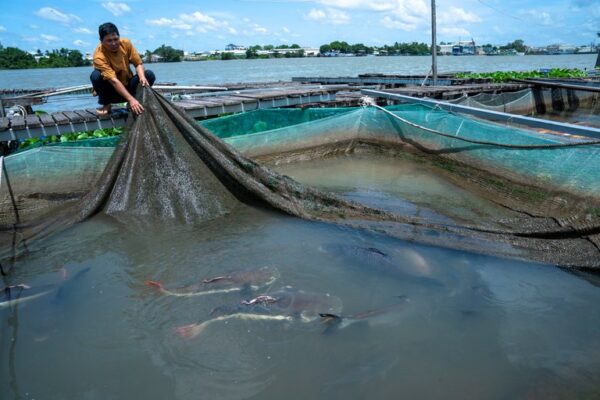
Participants at a Vietnamese-sponsored consultation have suggested that Hanoi should ask Phnom Penh to delay a proposed  canal project for further discussions, amid Vietnamese worries about the project’s environmental and economic impact. Construction of the 180 km (112 mile) Funan Techo canal, connecting the Cambodian capital, Phnom Penh, with the Gulf of Thailand, is planned to begin later this year and to be completed within four years. The proposed canal will include a section of the Mekong River, raising concern in Vietnam about the impact downstream, especially in Vietnam’s rice-growing Mekong Delta. The canal could “reduce the flow of the river by up to 50% by the time it comes to Vietnam,” said Le Anh Tuan, a prominent Vietnamese scientist.  Vietnam needs more time for consultation in order to protect the river’s delta, home to 17.4 million people, Tuan told the meeting in the town delta of Can Tho. Another expert, Dang Thanh Lam from the Ministry of Agriculture and Rural Development, said Vietnam must ask for an environment impact report from Cambodia. The U.S. Embassy in Phnom Penh also called for more information, saying that the Cambodian people as well as people in neighboring countries “would benefit from transparency on any major undertaking with potential implications for regional water and agricultural sustainability.” “We urge authorities to coordinate closely with the Mekong River Commission (MRC) to provide additional project details and to participate fully in any appropriate environmental impact studies to help the MRC and member countries fully understand, assess, and prepare for any possible impacts of the project,” an embassy spokesperson said. Ly Van Bon, the owner of the Bay Bon fish pond located on the Mekong river which was affected by sediment, shows redtail catfish inside his fish pond in Mekong’s regional capital Can Tho, Vietnam, May 25, 2022. (Reuters/Athit Perawongmetha) For its part, Cambodia said it had secured endorsement for the project from the MRC chairman – Lao President Thongloun Sisoulith. Sisoulith has just visited Phnom Penh and, during a meeting with Cambodian Senate leader and former prime minister Hun Sen, he was asked to show his support for the canal.  “In response, the Laotian president, without hesitation, announced his support,” Cambodia’s Fresh News media outlet, which is supportive of the government, reported. No obligation  Laos and Cambodia are both long-term allies of Vietnam but both have in recent years leaned more towards China. Vietnam has repeatedly expressed concerns about the possible environmental and economic impacts of the project. This month, a Vietnamese foreign ministry spokesperson urged Cambodia to provide information and an impact assessment on the water resources and ecological balance of the delta region. In response, a senior Cambodian official said that Phnom Penh was not obliged to do so. Cambodia’s Minister Delegate attached to the Prime Minister in charge of ASEAN affairs, So Naro, told the Khmer Times that Cambodia was not legally required to submit any document to Vietnam  regarding the studies and construction of the Funan Techo canal. Cambodia had submitted “all documents of the studies on the canal related to the impacts on the environment and the water resources” to the MRC, So Naro said. The MRC is an intergovernmental organisation in charge of the sustainable management of the Mekong basin. “The Vietnamese authorities can request access to those files,” So Naro said. Cambodia has insisted that the canal  would not disrupt the flow of the Mekong.  The projected Funan Techo canal (in blue). (Google Maps/ RFA) Officially known as the Tonle Bassac Navigation Road and Logistics System Project, the Funan Techo canal will be developed by a Chinese company at a cost of US$1.7 billion. It will mean that more trade can flow directly to Cambodian  ports, bypassing Vietnam. The Cambodian government said it would cut the transport costs and reduce dependence on Vietnamese ports. It also said that the project will bring great social and economic benefits to 1.6 million Cambodians living along the canal. Security questions Besides the environment and economic impacts, analysts say Vietnam is also worried about the security implications of the canal. There have been suggestions that the canal could allow Chinese navy ships to travel upstream from the Gulf of Thailand and the Chinese-developed Ream naval base on the Cambodian coast close to the border with Vietnam.  Cambodia has rejected such speculation with Hun Sen insisting that Cambodia and Vietnam “are good neighbors and have good cooperation in all fields.” But Vietnam has been in dispute with China over some island chains in the South China Sea and it eyes China’s involvement in the region with suspicion. Vietnam shares a long land border with Cambodia. Between 1977-1978 there was fighting between Cambodia’s Khmer Rouge and Vietnamese troops during the so-called southwest border war, which led to a Vietnamese invasion and the establishment of a pro-Hanoi government in Cambodia. The situation on Vietnam’s western border should get more attention because of “threats of untraditional security challenges, mostly over the Mekong delta,” said Nguyen The Phuong, a Vietnamese political scientist at the University of New South Wales in Australia. “A loss of the Mekong’s ability to sustain large scale food production will have tremendous impact on Vietnam’s security in the south,” Phuong said. “From my point of view, the western front is becoming more critical day by day but Vietnam is too distracted by maritime issues at the eastern front, or the South China Sea.” Edited by Mike Firn and Taejun Kang.

Read More

Young Laotians held at Myanmar casino fearful of fighting nearby

A group of 14 young Laotians who are being held at a Chinese-run casino in Myanmar said they are frightened by the recent fighting in nearby Myawaddy and are calling for new efforts to free them. The young Laotians were trafficked to work as scammers at a place called “Casino Kosai” in an isolated development near Myawaddy.  Karen Nation Union, or KNU, and allied anti-junta guerrilla armies took control of the important trade town earlier this month during intense fighting with Myanmar’s military.  Some of the young Laotians recently overheard junta soldiers saying the casino could be a target for bombing later this week, four of the young Laotians told Radio Free Asia on Tuesday. “I would like to call on the soldiers of KNU to rescue us from this place as soon as possible because the fighting is moving closer and closer to us,” one of the young Laotians, who like other sources in this report requested anonymity for safety reasons, told RFA. “Right now, we’re hearing a lot of loud shots toward us,” he said. “We’re afraid that we’ll get shot by stray bullets.” Earlier this month, two teenage girls were allowed to leave the casino after a 40,000 yuan (US$5,500) fee was paid to gain their freedom. They arrived home in Luang Namtha province in northern Laos on April 8.  The Chinese-owned ‘Casino Kosai’ in Myawaddy, Myanmar, near the Thai border. (Citizen journalist) The remaining 14 youths and their parents are hoping that officials at the Lao Embassy in Yangon can negotiate their release.  “The only hope I have right now is that the higher-up authorities of all sides are stepping up their efforts because we the parents have been trying and failing to rescue our children for more than two years now,” a mother of one of the Laotians told RFA. ‘Emotionally affected by it’ Many of the young Laotians originally sought jobs in one of the casinos in the Golden Triangle, the border region Laos shares with Thailand and Myanmar.  But instead they ended up trafficked and held captive at the casino, which is about 320 kilometers (200 miles) south of the Golden Triangle and 640 kms (400 miles) from their homes in northern Laos.  For more than a year, their parents have sent pleading messages to government officials in Laos and Myanmar. With the recent fighting nearby, they have become even more concerned, several parents told RFA. “I can’t eat and I can’t sleep right now because I worry about the safety of my daughter,” another mother said. “I heard about the situation over there getting worse, and I’m emotionally affected by it. I’m always thinking about my daughter.” A Lao embassy official told RFA on Tuesday that they are still gathering information on the 14 Laotians and will send a request to junta authorities soon. “We’re trying our best to rescue these Laotians,” he told RFA on Tuesday. Translated by Max Avary. Edited by Matt Reed and Malcolm Foster.

Read More

Injured sent to Thai border hospital following Myanmar clash

A Thai border hospital received nearly 40 injured people for treatment after a battle in neighboring Myanmar, according to Thai officials on Monday. At least 38 were admitted in total, Thai public health minister Cholnan Srikaew said during a press conference at Mae Sot General Hospital on Monday.  Mae Sot is a Thai city that shares a border with Myanmar to the west. It is notable as a trade hub and for its substantial population of Burmese migrants and refugees. “We treat them according to their conditions, mostly involving surgery,” he said. “There were 22 people admitted on Saturday. Another 16 gradually came on Sunday.” Cholnan declined to disclose how many junta troops and rebel soldiers were included among the injured. “We do not discriminate which group they are,” he said, adding that foreign nationals would be referred to relevant security agencies following their treatment. The armed branch of the Karen National Union, called the Karen National Liberation Army, and its allies captured junta Infantry Battalion 275 in Myawaddy, a Burmese town that shares a border with Thailand’s Mae Sot, on April 10.  After rebel forces intercepted a junta convoy and injured over 100 soldiers on its way to recapture Myawaddy on Thursday, Mi-35 helicopters bombed the town in retaliation on Saturday around 3 a.m.  Gunfire between junta troops and rebel forces and airstrikes could be heard late into late Sunday morning, Thai soldiers and Mae Sot residents told Radio Free Asia.   Since the rebel capture of Battalion 275, about 200 junta troops have been stranded at a customs compound near the border’s Thai-Myanmar Friendship Bridge No. 2, roughly 10 kilometers (six miles) north of Mae Sot. RFA could not confirm if these troops were among those admitted to Mae Sot’s hospital.  Following Saturday and Sunday’s battles, about 3,000 people were evacuated and several hundred refugees were taken to Rujira ranch a few kilometers north of Thai-Myanmar Friendship Bridge No. 2, according to Thai officials.  The evacuees were predominantly Myanmar, said Thai soldiers, in addition to some Thai nationals working in Myanmar. Thai authorities provided refugees with food and medical services. As of Monday, about 2,000 displaced people have returned since fighting calmed in Myawaddy, the Bangkok Post reported on Monday, adding that Thai-Myanmar Friendship Bridge No. 1, which is used for immigration, remains open.  The newspaper cited a Thai military officer as saying that negotiations between the junta and the Karen rebel force and its allies have begun.  Padoh Saw Taw Nee, a spokesperson at The Karen National Union, told RFA that it is reviewing the military and public welfare situation since fighting has calmed. Translated by Kiana Duncan. Edited by Taejun Kang and Mike Firn.

Read More

Lao coffee growers feel pinch of worker shortage, high inflation

As the coffee bean harvesting season begins, plantation owners in southern Laos face a shortage of laborers because of low wages and high inflation in the small, landlocked Southeast Asia country, said people who work in the industry. Workers on plantations in Champassak province’s Paksong district are shunning jobs that pay just US$10-13 a day, based on the weight of coffee beans they pick, and instead heading for better paying work in neighboring Thailand. Others have sought jobs on cassava farms, where the pay is slightly better, a coffee farm worker told Radio Free Asia on Tuesday.  Coffee growers in the district usually need 400-600 workers to harvest the beans, a plantation owner in the district said. Coffee beans are the main cash crop for many small-scale farmers in Laos and the country’s third-largest agricultural export product. Lao coffee is exported to more than 26 countries in Asia, Europe and North America, according to the International Trade Centre in Geneva, Switzerland. Most coffee farms in Laos are located in Champassak, Sekong and Salavan provinces on the Bolaven Plateau, known as the country’s coffee heartland. Sitting atop an ancient volcano, the plateau’s nutrient-rich soil and cool climate are conducive to growing coffee trees. Other coffee-growing areas are in Houaphanh and Xieng Khouang provinces in the north. A view of a coffee plantation in Paksong district of southern Laos’ Champasak province in September 2018. (RFA) But the country’s current high inflation rate, which stood at nearly 25% in March, is driving laborers to jobs that pay better wages, people involved in the industry said.  “Many laborers like to seek higher-paid jobs in Thailand as they get paid low working in the country,” the coffee plantation employee said. Like others in this report, he insisted on not being identified for fear of getting in trouble. “Therefore, we are facing a shortage of labor now, and inflation is the main factor causing this problem.”  Desperate for workers The coffee farm owner in Paksong said the labor shortage in the industry is nothing new and that inflation has been a key factor.  “If they work for us, they earn around US$100-150 per month, but they can earn around US$350 per month if they work in Thailand,” he said. To cope with the current labor shortage, some coffee farm owners have raised wages to attract more laborers, which means higher fixed costs. The coffee farm owner said he has had to double wages to US$15-20 a day to get workers to pick the beans.  “If we do not provide this rate, they will not work for us,” he said. “Some laborers just come to work for the coffee harvesting season, but go back to Thailand once [it] ends.” A woman works in the rain on a coffee plantation on the Bolaven plateau in southern Laos, Sept. 2, 2003. (Karl Malakunas/AFP) The labor shortage in Laos’ coffee industry began in 2020 with the COVID-19 pandemic, according to a Champassak province official with knowledge of the situation, who declined to be named because he is not authorized to speak to the media.  There were over 218,00 confirmed cases of the highly contagious respiratory infection in Laos, and nearly 760 recorded deaths, according to the Johns Hopkins Coronavirus Resource Center, which stopped collecting data in March 2023. A coffee growers association has contacted the provincial Department of Labor and Social Welfare for help in finding seasonal laborers for the past three years, the official said.  “We tried to help coffee farm operators in the province to find laborers to meet their needs, but very few people are interested in working in this kind of job,” he said. Thongphat Vongmany, deputy minister of agriculture and forestry, said in February that Laos’ agricultural exports totaled US$1.44 billion in 2023, but he did not give a separate breakdown for coffee exports. Agriculture Minister Phet Phomphiphak, however, told the country’s National Assembly in December 2023 that Laos’ coffee exports during the first nine months of 2023 totaled US$64 million. Translated by Phouvong for RFA Laos. Edited by Roseanne Gerin and Malcolm Foster.

Read More

Blinken to visit China amid claims about Russia support

U.S. Secretary of State Antony Blinken will travel to China on Wednesday, according to a senior State Department official, in a trip that comes as he and others in Washington accuse Beijing of “fueling” Russia’s war in Ukraine by helping to resupply its military. Blinken will travel to Shanghai and Beijing from Wednesday to Friday, said the official, who spoke on condition of anonymity to discuss the plans ahead of time. The official said he could not yet confirm that Blinken would meet Chinese President Xi Jinping during the visit. The trip will attempt to build on recent diplomatic outreach to Beijing, the official explained, but would also necessitate “clearly and directly communicating [American] concerns on bilateral, regional and global issues” where China and the United States differ on policy. Among other issues, Blinken will raise “deep concerns” about alleged Chinese business support for Russia’s defense industrial base, the crisis in the Middle East and also in Myanmar, the issue of Taiwan and China’s recent “provocations” in the South China Sea, he said. But the official played down the likelihood of results, with many of the differences between Washington and Beijing now deep-seated. “I want to make clear that we are realistic and clear-eyed about the prospects of breakthroughs on any of these issues,” he said.  He also demurred when asked if Blinken would meet Xi on Friday, as is rumored. But he said more scheduling details will be released later. “It’s safe for you to expect that he’ll spend considerable time with his counterpart … Foreign Minister Wang Yi,” he said. “We are confident our Chinese hosts will arrange a productive and constructive visit.” ‘Fueling’ the Ukraine war American officials have since last week accused Chinese businesses of keeping Russia’s war effort afloat by exporting technology needed to rebuild the country’s defense industrial base that supplies its military. Speaking to reporters on Friday on the Italian island of Capri ahead of the Group of 7 foreign ministers’ meeting, Blinken said U.S. intelligence had “not seen the direct supply of weapons” from China to Russia but instead a “supply of inputs” required by Russia’s defense industry. The support was “allowing Russia to continue the aggression against Ukraine,” he said, by allowing Moscow to rebuild its defense capacity, to which “so much damage has been done to by the Ukrainians.” “When it comes to weapons, what we’ve seen, of course, is North Korea and Iran primarily providing things to Russia,” Blinken said. “When it comes to Russia’s defense industrial base, the primary contributor in this moment to that is China,” he explained. “We see China sharing machine tools, semiconductors, [and] other dual-use items that have helped Russia rebuild the defense industrial base that sanctions and export controls had done so much to degrade.”   Beijing was attempting, Blinken said, to secretly aid Russia’s war in Ukraine while openly courting improved relations with Europe. German Chancellor Olaf Scholz met with Xi in Beijing on Tuesday, and Xi is set to meet French President Emmanuel Macron in Paris next month.   “If China purports, on the one hand, to want good relations with Europe,” he said, “it can’t, on the other hand, be fueling what is the biggest threat to European security since the end of the Cold War.” The G-7 group, which also includes Canada, France, Germany, Italy, Japan and the United Kingdom, also released a statement on Friday calling on China “to press Russia to stop its military aggression.”  The seven foreign ministers also expressed their concern “about transfers to Russia from business in China of dual-use materials and components for weapons and equipment for military production.” In an email to Radio Free Asia, Liu Pengyu, a spokesman for the Chinese Embassy in Washington, did not deny Blinken’s claims.  But he said China “is not a party to or involved in the Ukraine crisis” and that the country’s position on the war is “fair and objective.” “We actively promote peace talks and have not provided weapons to either side of the conflict,” Liu said. “At the same time, China and Russia have every right to normal economic and trade cooperation, which should not be interfered with or restricted.” Not the only tension Blinken’s trip will come amid a slew of other squabbles between the world’s two major powers bubbling since last year’s Xi-Biden talks. In a speech at Vanderbilt University in Nashville, Tennessee, on Thursday, FBI Director Christopher Wray repeated claims he made to Congress earlier this year that Chinese hackers were targeting key U.S. infrastructure and waiting to “wreak havoc” in case of a conflict. On April 11, Biden notably warned Beijing that the United States would come to the aid of Philippine vessels in the South China Sea if they were attacked by China, calling the commitment “ironclad.” On the economic front, U.S. Treasury Secretary Janet Yellen, who herself visited Beijing this month, has slammed Beijing for what she says is over-subsidization of green technology, with cheap Chinese exports crippling development of competing industries worldwide. Xi also expressed concerns to Biden during a phone call on April 2 about a bill that would allow the U.S. president to ban the popular social media app TikTok, which U.S. officials have called a national security threat, if its Chinese parent company does not divest. China, meanwhile, on Friday forced Apple to scrub social media apps WhatsApp and Threads, both owned by Facebook parent company Meta, from its App Store, citing “national security concerns.” Blinken will be joined on his trip by Liz Allen, the under secretary for public diplomacy and public Affairs; Daniel Kritenbrink, the assistant secretary of state for East Asia and the Pacific; Todd Robinson, the undersecretary for narcotics and law enforcement; and Nathaniel Fick, the U.S. ambassador-at-large for cyberspace and digital policy.

Read More