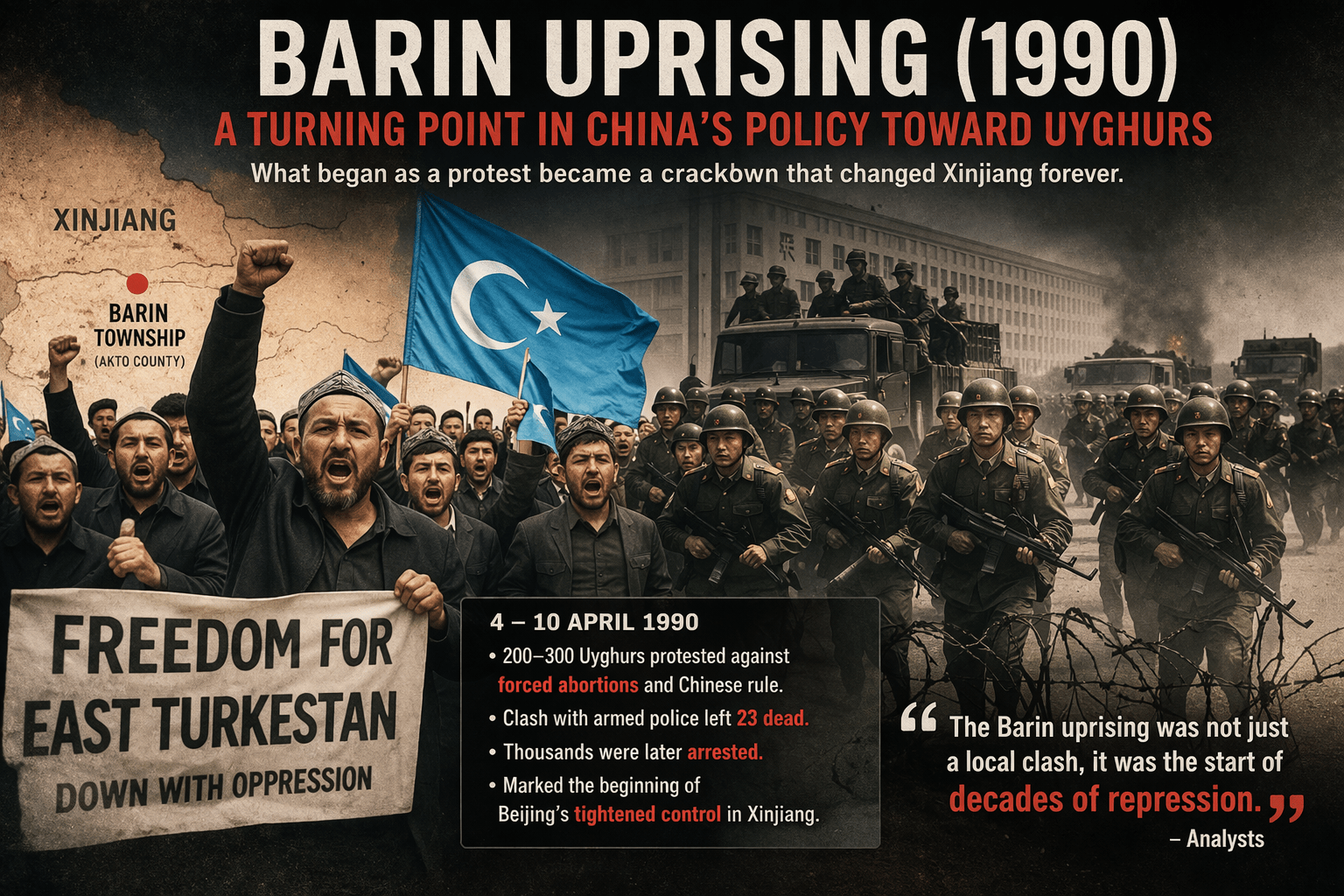
April 4, 1990, marked a defining moment in the modern history of Xinjiang. What began as a localized protest in Barin Township rapidly escalated into an armed confrontation that would reshape Beijing’s approach toward the Uyghur population for decades to come.
The Barin uprising was not merely a short-lived clash between militants and state forces. It exposed deep-rooted tensions over governance, identity, and state control in China’s far-western region.
From Protest to Armed Conflict
The unrest began when several hundred Uyghur men gathered to protest policies widely perceived as intrusive and discriminatory. Among the most contentious issues were the extension of strict family planning measures to Uyghurs and broader dissatisfaction with Beijing’s control over the region.
Eyewitness accounts and later reports suggest that the protest quickly turned violent after armed elements within the crowd confronted security forces. Within hours, the situation escalated into a full-scale armed standoff involving the People’s Armed Police and later the People’s Liberation Army.
By April 10, Chinese forces had suppressed the uprising. Official figures reported 23 deaths, though independent verification remains difficult due to tight state control over information.
Competing Narratives
One of the most striking aspects of the Barin uprising is the divergence in how it is interpreted.
- Chinese authorities described it as a “counter-revolutionary armed riot”, blaming extremist elements such as the East Turkestan Islamic Party.
- Some external analyses, including U.S.-based reports, attributed the organization to a broader nationalist movement seeking autonomy or independence.
- Uyghur exile groups, meanwhile, frame the incident as a “revolution” or “massacre”, emphasizing state repression rather than militancy.
This clash of narratives reflects a broader information asymmetry surrounding Xinjiang, where independent reporting has historically been limited.
A Catalyst for Policy Hardening
While the uprising itself lasted less than a week, its consequences were far-reaching.
Following the events, Chinese authorities launched sweeping security measures across Xinjiang. Thousands of individuals were reportedly detained in the months that followed, accused of separatism or counter-revolutionary activity.
Analysts widely regard the Barin uprising as a watershed moment—one that accelerated Beijing’s shift toward a more securitized and surveillance-driven governance model in the region. Over time, this approach would evolve into the extensive control mechanisms that Xinjiang is known for today.
Legacy and International Reactions
Decades later, the Barin uprising remains a sensitive and politically charged subject.
Uyghur diaspora groups continue to commemorate the event annually, portraying it as an early symbol of resistance. Meanwhile, governments such as Turkey have periodically raised the issue, reflecting broader geopolitical tensions tied to the Uyghur question.
For Beijing, however, the incident remains framed within the narrative of counterterrorism and national stability.
Conclusion
The Barin uprising was not an isolated ঘটনা but a precursor to a much larger and ongoing conflict over identity, sovereignty, and human rights in Xinjiang. Its legacy lies less in the number of casualties and more in the policies it helped shape.
More than three decades later, the questions it raised—about governance, resistance, and the limits of state power—remain unresolved.