The Middle East has entered one of its most volatile military confrontations in decades. What began on February 28, 2026, as a coordinated U.S.–Israeli strike on Iranian military and nuclear infrastructure has rapidly escalated into a regional war involving missile exchanges, drone strikes, naval clashes, and widening geopolitical implications.
U.S. President Donald Trump, who returned to office earlier this year, named the campaign “Operation Epic Fury.” The conflict has now entered its second week, with the balance of power shifting but no sign of an immediate ceasefire.
Timeline of Major Military Events
| Date | Key Developments |
|---|---|
| Feb 28, 2026 | U.S. and Israel launch massive strikes on Iran’s nuclear and military infrastructure. |
| Feb 28 (later) | Iran retaliates with hundreds of missiles and thousands of drones targeting Israel and U.S. bases. |
| Mar 1 | U.S. B-2 bombers strike underground missile facilities; Israel expands air campaign. |
| Mar 2 | Hezbollah joins the conflict from Lebanon; Israeli ground forces enter southern Lebanon. |
| Mar 3–4 | Iranian strikes expand to Iraq, Jordan, and Saudi Arabia; regional tensions spike. |
| Mar 5–6 | Israel bombs Hezbollah targets in Beirut suburbs; Iran launches multiple missile waves. |
| Mar 7–8 | War enters second week as both sides continue aerial and missile attacks. |
The Opening Barrage: February 28
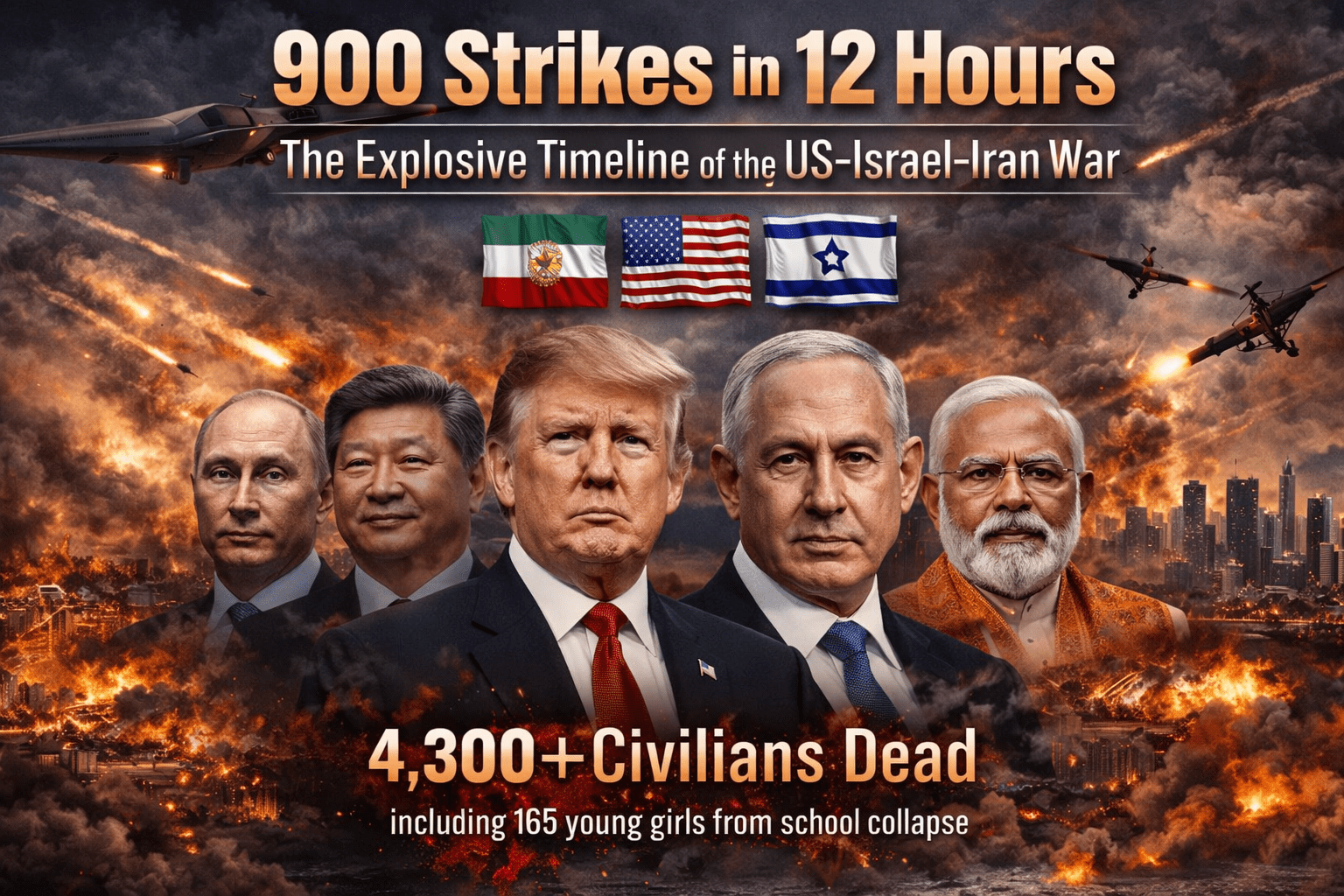
In the pre-dawn hours of February 28, U.S. and Israeli forces unleashed a massive opening strike of nearly 900 attacks within the first 12 hours.
Primary Targets
- Command centers in Tehran
- Nuclear facilities in Natanz, Fordow, and Isfahan
- Missile bases in Qom and Karaj
- Military hubs in Kermanshah and Chabahar
The operation involved:
| Weapon System | Used By | Purpose |
|---|---|---|
| Air-launched ballistic missiles | Israel | Precision strikes on strategic targets |
| Tomahawk cruise missiles | United States | Long-range infrastructure destruction |
| Electronic warfare | U.S.–Israel | Neutralizing radar and air defenses |
The strike reportedly killed Iran’s Supreme Leader, Ali Khamenei, along with several senior Islamic Revolutionary Guard Corps (IRGC) commanders.
Civilian Casualty Incident
One missile struck a girls’ school in Minab near Bandar Abbas, collapsing the building and killing approximately 165 people, most of them students. Both Washington and Tel Aviv deny the site was intentionally targeted, but the incident has triggered international condemnation and protests.
Iran’s Massive Retaliation
Within hours of the initial attack, Tehran launched one of the largest missile and drone barrages in modern Middle Eastern warfare.
Iranian Weapons Deployed
| System | Type | Range / Payload |
|---|---|---|
| Shahed-136 | Loitering suicide drone | ~1,000 miles range |
| Qadr | Medium-range ballistic missile | Precision strikes on bases |
| Fattah | Advanced ballistic missile | Hypersonic-capable variants |
| Khorramshahr-4 | Heavy ballistic missile | 1,500-kg warhead |
Targets Hit
Iranian strikes targeted:
- Ben Gurion Airport in Israel
- Israeli air bases and command centers
- U.S. bases at Al Udeid (Qatar) and Al Dhafra (UAE)
- Military facilities in Bahrain, Kuwait, Iraq, Jordan, and Saudi Arabia
Additional incidents included:
- A drone strike on the U.S. Embassy in Riyadh, causing a fire but no casualties.
- A missile attack on an oil terminal in Fujairah, UAE, temporarily disrupting exports.
By the end of the day:
| Iranian Attack Totals | Estimated Numbers |
|---|---|
| Ballistic missiles launched | 500+ |
| Drones deployed | 2,000+ |
| Targets claimed | 200+ |
Escalation: March 1–2
Following confirmation of Khamenei’s death, the United States intensified its operations.
U.S. Actions
- B-2 stealth bombers dropped 2,000-pound bunker-buster bombs on underground missile launch facilities.
- Iranian launch capability reportedly reduced by up to 90%.
Israeli Air Campaign
| Metric | Estimate |
|---|---|
| Total strikes | ~3,400 |
| Fighter jets per wave | 80+ |
| Munitions dropped | ~7,500 |
Hezbollah Joins the War
The Lebanese militant group Hezbollah launched rockets into northern Israel, prompting Israeli ground incursions into southern Lebanon by March 2.
Naval Warfare and Regional Expansion
The conflict expanded into maritime and regional theaters.
Key Naval Developments
| Incident | Outcome |
|---|---|
| U.S. submarines engage Iranian fleet | 43 vessels reportedly sunk |
| Iranian missile attack on USS Abraham Lincoln group | Limited impact |
| Drone carrier destroyed | Iranian naval losses increase |
Additional Strikes (March 3–4)
Iran launched attacks on:
- Kurdish militant positions in Iraq
- A $300 million U.S. radar installation in Jordan
- Oil infrastructure in Saudi Arabia
The War Intensifies: March 5–6
Israel expanded its operations against Hezbollah in Lebanon.
Israeli Actions
- Airstrikes in Beirut suburbs
- Targeted destruction of Hezbollah weapons depots
Iranian Counterattacks
Iran launched its 25th missile wave, including:
- Cluster-warhead missiles targeting central Israel
- Additional drone swarms aimed at U.S. installations.
Casualty and Damage Estimates
| Country/Side | Estimated Casualties |
|---|---|
| Iran | 1,500+ deaths, including civilians |
| United States | 6–10 service members killed |
| Israel | Dozens injured from shrapnel and debris |
| Regional states | Infrastructure damage and limited casualties |
Airspace closures and evacuation efforts across the Gulf have disrupted commercial aviation and shipping routes, while global oil prices have surged amid fears over the Strait of Hormuz. Over 4,300 civilians have died in the war so far.
China Positions Itself as Mediator
China has attempted to project itself as a diplomatic stabilizer.
President Xi Jinping faces significant strategic concerns as Iran supplies roughly 10% of China’s oil imports.
Chinese Actions
| Initiative | Purpose |
|---|---|
| Dispatch of envoy Zhai Jun | Attempt mediation |
| Calls for ceasefire | Prevent escalation |
| Evacuation of Chinese nationals | Protect citizens |
Chinese Foreign Minister Wang Yi warned the war “should never have happened.”
However, our reporters found that Beijing is quietly assisting Tehran through financial support, components, and dual-use technologies while avoiding direct involvement. Read our report on how the Chinese Air Defence system (HQ-9B) “collapsed” during the war and affected Iran.
India Walks a Diplomatic Tightrope
India has adopted a cautious yet pro-Israel leaning stance.
Prime Minister of India Narendra Modi visited Israel days before the conflict erupted and publicly declared India’s solidarity with Israel.
Strategic Risks for India
| Concern | Impact |
|---|---|
| 10 million Indians in Gulf states | Safety risks |
| Rising oil prices | Economic strain |
| Strained ties with Iran | Energy security concerns |
India has publicly called for restraint and dialogue, but its silence on condemning the strikes has sparked criticism domestically.
Russia’s Shadow Role
Russia has played a covert but influential role in the conflict.
President Vladimir Putin has condemned the war as “unprovoked aggression”, while pushing for a UN-brokered ceasefire.
However, intelligence reports suggest Moscow is providing real-time targeting information to Iran regarding U.S. naval and air deployments.
This support stems from the January 2025 Russia–Iran strategic partnership agreement, which expanded military and technological cooperation between the two countries.
The Strategic Outlook
As of March 8, 2026, the conflict remains a war of attrition.
Current Battlefield Dynamics
| Factor | Assessment |
|---|---|
| Air superiority | U.S.–Israel advantage |
| Missile capability | Iran degraded but active |
| Naval control | U.S. dominance |
| Regional escalation | Increasing |
President Trump has demanded Iran’s unconditional surrender, though no ground invasion has been launched.
Tehran, meanwhile, has vowed to continue fighting for up to six months, betting that prolonged conflict could shift international pressure against Washington and Tel Aviv.
A Conflict With Global Consequences
The war is already reshaping geopolitical alignments, global energy markets, and military calculations across multiple continents.
With the Strait of Hormuz under threat, Hezbollah engaged, and major powers maneuvering behind the scenes, the Middle East stands on the brink of an even wider confrontation.
For now, the skies over the Gulf remain filled with missiles, drones, and uncertainty.
The world watches — and waits.