Van Thinh Phat chairwoman sentenced to death in Vietnam’s biggest fraud trial

Truong My Lan, the chairwoman of Vietnamese developer Van Thinh Phat, has been sentenced to death for masterminding a multi-billion-dollar fraud, state-controlled media reported Thursday. Judges at Ho Chi Minh City’s People’s Court said she was guilty of bribery, embezzlement and violating banking regulations. Lan owned a 91.5% stake in Saigon Commercial Bank and, over the course of 10 years, ordered bank officials to approve more than 2,500 loans to shell companies she controlled, causing the bank to lose the equivalent of US$27 billion. Lan ordered subordinates to bribe auditors at the State Bank of Vietnam to cover her tracks. Head banking inspector Do Thi Nhan received $5.2 million in bribes, while deputy chief inspector Nguyen Van Hung received $300,000, state media said. A family member told Reuters Lan planned to appeal the verdict. Edited by Elaine Chan.

Read More

In China, drones, social media monitor foreign journalists: report

Chinese authorities use drones to monitor and follow foreign journalists as they report from the country, as well as detaining, harassing and threatening them with non-renewal of their work permits if they report on topics deemed sensitive by the government, according to a new report on journalists’ working conditions. Four out of five members who responded to the Foreign Correspondents’ Club of China annual working conditions survey said they had experienced “interference, harassment or violence” while trying to do their jobs in China during the past year, the FCCC report found. Local governments are increasingly using technology to keep track of foreign media workers, the report found. “During a trip to Poyang Lake, where we were reporting on the status of the Yangtze River dolphin, we were followed by multiple cars with plainclothes individuals inside,” the report quoted a journalist with a European media organization as saying.  “At one point, the plainclothes individuals appeared to use a drone when a blocked sandy road prevented them from getting closer by car,” they said. A cameraman from Hong Kong Cable TV is restrained from photographing the crowd waiting to buy tickets for the 2008 Beijing Olympics, July 25, 2008, in Beijing, China. (Robert F. Bukaty/AP) Another European journalist reported similar high-tech surveillance when on a reporting trip to two provinces affected by extreme weather events linked to climate change. “We were followed by multiple carloads of plain clothes officers,” the report quoted them as saying. “Drones were sent out to follow and observe us when we got out of our vehicle to film/collect interviews. When we moved on foot to a spot, the drones would follow us.” Respondents also told the FCCC they had reason to believe the authorities had “possibly or definitely” compromised their WeChat (81%), their phone (72%), and/or placed audio recording bugs in their office or homes, the report found. ‘Endless cat-and-mouse game’ Another journalist with a European newspaper described reporting in China as “an endless cat-and-mouse game.” “Whatever strategy you try, the Chinese surveillance and security system adapts and closes the gap,” the report quoted them as saying. “Whatever strategies you use, the space for reporting keeps getting smaller and smaller.” A foreign reporter of many years’ experience in China who gave only the surname Lok for fear of reprisals told RFA Cantonese that she expects her communications apps to be monitored at all times. “I was talking about an issue with a friend here [in mainland China] … and may have mentioned it on WeChat,” Lok said. “Later, he was called in by the police to ‘drink tea’” – a euphemism for being called in for questioning. Journalists crowd a National People’s Congress press conference a day before the opening of the annual session of China’s parliament, in Beijing’s Great Hall of the People on March 4, 2019. (Greg Baker/AFP) “It turned out that the problem wasn’t him, but the conversation he had with me,” she said. “We have to be careful, because a lot of trouble has come from talking to people on WeChat.” A second Hong Kong journalist who gave only the surname Wong for fear of reprisals said it used to be easier for journalists to evade official surveillance than it is now. “The Chinese government’s digital surveillance methods are comprehensive,” Wong said. “You could describe them as a dragnet, in which every move the target makes is visible to them.” Online surveillance Huang Chao-nien, an assistant professor at the National Development Institute of Taiwan’s National Chengchi University, agreed, adding that the government has used online surveillance to target journalists for years. The government has long used an internet development model that intervenes in the market to control tech companies … forcing them to cooperate with the government in carrying out political surveillance and controls on public speech, he said. More than half of the journalists who took part in the FCCC annual survey said they had been “obstructed” at least once by police or other officials, while 45% encountered obstruction by unidentified persons, the report said. Some had been warned not to join the club as it was deemed an “illegal organization,” while others were threatened with non-renewal of their visas and work permits if they didn’t toe the line, the report said. Areas deemed particularly sensitive by Chinese officials were even harder to work in, it said, adding that 85% of journalists who tried to report from the far western region of Xinjiang in 2023 experienced problems.  “In Xinjiang we were followed the entire time,” the report quoted a European journalist as saying. “It was particularly unpleasant in Hotan, where we counted about half a dozen plainclothes following us by car or on foot.” “In Korla, we at some point had six cars following us. When we did a U-turn and then a detour over an abandoned construction site and dust road, they all faithfully followed us,” the journalist said. Chinese policemen manhandle a photographer, center, as he photographs a news event near the No. 1 Intermediate People’s Court, in Beijing Sunday, Jan. 26, 2014. (Andy Wong/AP) And the definition of “sensitive” areas appears to be expanding. “An increasing number of journalists encountered issues in regions bordering Russia (79%), Southeast Asian nations (43%) or in ethnically diverse regions like Inner Mongolia (68%),” the report said. More than 80% said potential sources and interviewees had declined to be interviewed because they didn’t have prior permission from their superiors to speak to foreign media. Fear of reprisals is even being felt among experts, pundits and commentators, the report said. “Academic sources, think tank employees and analysts either decline interviews, request anonymity, or don’t respond at all,” it quoted respondents as saying. Translated with additional reporting by Luisetta Mudie. Edited by Malcolm Foster.

Read More

Philippines’ Marcos denies ‘gentleman’s agreement’ with Beijing over South China Sea

Philippine President Ferdinand Marcos Jr. on Wednesday denied the existence of a “gentleman’s agreement” between his predecessor, Rodrigo Duterte, and China that Manila would not make repairs to a rusting military outpost in a disputed shoal in the South China Sea. Duterte’s former spokesman, Harry Roque, has said the previous Philippine government entered into a deal with Beijing to keep the “status quo” in the waterway, which has become the scene of increasingly tense confrontations between the two nations. As part of the deal, Duterte allegedly agreed the Philippines would not send construction materials to repair the BRP Sierra Madre, a dilapidated World War II-era naval ship that was deliberately run aground on Second Thomas Shoal in 1999. “We don’t know anything about it,” Marcos told reporters before leaving for talks with U.S. President Joe Biden and Japanese Prime Minister Fumio Kishida in Washington “There is no documentation, no record. We were not briefed [about it] when I came into office, no one told us that there was that agreement.” Marcos said his staff were demanding information from ex-Duterte officials, but “we still haven’t got a straight answer.” “I am horrified by the idea that we have compromised through a secret agreement, the territory, sovereignty and sovereign rights of the Philippines,” Marcos said. Since taking office in June 2022, Marcos has reversed Duterte’s pro-China policies, realigning with the United States and granting American troops greater access to Philippine bases.  Duterte has not directly commented on the supposed deal, but the Chinese embassy in Manila has alluded to it on a number of occasions after Chinese vessels have been accused of harassing Filipino supply boats heading to the Sierra Madre.  China claims nearly all of the South China Sea, while disregarding overlapping claims from Brunei, Malaysia, the Philippines, Vietnam and Taiwan. Last week, Chinese Foreign Ministry Spokesperson Wang Wenbin said Manila “has been going back on its words and provoking China” over Second Thomas Shoal, without directly mentioning any agreement. Roque has not replied to requests for comment made by RFA affiliate BenarNews, but he has been quoted widely in local media saying he stands by his earlier statement. “The gentleman’s agreement is to respect the status quo on the entire West Philippine Sea dispute,” he said, referring to the portion of the South China Sea within Manila’s exclusive economic zone. As Marcos left on Wednesday afternoon for Washington, the Philippine military reported that some 48 Chinese vessels – mostly from its maritime militia – were being monitored near another disputed outcrop, Scarborough Shoal, and three Philippine-occupied features in the South China Sea. BenarNews is an RFA-affiliated online news organization.

Read More

China gives monks a list of things they can’t do after the Dalai Lama’s death

In the event of the Dalai Lama’s death, Buddhist monks are banned from displaying photos of the Tibetan spiritual leader and other “illegal religious activities and rituals,” according to a training manual Chinese authorities have distributed to monasteries in Gansu province in China’s northwest, a source inside Tibet and exiled former political prisoner Golok Jigme said. The manual, which lists 10 rules that Buddhist clergy should follow, also forbids disrupting the process of recognizing the Dalai Lama’s reincarnation, said the source from inside Tibet who requested anonymity for safety reasons.  Tibetans believe they should determine his successor in accordance with their Buddhist belief in reincarnation, while the Chinese government seeks to control the centuries-old selection method. The 14th Dalai Lama, 88, fled Tibet amid a failed 1959 national uprising against China’s rule and has lived in exile in Dharamsala, India, ever since. He is the longest-serving Tibetan Buddhist spiritual leader in Tibet’s history. The manual, which was seen by Radio Free Asia and was issued to monks in Kanlho Tibetan Autonomous Prefecture in the historical Amdo region of Tibet, is the latest effort by Beijing to crack down on the religious freedom of the Tibetan people, experts and rights groups say.  A screenshot of the page in a Chinese government-issued training manual listing 10 rules for Tibetan Buddhist monks to follow in the event of the Dalai Lama’s death. (Citizen journalist) It is part of Beijing’s systematic attempts to make Tibetan Buddhists more loyal to the Chinese Communist Party and its political agenda rather than to their religious doctrine, said Bhuchung Tsering, head of the research and monitoring unit of International Campaign for Tibet in Washington. “This goes against all tenets of universally accepted freedom of religion of the Tibetan people that China purports to uphold,” he told RFA. China has imposed various measures to force Tibetan monasteries to conduct political re-education and has strictly prohibited monks and ordinary Tibetans from having contact with the Dalai Lama or Tibetans in exile, whom Beijing sees as separatists. The Chinese government has intensified its suppression of Tibetan Buddhism in the Tibetan Autonomous Region and in other Tibetan-populated areas in China in recent years. “The latest government campaigns against the Dalai Lama and Tibetan Buddhists’ religious practices in Gansu province represent another attempt by the Chinese government to interfere in the Dalai Lama’s reincarnation process,” said Nury Turkel, a commissioner on the bipartisan U.S. Commission on International Religious Freedom, or USCIRF. Turkel called on the U.S. government to sanction Chinese officials who violate religious freedom.  ‘Separatist ideology’ The manual also says monks are forbidden to engage in activities that undermine national unity, hurt social stability in the name of religion or require cooperation with separatist groups outside the country, the source said.   It says no illegal organizations or institutions will be allowed to enter monasteries and that the education system for monks cannot harbor elements of “separatist ideology.” He Moubou (C), secretary of China’s State Party Committee, visits Tibetan monks in Machu County, Kanlho Tibetan Autonomous Prefecture, in China’s Gansu province, March 19, 2024. (Citizen journalist) The rules also prohibit the promotion of “separatist ideas” and the dissemination of “separatist propaganda” via radio, internet and television or by other means, and forbids deception in the form of open or covert fraud, the source from inside Tibet said. “While the Chinese government implements various political education and activities targeting Tibetans, the primary focus seems to be eradicating Tibetan identity through the dismantling of Tibetan religion and culture,” said Golog Jigme, who was imprisoned and tortured by Chinese authorities in 2008 for co-producing a documentary on the injustices faced by Tibetans under Chinese rule. He now lives in Switzerland and works as a human rights activist. There are 10 Tibetan autonomous prefectures in Chinese provinces bordering Tibet, including ones in Gansu, Sichuan, Qinghai and Yunnan, where many ethnic Tibetans live.  Kanlho Tibetan Autonomous Prefecture in Gansu province, where authorities distributed the manuals, is home to about 415,000 Tibetans speaking the Amdo dialect. The province has about 200 large and small monasteries under its administration.  During a visit to two counties in Kanlho Tibetan Autonomous Prefecture in March, He Moubao, secretary of China’s State Party Committee emphasized the need for Tibetans to Sinicize religion and to implement the Chinese Communist Party’s policy on religious work. Monks should be guided in this regard to maintain national unity and social stability, he said. A Tibetan Buddhist monk holds two Chinese government textbooks on religious policies and laws and regulations given to monks at a monastery near Xiahe in China’s Gansu province, May 8, 2008. (Ng Han Guan/AP) “Communist China egregiously violates the religious freedom in Tibet by Sinicising Tibetan Buddhism to fulfill its political and ideological goals and agenda,” said former USCIRF Chair Tenzin Dorjee. “To say that no one can lawfully practice Buddhism after His Holiness the Dalai Lama passes away is an indication of imposing more religious repressions in Tibet later,” he told RFA. China, which annexed Tibet in 1951, rules the western autonomous region with a heavy hand and says only Beijing can select the next spiritual leader of Tibetan Buddhists, as stated in Chinese law.  Tibetans, however, believe the Dalai Lama chooses the body into which he will be reincarnated, a process that has occurred 13 times since 1391, when the first Dalai Lama was born.  At his home in Dharamsala earlier this month, the Dalai Lama, whose given name is Tenzin Gyatso, told a gathering of hundreds of Tibetans during a long-life prayer offering to him that he was in good health and was “determined to live for more than 100 years.” He has said on several occasions that his successor would come from a free country without Chinese interference.  Translated and edited by Tenzin Pema for RFA Tibetan. Edited by Roseanne Gerin and Malcolm Foster.

Read More

Rebels claim 2 junta bases in central Myanmar, taking 120 surrenderers

Over 100 junta troops surrendered after guerilla-style militias captured two of their camps in central Myanmar, a militia member told Radio Free Asia on Tuesday. The camps are located between two townships in Sagaing region, where anti-junta sentiment is high and indiscriminate attacks by the Myanmar military have been frequent since the army seized power in 2021.  Seven combined anti-junta armed groups, including Paungbyin People’s Defense Force and Homalin People’s Defense Force, carried out the most recent capture on Sunday. A member of the militia said the People’s Defense Forces now control the Chindwin river between two townships, strategic land that the junta used to target villages. The river was previously used by junta forces to transport supplies and fuel further attacks on villages situated nearby. “These camps and battalions are connected to Homalin and Paungbyin [townships]. Now, we can completely control the waters of the Chindwin river,” he told RFA, declining to be named for security reasons. “From that place, the military could attack villages in Paungbyin. But that area is now in our hands.” Some junta soldiers were trapped and later rescued by a Mi-17 helicopter from the junta air force base in Homalin, he added. The People’s Defense Force seized Light Infantry Battalions 396 and 370, as well as taking 120 surrenderers prisoner out of the 300 junta troops present. Troops stationed across Sagaing have frequently conducted attacks across the region and have been accused of gruesome assaults and baseless arrests of civilians, including women and children, people with disabilities and the elderly. Sagaing was also cited as the division with the highest rate of body-burning, a recurrent tactic by junta troops. RFA contacted Sagaing region’s junta spokesperson Nyunt Win Aung regarding the bases’ capture, but he did not respond.  Translated by RFA Burmese. Edited by Kiana Duncan and Taejun Kang. 

Read More

8 Lao women arrested in Thailand for prostitution

Authorities in Thailand have arrested eight Lao women, seven of whom entered the country illegally to work as prostitutes, and one who worked as their madam, Radio Free Asia has learned. According to the Anti-Trafficking in Person Unit of the Thai Department of Special Investigation, the seven women were aged 21 to 36, and they were arrested at a karaoke bar in Bang Pakong district in the southern province of  Chachoengsao. The eighth woman is the wife of the bar’s owner.  A police officer in Bang Pakong district confirmed Monday that the seven women, who were arrested on April 4, are still in custody and are awaiting trial and will be deported to Laos later. The sex trade is technically illegal in Thailand, but laws against it are rarely enforced. Authorities do, however, more strictly enforce immigration laws. “Usually, people from Laos, Cambodia and Myanmar are allowed to work in Thailand in only certain types of work like construction, but not in entertainment venues or karaoke bars,” Col. Pattanapong Sripinproh of the Anti-Trafficking in Persons Unit told RFA Lao.  “They are not allowed to work as bar girls or drink girls,” he said. “If they do, they’ll be arrested.” Thailand’s Central Investigation Bureau raid a karaoke shop April 4, 2024 in Bang Pakong district, Thailand. (Manager Online) Sripinproh explained that police were able to catch the eight women by going undercover and posing as johns. “One of our police officers disguised as a customer at the karaoke bar and agreed to pay 2,000 baht ($54) for sex with one of the women,” he said, explaining that the bar owner and a hotel get their cut of the money and the woman would get about 1,300 baht ($36). Following this lead, the police officers inspected the bar and found that seven women were working illegally. “Based on the law on foreign workers …  the violators will be fined up to 10,000 baht (US$272) and/or jailed for two months,” he said, but acknowledged that in most cases there is no fine or jail time. Instead the women are usually deported and blacklisted for two years. He also said that if the husband and wife were found guilty of human trafficking they could face up to 20 years in prison. “But in these cases we found out that those seven women are older than 20 and none of them were forced to prostitution,” said Sripinproh. “So, the husband and wife won’t be charged with human trafficking. But they will be charged with doing illegal business by providing sexual services.” RFA reported in March that four Lao women were arrested in Ban Bueng district in nearby Chonburi province for entering the country illegally and working as prostitutes. They told Thai police that they entered Thailand as tourists, rented rooms in a hotel and then sold sex. Translated by Max Avary. Edited by Eugene Whong.

Read More

Rebels push over 600 junta personnel out of Myanmar-Thailand border town

Myanmar junta forces, pushed out by rebel groups at the border township of Myawaddy, have requested to be evacuated with their family members through a Thai border town, Thailand’s foreign ministry said on Monday.  “After receiving the said request, and upon considering the urgency of the situation and the possibility of an evacuation of Myanmar personnel and their families to safe areas, a decision was made at the government level to approve the request from Myanmar on humanitarian grounds,” said the Thai Ministry of Foreign Affairs in a statement.  Around 617 personnel have requested evacuation, including 410 soldiers and 207 family members, according to Thai media.  Allied rebel armed groups in Kayin state, which border’s Thailand Tak province, have suspended some of the junta’s local government offices in the major trade hub township of Myawaddy since Saturday, said a local businessman. “At Friendship Bridge No. 1 also, immigration is issuing papers for people to cross [over the border], working as usual,” he said, declining to be named for security reasons. “The usual police, Office of the Chief of Military Security Affairs and Bureau of Special Investigation were not seen at Friendship Bridge No. 1.” Friendship Bridge No. 1 connects the Thai city of Mae Sot with Myanmar’s Myawaddy and has been run by Myanmar’s junta since it reopened in 2023 after a three-year hiatus.  The Karen Nation Union, working with guerilla armies, or the People’s Defense Forces, and the Border Guard Forces on Saturday’s maneuver, has not issued any updates about their hold on Myawaddy since the Thai ministry’s announcement.  The group announced on Saturday it captured Thin Gan Nyi Naung village in Myawaddy district, still 12 kilometers (seven miles) from the border.  In 2023, it seized a mountain overlooking Myawaddy, and took control of the city’s Asian Highway in December.  While these liminal successes at the border could mark significant economic and security changes, there are other strategic trade routes and military positions the junta still has a tight grasp on, said Dulyapak Preecharush, an associate professor of Southeast Asian Studies at Thailand’s Thammasat University. “Now, the opposition groups have more power than the [State Authority Council] in this area and will become the powerful stakeholder there,” he said. “However, despite the Tatmadaw’s [the military of Myanmar’s] failure in defending the city [Myawaddy], other military camps in Kayin state and its headquarter of Southeastern Regional Command in Mawlamyine have not been captured.” Non-political aid According to the Thai foreign ministry, one flight arrived from Myanmar at Mae Sot’s airport on Sunday. The ministry did not elaborate if all officials boarded the flight or were evacuated, but said the junta has since requested that remaining flights for Monday and Tuesday be canceled.  A meeting will be held at the Government House on Tuesday to “assess the situation” and “determine a course of action for Thailand,” the statement continued.  Thailand’s Ratchamanu task force, based in the border province of Tak, has stressed the country’s firm neutral stance among all warring factions in Myanmar. “In line with humanitarian principle, Thailand would not take side with Myanmar troops nor ethnic forces but we give assistance where applicable,” Task Force Commander Col. Nattakorn Reuntib told Radio Free Asia. Soldiers, regardless of their political association, would be disarmed, given basic assistance and repatriated, he added. Thailand’s foreign ministry has not responded to RFA’s inquiries as of this writing.  This development – the ethnic armies having more control over the border – could prompt Thailand’s officials to re-examine their operations in Mae Sot, said political analyst Panitan Wattanayagorn. “Who controls the bridge must control immigration,” he said, adding that new groups may be more flexible on the border than the junta was. “The Thai officers must renegotiate with the new groups to make sure there is no real surge or increase in terms of crossing borders illegally.” Edited by Elaine Chan and Taejun Kang.

Read More

Arakan Army’s gains enough to enable self-rule in Myanmar’s Rakhine state

The Arakan Army, or AA, is continuing their sweep across Rakhine, furthering the military gains of the ethnic Three Brotherhood Alliance, of which it is a member, in Shan state. While the capture of nine towns, with a tenth in southern Chin state, is another humiliating defeat for the Burmese military, it also sets the scene for a very messy political discussion moving forward. Myanmar’s military continues to be on their back feet. The Kachin Independence Army continues to make gains, recently securing control over a major trade route with China, after seizing the last of the military camps along the Bhamo-Myitkyina highway. The once staunchly pro-junta border guards forces in Kayin state are now hedging their bets and putting some distance between themselves and Naypyidaw.  Meanwhile, the junta’s announced counter-offensive out of Lashio against the Ta’ang National Liberation Army and Myanmar National Democratic Alliance Army – the other two members of the Three Brotherhood Alliance – in northern Shan State has not materialized. But it’s in Rakhine where the military has been handed its most significant territorial defeats. The AA has captured six of Rakhine’s 17 townships and several smaller towns since launching an offensive on Nov. 13, 2023, with ongoing offensives against several others. As of early April, the AA had captured some 170 junta camps and posts, as well as several larger bases, battalion headquarters, and training facilities. Arakan Army soldiers stand with an artillery piece after capturing the Ta Ron Aing base in Chin state from junta forces, Dec. 4, 2023. (AA Info Desk) The capital of Sittwe is surrounded, and many civil servants have been withdrawn. The Chinese special economic zone in Kyaukphyu is on the verge of falling, prompting the United League of Arakan, the AA’s political wing, to publicly pledge to protect all foreign direct investment that benefits Rakhine and “ensure the smooth continuation of their operations.” At present, China’s US$8 billion investment, which includes their oil and gas pipelines and a proposed deepwater port with rail and road links, can only be accessed by sea. As a recent International Institute for Strategic Studies report concluded: “But no matter the final outcome, the AA’s sweeping gains are already enough to enable self-rule over a large portion of the Rakhine homeland and to reshape the wider balance of power in Myanmar.” Little leverage over AA in Rakhine On April 1, 2024, China’s special representative to Myanmar, Deng Xijun, met with junta chief Senior Gen. Min Aung Hlaing in Naypyidaw to try to broker a ceasefire. While the Chinese-brokered ceasefire between the Three Brotherhood Alliance and the military regime is tenuously holding in northern Shan state, the AA refuses to be bound by it in Rakhine. China has less leverage over the AA, which has shown no interest in halting their offensive. The AA has stated their intention to capture the entire state, not just their traditional heartland in the north, though it’s not clear that they have the manpower and resources to do so. Over-reach could spread their forces too thin. The AA is in the midst of an offensive in Ann township, which is not just the headquarters of the military’s Western Command, but the key junction on the road to Magwe region. The loss of Ann would make overland resupply to northern and central Rakhine extremely difficult. Overland supply could only come in through the highway from Bago region’s Pyay township in the south. The military has responded in typical fashion, with more indiscriminate air and long-range artillery strikes against unarmed civilians. In a two-day period in early April, six civilians were killed and 16 were wounded. RFA Burmese reported that some 79 Rohingya civilians have been killed and 127 more have been wounded in the past four months. The junta has commenced implementation of its national plan to conscript some 5,000 people a month, including amongst ethnic Rohingya in Rakhine, despite the assassination of local administrators. People who appear to be Rohingya Muslims in Rakhine state undergo weapons training by junta military personnel on March 10, 2024. (Image from citizen journalist video) This is a perverse irony after the military waged an ethnic cleansing campaign that drove 1 million ethnic Rohingya, whom they refer to as “illegal Bengalis,” into Bangladesh, and kept many others in concentration camps. Poorly armed and trained conscripts have limited military utility, indicating the military’s desperation for manpower. Role of Rohingya conscripts But the Rohingya conscripts play a much more important role in fomenting political strife within the opposition camp. The Buddhist-dominated Arakan Army has a tense relationship with the Rohingya population. It has tenuously accepted the shadow National Unity Government’s position that the Rohingya are legal citizens and that they should be returned to the country from Bangladesh in an orderly fashion. There have been a number of reports that the military is reaching out to the Arakan Resistance Solidarity Army, or ARSA, whose misguided raids on border posts and police stations in 2017 were the casus belli for the military’s ethnic cleansing campaign. Since being driven into Bangladesh, ARSA’s primary activities have been to secure control over the refugee camps and eliminate rivals within the Rohingya community; they have not participated in the armed rebellion. That the military believes that they can recruit ARSA as a proxy against the AA seems preposterous. The AA is neither willing to share any political power in Rakhine nor countenance the presence of any other armed actors. So there is a perverse logic to the military’s overtures to ARSA, which is searching for relevance. With mounting battlefield losses, the best that the military can do is to strike up ethnic and sectarian tensions. This should come as no surprise: stoking communal tensions has always been a key party of their strategy. An airstrike by Myanmar junta forces destroyed houses in Minbya township’s Myit Nar village in Rakhine state on April 3, 2024. (Arakan Princess Media) Indeed, the United Nations’ Independent Investigative Mechanism for Myanmar, which was established following…

Read More

Netflix’s take on ‘Three-Body Problem’ gets mixed reviews in China

A Netflix adaptation of Chinese sci-fi author Liu Cixin’s “The Three-Body Problem” has sparked mixed reactions in China, with some complaining of a lack of nuance, that much of the action takes place outside of China and that key characters are played by non-Chinese actors. But others praised it as a well-made adaptation for Western audiences and had made improvements in female characters. The show, which premiered on March 21 just as a man was sentenced to death for fatally poisoning one of its producers, billionaire Lin Qi, was Netflix’s most-watched English TV show from March 25-31. It features scenes of a political “struggle session” from the Cultural Revolution under the rule of late supreme leader Mao Zedong, in which physicist Ye Zhetai is beaten to death by Red Guards after being denounced by his own wife, for teaching the Big Bang theory and therefore failing to deny the existence of God. The scenes — omitted from a homegrown adaptation of Liu’s books produced by Tencent — are likely one of the reasons that the show is officially blocked in China. But viewers in China still discussed it widely after using circumvention tools to get around the “Great Firewall” of government censorship. Violence under Mao Reports emerged on social media in January that the show would likely be blocked on the orders of the ruling Chinese Communist Party’s Central Propaganda Department. While RFA was unable to confirm those reports independently, the political violence of the Mao era remains a highly sensitive topic for the government today, and has gotten other films and TV shows banned before. Publicity still for the Tencent adaptation “Three Body.” (Baidupedia) Nonetheless, enough people were able to see the show to discuss and search for “Three Body beating/hanging scene” on the Weibo social media platform, according to trending searches spotted by RFA this week. The hashtag #3BodyProblem# garnered billions of views on Weibo, according to The Guardian newspaper, and notched up a 6.9/10 score on Douban’s review site, compared with an 8.7 score for Tencent’s Chinese-made version of the show, which premiered in January. Mixed reviews Some appear to have been underwhelmed by the show, which transplants a good deal of the action to the United Kingdom, and changes the genders, ethnicities and names of several major Chinese characters in the book. One post complained that all of the best Chinese male leads had been given to non-Chinese actors. The show’s producers have said they wanted the whole world to be depicted. Douban user Victor’s Catzz described the Netflix version as “quite good,” adding that it improves considerably on Liu Cixin’s writing of female characters and foreigners, which he thought was “a mess anyway.” “What’s wrong with Netflix making reasonable adaptations for English-speaking audiences?” the user wrote in a post titled “A minority opinion.” @Rick Ro$$ from Shaanxi disagreed, commenting: “Netflix has switched up a lot of the ideas in the original work. Those ideas were precisely the essence of The Three-Body Problem.” One comment thought pro-Beijing “little pinks” had hijacked the show’s rating on public review sites, while others argued over whether the characters were more two-dimensional in the Chinese-made TV show or in the Netflix version. @engauge commented from Guangdong that the “melodrama” in the Netflix version had glossed over the “global vision and apocalyptic background to the political and social turmoil in the original work.” Sichuan user @Drunken_and_dreamed_98147 wanted to know why, if the show’s setting had been transplanted elsewhere, the writers had kept the Cultural Revolution scenes. “Why not change that era to show discrimination against black people in America?” the user wanted to know. “Wouldn’t that satisfy foreign requirements for political correctness even more?” Cultural Revolution Alexander Woo, executive producer of Netflix’s version of “The Three-Body Problem,” told The New York Times in a recent interview that scenes of the 1966-76 Cultural Revolution held a special meaning for him as his family lived through that era, as did the family of the episode’s director Derek Tsang. “We give a lot of credit to him for bringing that to life,” Woo told the paper. “He took enormous pains to have every detail of it depicted as real as it could be. I showed it to my mother, and you could see a chill coming over her, and she said, ‘That’s real. This is what really happened.’” Publicity still from Netflix’s “The Three-Body Problem” (Netflix) Tsang told RFA’s Cantonese service in an interview in January that he felt the depiction of the Cultural Revolution was a key part of the show. “It is becoming increasingly difficult to depict that period in any way [in China],” he said. “But it is a very important part of history.” “If we are honest, we can all learn from it if we face up to it and take it seriously. It’s important to show everyone how ridiculous that period was,” Tsang said. U.K.-based writer Ma Jian said one of the reasons that the Cultural Revolution is still so sensitive in today’s China is that President Xi Jinping is drawing on Mao Zedong’s playbook even now, prompting fears that he is going to drag the country back to that era. “Xi Jinping wants a return to the Cultural Revolution, and to imitate Mao Zedong,” Ma said. “[But] the whole world has seen through the horror of totalitarianism.” Translated with additional reporting by Luisetta Mudie. Edited by Malcolm Foster.

Read More

Sri Lankans present rare Buddha relics to the Dalai Lama

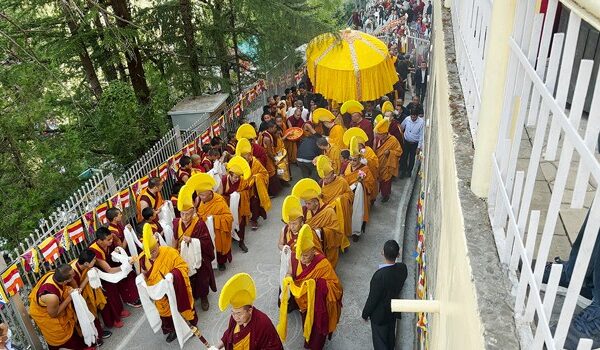
A delegation of Sri Lankan Buddhists on Thursday presented relics of the Buddha to the Dalai Lama at his home in Dharamsala, India, in a gesture that was celebrated by hundreds of Tibetans who lined the streets with silk scarves and flowers. The relics – fragments of the Buddha’s bones and teeth – have immense historical and spiritual significance, connecting Buddhist worshippers to the legacy of Buddha, a wandering ascetic and religious teacher who lived during the 6th and 5th centuries BCE and whose teachings formed the key tenets of Buddhism.  Tibetans along the streets paid their respects as the relics made their way to the Dalai Lama’s residence.  The leader of the Sri Lankan delegation, Waskaduwe Mahindawansa Maha Nayaka Thero, said the relics were presented to the Tibetan Buddhist spiritual leader on behalf of the entire Sangha community in Sri Lanka as a token of their “immeasurable gratitude and admiration” for his role in “accomplishing more for Buddhism than anyone in history.” “This marks a special momentous occasion for the entire Buddhist community in the world because we were able to gift the holy, authentic, sacred relics of the Buddha as a token of appreciation for His Holiness the Dalai Lama’s kindness, wisdom and compassion towards the entire humankind,” he said. The Buddhist community reveres the Dalai Lama as a living Bodhisattva – a being who is on the way to becoming enlightened – making him the only eligible person in the world to whom to give the authentic and holy relics, he added. Maha Nayaka Thero is head of Amarapura Sambuddha Sasanodaya Maha Nikaya, a sect of Theravada Buddhism, which is practiced in Sri Lanka and other parts of Southeast Asia.   ‘The world needs peace’  The Dalai Lama waited outside the gate to his home to receive the relics and welcome the Sri Lankans, as monks chanted prayers and staged a formal welcome, and artists performed Tibetan songs and dances. “On a practical level, the world needs peace, and that’s the core of the Buddha’s message,” the Dalai Lama said.  “However, I’m prepared not to mention Buddhism as such, but to emphasize secular ethics and universal values, crucial among which is compassion,” he said. “The important thing is to have a warm heart.” The relics of the Buddha are carried up to the Dalai Lama’s residence in Dharamsala, India, April 4, 2024. (Tenzin Woser/RFA) The delegation, including Damenda Porage, founder-president of the Sri Lankan-Tibetan Buddhist Brotherhood, said it was a long-held wish to offer the relics to the Dalai Lama as a gift.  Six years of planning The event was the culmination of six years of planning and preparation, with the assistance of the 7th Ling Rinpoche, the reincarnation of the Dalai Lama’s tutor, accelerating the fulfillment of the presentation of the relics, the delegation said. The items presented to the Dalai Lama are part of 21 authentic relics that have been preserved for several generations at the Sri Lankan Buddhist temple of RajaGuru Sri Subuthi Waskaduwa Maha Viharaya in Waskaduwa, near the capital Colombo.  “These sacred relics, discovered during the British reign in India in the Piprahwa excavations, hold profound significance for millions of Buddhists worldwide,” the Sri Lankan Buddhist leader said. After the Buddha’s passing, the relics were divided and enshrined in stupas in eight kingdoms, including the ancient city of Kapilavastu, which was known as the capital of the Shakya kingdom where the Buddha spent the first 30 years of his life.  These relics were later discovered at an excavation at Piprahwa, a modern-day archaeological site in Uttar Pradesh, India, or what was earlier known as Kaplivastu, during the British reign in India.  In 1898, British official William Peppe presented them to the Sri Lankan monk, Waskaduwe Sri Subhuti Mahanayake Thero, who took the Kapilavastu Buddha relics to Sri Lanka. Additional reporting by Tenzin Woser for RFA Tibetan. Edited by Roseanne Gerin and Malcolm Foster.

Read More