
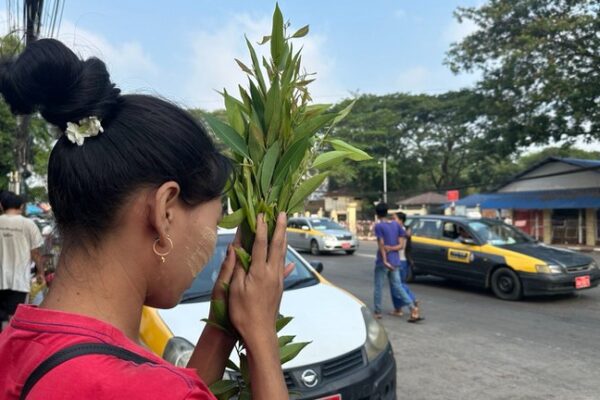
Myanmar junta releases thousands of prisoners in New Year amnesty

Myanmar prisons nationwide released over 3,000 prisoners on Wednesday, according to junta-controlled media. Since the country’s 2021 coup, thousands of civilians have been arrested for donating to groups opposing the junta, protesting and speaking out against the military regime’s leaders.  According to the junta’s media statement, reduced sentences were given “for the peace of mind of the people” and “social leniency” during the Burmese New Year Commemoration. Prisoners were released under the condition that if they commit another crime, they will serve the remainder of their previous sentence as well as the sentence for their most recent crime, in accordance with the country’s Criminal Procedure Law, military-supported channels like MRTV continued.  Prisoners’ family members have been waiting in front of Yangon region’s infamous Insein Prison since early on Wednesday morning, residents said.  Family members waiting in front of Insein Prison in Yangon region on April 17, 2024. (RFA) The mother of a political prisoner waiting by Insein Prison on Wednesday said she hopes to see her son, who has been in prison for three years for defamation. “The people in the prison said that prisoners like my son with a prison term of less than three years would be released, while prisoners with a long sentence would get a reduced prison term,” she said, declining to be named for security reasons.  “That’s why I am waiting for my son. He was arrested and jailed when [junta forces] found revolutionary messages on his phone while checking the [ward’s] guest list that night,” she continued, referencing a housing registration system that has intensified since the junta took power. However, like previous amnesties, which have been criticized as a false show of humanity from the junta in the past, only a small number of political prisoners will likely be released, said Thaik Tun Oo, a member of Political Prisoner Network-Myanmar. “Even if there are political prisoners among the released, there will be a few well-known figures, a few political prisoners and there will be a lot of other people with criminal charges, just like the [junta] has done throughout the post-coup period,” he said “As far as we have found out, we have even heard that there are no political prisoners released in some prisons. I think they may have difficulty releasing political prisoners after the recent military defeats,” he said, referring to military victories since last October by the Three Brotherhood Alliance and the Karen National Liberation Army. In addition to the more than 3,303 prisoners, eight foreign prisoners who were jailed locally were released and deported, according to the military’s announcement. Prior to Wednesday’s amnesty, the junta administration also released 9,652 prisoners on Jan. 4, 2024 for Burmese Independence Day, but few political prisoners were among them, according to advocates for those jailed under the military regime.  According to the statements released by the junta, only 15 pardons were granted and a total of 95,000 prisoners have been released in more than three years since the coup.  Translated by RFA Burmese. Edited by Kiana Duncan and Mike Firn.  

Read More

China axes hundreds of TV dramas depicting family tensions

China’s internet censors have deleted hundreds of online TV dramas for portraying the negative aspects of family life amid an attempt by the ruling Communist Party to get more people to start families and rescue plummeting birth rates. Censors at video platforms Douyin and Kuaishou deleted more than 700 videos of TV micro-dramas portraying in-fighting between in-laws because of the “extreme emotions” they evoked, the government’s “Rumor-refuting platform” on Weibo reported. “Many micro-dramas on this theme deliberately amplify and exaggerate conflicts between husband and wife, conflicts between mother-in-law and daughter-in-law, and intergenerational conflicts through eye-catching stereotypes and abnormal and bizarre relationships,” the post said. The move comes as President Xi Jinping tries to promote marriage and family life as a way of boosting flagging birth rates. The number of Chinese couples tying the knot for the first time has plummeted by nearly 56% over the past nine years, with such marriages numbering less than 11 million in 2022. A November 2023 poll on the social media platform Weibo found that while most of the 44,000 respondents said 25 to 28 are the best ages to marry, nearly 60% said they were delaying marriage due to work pressures, education or the need to buy property. The logo of Chinese video sharing company Kuaishou is seen at its company in Hangzhou, in eastern China’s Zhejiang province on February 5, 2021. (AFP) Birth rates have fallen from 17.86 million in 2016 to just 9.02 million in 2023, despite a change in policy allowing couples to have up to three children in 2021.  In October, Xi called on women to focus on raising families, and the National People’s Congress this month started looking at ways to boost birth rates and kick-start the shrinking population, including flexible working policies, coverage for fertility treatment and extended maternity leave. Changing priorities But young women in today’s China are increasingly choosing not to marry or have kids, citing huge inequalities and patriarchal attitudes that still run through family life, not to mention the sheer economic cost of raising a family. A recent study of Mandarin pop songs aimed at a female audience focused far less on romantic love and more on personal freedom and economic independence. It appears the authorities want to avoid having women put off taking the plunge into family life by clamping down on mother-in-law gags and other depictions of family tensions. A screen shows a military parade at a booth of Chinese video-streaming startup Kuaishou, at the 2020 China International Fair for Trade in Services (CIFTIS) in Beijing, September 4, 2020. (Tingshu Wang/Reuters) “Douyin and Kuaishou have recently removed from the shelves a number of illegal micro-short dramas that deliberately choreographed “mother-in-law and daughter-in-law battles” to exaggerate extreme emotions.” The deleted shows “promoted unhealthy and non-mainstream views on family, marriage and love, and deliberately amplified and exaggerated conflicts between husband and wife, mother-in-law and daughter-in-law, etc,” the Weibo “rumor-refuting” post said. The censored titles included shows called “My Husband is a Mommy’s Boy,” “In the Doghouse with Mother-in-law,” and “Rich Lady Strikes Back,” and were removed to promote the “healthy development” of the online video market, it said, adding that Kuaishou had deleted more than 700 such shows. China’s State Administration of Radio, Film and Television has also issued new rules requiring platforms to apply for a license to distribute online TV shows, starting June 1. ‘Positive energy’ Current affairs commentator Chang Guantao said many online TV producers like to use social injustice as a talking point to get more viewers, which he said was “embarrassing” to the government, which wants anything posted on China’s tightly controlled internet to exude “positive energy” for the future of the country. “More and more micro-dramas are vying with each other to directly address society’s sore points, and those marginalized by government policy,” Chang said.  “This is likely something that news regulators and public opinion control agencies don’t want to see, so they have to regulate and control them, and limit their development in various ways,” he said. The logo of Chinese video-streaming startup Kuaishou is seen in Beijing, China May 10, 2017. (Stringer/Reuters) Current affairs commentator Bi Xin said micro-dramas have been much more lightly regulated than regular TV shows — until now. “It doesn’t cost too much to make a micro-drama, around 300,000 yuan (US$41,000), but they have a wider reach,” Bi said. “The authorities need to suppress and manage them by forcing them to get licensed, because their content isn’t always in line with the main theme [of government propaganda].” The news website Caixin quoted micro-drama producers as saying that there will now be a classification and hierarchical review system for the shows, which will be divided according to their production budget. Higher budget shows will be directly regulated by the State Administration of Radio, Film and Television, while lower budget productions will be managed by the same authorities at the provincial level. The lowest-budget shows will be left to video-sharing platforms to censor, the report said. Translated by Luisetta Mudie. Edited by Malcolm Foster.

Read More

Myanmar junta soldiers surrender in ethnic army’s first Tanintharyi win

Nearly 50 junta soldiers surrendered to an ethnic armed group in southern Myanmar, its political wing announced on Tuesday The Karen National Union’s armed branch, the Karen National Liberation Army, intercepted junta troops in Tanintharyi region’s Myeik township.  Commander Lieutenant Colonel Aung Hein, leading the junta’s Myeik-based Infantry Battalion 103, surrendered to the Karen army’s Brigade 4, according to a statement from the Karen National Union. The Karen National Liberation Army intercepted 48 troops on their way back to regroup in Htee Hta Byu Har junta camp on Monday, while six junta soldiers were killed in the attack. The group began fighting for territory in Tanintharyi in November 2022. This victory marks a first for the Karen National Liberation Army’s successes in the region, a spokesman for KNLA allies the Myeik District Revolutionary Force told RFA. “We can say that this surrender was the very first of its kind in Tanintharyi region,” he told RFA, declining to be named for security reasons. “I heard that they surrendered yesterday.” The troops that surrendered used to conduct military operations in Tanintharyi and Palaw townships, he said, adding that joint Karen National Union and People’s Defense Forces are conducting operations against the army in Dawei and Palaw township. RFA contacted Tanintharyi region’s junta spokesperson Thet Naing for a comment on the incident, but he did not respond by the time of publication.  Nearly 70 light and heavy weapons were seized and the 48 junta soldiers who surrendered are being held in accordance with international law, the Karen National Union’s statement said. Translated by RFA Burmese. Edited by Kiana Duncan and Mike Firn.

Read More

Chinese authorities arrest 4 Tibetans for protest over land grab

Police have arrested and detained four Tibetans who protested Chinese authorities’ seizure of pasture land owned by Tibetans in the Tibet Autonomous Region, three sources inside Tibet told Radio Free Asia. On April 10, residents of Taktsa village in Luonixiang rural township in Markham county in Chamdo, or Changdu in Chinese, clashed with authorities after they appealed against the land grab and demanded compensation, said the sources, who requested anonymity for fear of reprisal. In 2023, a Chinese county official illegally sold the pasture land to businessmen without the knowledge of locals and without providing them any compensation, the sources said.  The Tibetans had no knowledge that their land had been seized illegally until this April when the businessmen sent people to clear it. The Tibetans then confronted authorities, demanding payment. Police arrested and detained four of the Tibetans, and slapped and beat many others at the scene, said one of the sources.  There were no immediate details about the status of the four or the charges against them, and it is not clear for what purpose the seized land will be used.  Despite repeated attempts, RFA did not receive any immediate response to calls to Markham county authorities and the local police station.  Chinese police argue with Tibetans protesting the seizure of pasture land in Markham county in western China’s Tibet Autonomous Region, April 10, 2024. (Citizen journalist/video screenshot) Chinese authorities in the Tibet Autonomous Region and in Tibetan-populated areas of nearby Chinese provinces often ignore residents’ concerns about mining and land grabs by local officials, who routinely rely on force to subdue those who complain or protest, according to human rights groups. Over the past few years, there have been several reports of similar land grabs that have taken place in Chamdo, a resource-rich area in eastern Tibet.  Most of the land grabs have been related to mining, including copper, gold and lithium, and development projects that China has undertaken in the areas. In some cases, Tibetans have been forced from their homes. Thumbs up Videos obtained by RFA show over a dozen Tibetans pleading before Chinese police as they raised both their thumbs up — a Tibetan gesture of a request to show mercy.  The gesture was also seen being made by Buddhist monks and Tibetans residents during February protests in Dege county, southwestern China’s Sichuan province, in an appeal to Chinese officials to stop a planned dam project on the Drichu River. Chinese police argue with Tibetans protesting the seizure of pasture land in Markham county in western China’s Tibet Autonomous Region, April 10, 2024. (Citizen journalist/video screenshot) In the videos from Markham county, young and elderly Tibetans kneel before police clad in black, and wail, while others pull and tug at the authorities to heed their pleas. The land in question is used by about 25 Tibetan families to graze their animals and for recreation purposes, the sources said.  Chinese authorities have arrested the official who had colluded with the businessmen to illegally seize the land without compensating the Tibetans, charging him with corruption, said one of the sources.  Now, the residents are demanding compensation for the land that had been occupied, he added. Chinese police have forbidden the Tibetans from sharing information about the incident with people outside China, the sources said.  Translated by Dolma Lhamo and edited by Tenzin Pema for RFA Tibetan. Edited by Roseanne Gerin and Malcolm Foster.

Read More

Water festival attacks kill 3 during Myanmar coup leader’s holiday

Missile attacks on two universities in a holiday town in Myanmar killed three and injured eight, residents told Radio Free Asia on Monday.  During coup leader Senior Gen. Min Aung Hlaing’s Thingyn – or water festival – visit to Mandalay division’s Pyinoolwin city on Sunday, an unknown group fired more than 15 missiles at two military universities. The blasts, which hit the Defense Services Academy and Defense Services Technology Academy, also damaged a department of a nearby hospital and Aung Myay Zaya monastery.  The missiles injured five civilians when they landed on Pyinoolwin Hospital’s orthopedics department, said one Pyinoolwin resident, declining to be named for security reasons.  “The two monks who died were people who wore robes during the Thingyn period. They died when the explosion happened near them,” he said, describing civilians who temporarily become monks to observe Myanmar’s new year water festival. “The last man who died on the spot was in Ward No. 8. Another three people were injured in this neighborhood alone.” Following the attack, tourists who came for the holiday and some permanent residents fled the city, he added.  From 9 p.m. to 10 p.m. on Sunday evening, about 40 shots and explosions could be heard, said one Pyinoolwin resident who was near the site of the attack.  “After the sound of the missiles, Defense Services Academy and Defense Services Technology Academy troops cut the power. The military and social aid vehicles were busy,” he said, declining to be named for fear of reprisals. “I knew they fell in the area of the Defense Services Academy.” Staff at Pyinoolwin Hospital are preparing to move patients to Mandalay Hospital, while junta soldiers are conducting security checks around the city, residents said.  No group has claimed responsibility for the attacks yet, but residents told RFA that they were likely carried out from a hill behind the university campuses.  The junta has not issued any statements about the attacks. RFA called Mandalay division’s junta spokesperson Thein Htay for more information on the attacks, but he did not respond.   Residents told RFA they believe the attack was carried out because of Min Aung Hlaing’s visit. On Sunday, a bomb exploded near a pavilion in Mandalay city, injuring 12 people.  Translated by Kiana Duncan. Edited by Mike Firn.

Read More

Viral video highlights targeting of Hmong women to marry Chinese men

The man behind the phone chuckles as he calls out in the Hmong language to villagers sitting around a raised wooden home in rural Laos. A young man in a yellow hooded sweatshirt offers a slightly embarrassed smile, while other men gathered around a motorbike appear to pay him no mind. The camera zooms in on two young women who look shocked or turn away, as others laugh, before it settles on a girl barely in her teens, sitting atop a bike between two other children. This 30-second video, shot in an undisclosed location in Laos, went viral late last month after it was posted to Facebook, along with dialogue warning of ethnic Hmong middlemen working as interpreters for Chinese nationals seeking Hmong women and girls as wives. While the offer of marriage can be a financial leg up for largely poor Hmong villagers in rural Laos, many women who accept end up victims of human trafficking, according to a Lao official, who is calling on authorities to take action against the middlemen.  Some of the women end up as forced laborers and sometimes face physical punishment, the official said. “In the video, the middleman goes to a village and says that there are some Chinese men looking for Lao Hmong girls and women to be their wives,” a speaker of the Hmong language told Radio Free Asia.  “The video doesn’t mention the province, district, or village,” he said. “It’s only clear that Chinese men are looking for Lao Hmong wives.” A Lao Hmong middleman assists Chinese middlemen looking for Lao Hmong girls and women to marry Chinese men, March 24, 2024 in Laos. (Citizen journalist) The women and girls typically live in remote hill areas and are usually uneducated, according to an official from the Lao People’s Revolutionary Youth Union, the ruling party’s youth wing. “As I observe, some of the men cannot marry Chinese women because they are poor,” the youth official said. “But when they come to Laos, they’re in a better position in terms of wealth.” Loopholes in Laos’ laws The Chinese men offer the parents large amounts of money or promise to build a modern cement house, he said.  And they mostly target the Lao women in their early 20s, with fair skin and a small body, a source in Vientiane province’s Thoulakhom district told RFA. The influx of Chinese people into Laos in the last few years has presented new challenges to the Lao government’s anti-human trafficking efforts, according to several government officials. Many of the Chinese men obtain all of the required Lao government documents before marrying Hmong women, one Vientiane-based official told RFA. That can make it more difficult for provincial authorities to gauge whether the women will face an abusive situation once they move to China, the official said. “There are some loopholes in Lao regulations and laws for the Chinese men to take advantage to bring Lao girls and women to China,” the official said. “We only know their whereabouts once they face problems and are in a situation where they need help. But we can’t stop them from going to China with their new husbands.” It was unclear how many Hmong women have moved to China to marry Chinese men in recent years. But Lao government officials and one person who works for an NGO said the practice has become commonplace in the country’s north, particularly in Luang Prabang and Oudomxay provinces. “I just saw this happen earlier this year,” a resident of Xayabury province’s Hongsa district told RFA. “A middleman who works for Chinese men came here to negotiate with parents of Hmong women. When the parents said yes, he did all the paperwork according to regulations and laws on marriage.” In every instance, the Hmong women and the Chinese men didn’t meet each other until after the paperwork was completed, he said. Because of that, the village doesn’t hold an engagement ceremony, like with other marriages. Translated by Phouvong. Edited by Matt Reed.

Read More

Wildfire destroys prized mushrooms, income source for Tibetans

A recent wildfire in a Tibetan-populated area of China’s Sichuan province ravaged vast swathes of forests covered with pine and oak trees that nurtured a hidden treasure and an economic lifeline for residents — matsutake mushrooms.  The wildfire that broke out in March in Nyagchu county, or Yajiang in Chinese, in Kardze Tibetan Autonomous Prefecture, forced 3,000 people from the traditional Kham region of Tibet to evacuate the area and burned down several houses. No human casualties have been reported.  But the fire destroyed about one-sixth of the county’s matsutake output, Chen Wen, director of the Yajiang Matsutake Industrial Park, told Chinese media. The mushrooms, which Tibetans gather to supplement their income and others use in dishes in Japan, South Korea and China, may not grow again in the burned area for at least 20 years, he said. Matsutake mushrooms, seen in this undated photo, are referred to as ‘oak mushrooms’ in a nod to their symbiotic relationship with evergreen oak trees in Tibet. (Citizen journalist) China is the world’s largest producer and exporter of matsutake mushrooms, exporting US$30.3 million in 2022, while Japan is the top importer, bringing in US$24.7 million that year. The primary places where the mushrooms grow in China are within the Tibetan plateau, including in Nyagchu county, which accounted for more than 12% of China’s annual output, according to the Yajiang County Agriculture and Animal Husbandry Science and Technology Bureau.  Demanding and lucrative Many families in Nyagchu — where Tibetans make up the majority of the county’s population of over 51,000 — have for years braved the frigid mountain air to forage for the elusive mushrooms during the traditional harvest season between July and September.  Foraging matsutake is a demanding if lucrative job with harvesters often spending weeks at high altitudes in harsh weather conditions to search for the mushrooms, said an area resident. Some varieties are rare and require meticulous searching, while others grow underground and require careful removal, he said. “In one day, you can make more than 2,000 yuan (US$300) during the harvesting season,” said a source inside Tibet who requested anonymity for fear of reprisal. Tibetans forage for matsutake mushrooms in this undated photo. (Citizen journalist) Residents believe that the impact of the fire may force some Tibetans to abandon matsutake harvesting and seek alternative sources of income in other areas. But at a recent press conference on the impact of the wildfire, Sichuan provincial representatives did not mention the disaster’s potential effects on the livelihoods of Tibetans who rely on matsutake harvesting. The fire also damaged the local ecosystem, killing birds and insects that play a role in the growth of the mushrooms, said an area resident, adding that the long-term ecological consequences of the blaze remain unclear. “Nyagchu is renowned for its abundance of naturally grown matsutake, and the harvest is a crucial source of income for many Tibetan families in the county,” said Washington-based Tsering Palden, a native of Nyagchu, who has sold the mushrooms in the past.  Palden estimates that area households earn about 200,000 yuan (US$28,000) annually from selling the mushrooms. ‘Oak mushrooms’ In Tibet, matsutake mushrooms are most commonly referred to as “oak mushrooms,” or beshing shamo and besha for short in Tibetan, in a nod to their symbiotic relationship with evergreen oak trees in Tibet.  Matsutake mushrooms, seen in this undated photo, are a highly prized delicacy in many parts of Asia. (Citizen journalist) In his 2022 book “What a Mushroom Lives for: Matsutake and the Worlds They Make,” Michael Hathaway, professor of anthropology at Simon Fraser University in Vancouver, Canada, describes how Tibetan villagers in Yunan province hunt for them. The villagers gather the mushrooms in the morning and return home when dealers arrive at a market or drive along the roads, buying them as they go, he writes. The dealers then sell their matsutake to other dealers, who arrange for them to be shipped across China and to Japan and South Korea. The price of matsutake mushrooms had jumped over the past 40 years from the equivalent of about US$1 per pound (2.2 kg) in 1985 to US$70 per pound, according to Beijing-based Tibetan writer and poet Tsering Woeser. The mushrooms have specific environmental requirements for growth and thrive in undisturbed, high-altitude forests with the right balance of sunlight and moisture, said the source inside Tibet. “The fire has disrupted these conditions and may take years for the ecosystem to recover sufficiently to support matsutake growth,” he added.  Translated and edited by Tenzin Pema for RFA Tibetan. Edited by Roseanne Gerin and Malcolm Foster.

Read More

Uyghur activist receives Roosevelt freedom of worship award

A Uyghur activist on Thursday received a Four Freedoms award from the Roosevelt Foundation for years of campaigning for the rights of Muslim Uyghurs in far-western China’s Xinjiang region. Zumretay Arkin, director of global advocacy and chair of the Women’s Committee at the World Uyghur Congress, was presented the Freedom of Worship Award at a ceremony attended by members of the Dutch royal family and Prime Minister Mark Rutte. Zumretay Arkin is awarded the Freedom of Worship medal by the Roosevelt Foundation at a ceremony in Middelburg, the Netherlands, April 11, 2024. (Zumretay Arkin via Twitter) Based in the Netherlands, the Roosevelt Foundation honors individuals and organizations committed to protecting the Four Freedoms — freedom of speech, freedom of worship, freedom from want and freedom from fear — proclaimed by former U.S. President Franklin Roosevelt in a 1941 speech. The awards ceremony was held in Middelburg, capital of the Dutch province of Zeeland. Roosevelt’s ancestors were from a village named Oud-Vossemeer in Zeeland. “Me, standing here, accepting this prestigious award is a strong message to the Chinese government that we will not be silenced,” Arkin said during her acceptance speech. “The persecution of the Uyghurs is not merely a domestic issue confined to the borders of China; it is a matter of global concern that demands our collective action and solidarity,” she said. Zumretay Arkin makes a short speech after receiving the Freedom of Worship Award from the Roosevelt Foundation at a ceremony in Middelburg, the Netherlands, April 11, 2024. (Zumretay Arkin via Twitter) Arkin, 30, called on the international community not to remain silent in the face of egregious human rights abuses and to hold the Chinese government accountable for its actions while demanding an end to the repression of religious freedom and genocide in East Turkistan, Uyghurs’ preferred name for Xinjiang. Arkin has drawn international attention to the suppression of religious freedom and violations of Uyghur human rights, founded a Uyghur friendship group for women worldwide, and worked to support Uyghur refugees, according to the Four Freedoms Awards website.   She has advocated for the protection and preservation of Uyghur culture, religion and language in international forums, including at the United Nations, the website said.   Zumretay Arkin (3rd from R) stands with other award winners and officials at the Roosevelt Foundation in Middelburg, the Netherlands, April 11, 2024. (Zumretay Arkin via Twitter) The U.S. and other Western governments have deemed China’s severe repression of Uyghurs in Xinjiang, including mass internments in camps, torture, and forced abortions and sterilizations of Uyghur women, as a genocide and crimes against humanity.  In February 2021, the parliament of the Netherlands was the first European legislature to pass a nonbinding motion saying that the treatment of the Uyghurs in China amounted to genocide. Edited by Malcolm Foster.

Read More

Thailand ready for any scenario on Myanmar border, foreign minister says

Thailand’s Ministry of Foreign Affairs has discouraged Myanmar’s junta from further violence In the border region after the army lost a major border town, the Thai foreign minister said Friday. Allied rebel forces, including the Karen National Union, captured a final junta battalion in Kayin state’s Myawaddy on Thursday morning, effectively gaining control of the city and causing thousands to flee into the border region.  “We have sent a message to the [State Administration Council], as a matter of fact, that we do not want to see violence there,” Thai Foreign Minister Parnpree Bahiddha-Nukara said at a press conference in Mae Sot on Friday afternoon. “We are also talking to ASEAN by way of statement, as well, but certainly to get everyone back on track to the five-point consensus,” he said, referring to the 2021 plan which included a call for a ceasefire and dialogue between all parties in Myanmar. The allied rebel’s capture has caused neighboring Thailand’s armed forces to deploy soldiers alongside Thai-Myanmar Friendship Bridges, which regulate both people and goods and connect Myanmar’s Myawaddy to Thailand’s Mae Sot. Thailand is prepared to accommodate four different affected groups, the foreign minister said.  This includes junta soldiers, 200 of which could be seen on Thursday and Friday, sheltering in northern Myawaddy near Thai-Myanmar Friendship Bridge No. 2. “At this point, there is no indication yet that they want to cross over,” Parnpree said. “For Thailand, we have no issue addressing any type of entry into the country on a strictly humanitarian basis.” Thailand allowed 600 junta personnel, including soldiers and their families, to be sent back to Myanmar through Mae Sot by plane on Sunday. In the event further conflict erupts, Thai nationals living near the border would be given shelter and access to necessities, while preparations have been made and assistance provided to Myanmar nationals to escape to safety, he continued.  According to the Karen Department for Health and Welfare, fighting in Myawaddy district has displaced 2,000 new people into Thailand’s Tak border province. These people are in need of food, shelter and medicine, a spokesperson said. About 30 people have been injured, but the number of casualties is still unknown. Edited by Mike Firn and Elaine Chan.

Read More

Biden: US will defend Philippines if vessels are attacked

U.S. President Joe Biden said Thursday that American military support for the Philippines was “ironclad,” and any attacks against its vessels in the South China Sea would invoke a 1951 treaty that compels each country to come to the other’s aid in the event of a conflict. The comments came ahead of an unprecedented summit between Biden and his Japanese and Philippine counterparts at the White House. A senior U.S. official said the talks were arranged because of the recent flare-up in tensions between Beijing and Manila in the South China Sea. “I want to be clear, the United States’ defense commitments to Japan and to the Philippines are ironclad,” Biden said at the opening of the meeting. “Any attack on Philippine aircraft, vessels or armed forces in the South China Sea would invoke our mutual defense treaty.” The U.S. has a mutual defense treaty with the Philippines and a military alliance with Japan, both of which were inked in 1951. Chinese coast guard vessels fire water cannons towards a Philippine resupply vessel, the Unaizah, on its way to a resupply mission at Second Thomas Shoal (Ayungin Shoal) in the South China Sea, March 5, 2024. (Adrian Portugal/Reuters) Japanese Prime Minister Fumio Kishida and Philippine President Ferdinand Marcos Jr. said that increased trilateral cooperation between the Pacific nations was borne from their shared democratic values and evidenced by joint military drills in the South China Sea last weekend. “It is a partnership born not out of convenience nor of expediency,” Marcos said, “but as a natural progression of a deepening cooperation amongst our three countries, linked by a profound respect for democracy, good governance and the rule of law.” Water cannon attacks Chinese coast guard vessels have in recent weeks fired water cannons at Philippine boats attempting to supply a deliberately sunken warship that serves as a Philippine naval outpost at the Second Thomas Shoal (Ayungin Shoal), with Beijing also warning Manila against trying to access it. The shoal lies in South China Sea waters within the Philippines’ exclusive economic zone, where Manila holds sovereign rights. But Beijing claims most of the sea as its historic territory and says Manila must ask permission from Chinese authorities to access the area. People protest against the Marcos administration’s 2023 decision to grant the United States greater access to military bases in the Philippines, as they demonstrate in a park near the White House in Washington, where the leaders of the U.S., Philippines, and Japan were holding a summit, April 11, 2024. (BenarNews) Earlier on Thursday, Chinese foreign ministry spokesperson Mao Ning accused Manila of “violating China’s sovereignty” for decades due to the half-sunken BRP Sierra Madre, which was grounded at the shoal in 1999 to maintain Manila’s sovereignty but now needs repairs. Speaking at a daily press briefing, Mao said Chinese authorities were “willing to allow” Philippine vessels to freely access the increasingly dilapidated outpost – but only to “tow” it away, and not repair it.  She said Manila needed to inform Beijing of any such plans before accessing the area, and then “China will monitor the whole process.” “If the Philippines sends a large amount of construction materials to the warship and attempts to build fixed facilities and a permanent outpost, China will not accept it and will resolutely stop it in accordance with law and regulations to uphold China’s sovereignty,” Mao said. She added that China’s recent “activities” in the South China Sea, such as the water-cannoning of Philippine vessels, “are in full compliance with international law” and “there’s nothing wrong about them.” ‘Crystal clear’ A senior U.S. official, speaking on condition of anonymity prior to the summit, told reporters that Biden had been “crystal clear” about American military support for Manila, and said the flare-ups with China in the South China Sea were an impetus for Thursday’s summit. USS Mobile, JS Akebono, HMAS Warramunga, BRP Antonio Luna and BRP Valentine Diaz sail in formation during a multilateral maritime cooperative exercise between Australia, the United States, Japan and the Philippines within the Philippines’ exclusive economic zone in the South China Sea, April 7, 2024. (POIS Leo Baumgartner/Royal Australian Navy) “It is one of the reasons for the meeting because we are very concerned about what we’ve been seeing,” the official said. “He has repeated many times that the U.S.-Philippines Mutual Defense Treaty applies to the South China Sea, including Philippine vessels that may be underway there, including its coast guard vessels,” the official said. Another U.S. official added that Philippine and Japanese coast guard officers would be welcomed aboard U.S. Coast Guard ships during a maritime exercise later this year “to further train and synchronize our work together” in case of a future attack that sparks a conflict. Philippine activists protesting outside the U.S. Embassy in Manila on April 11, 2024, warned that a Washington summit between the leaders of the Philippines, United States and Japan could provoke an angry response from China over the South China Sea and threaten regional stability. (Gerard Carreon/BenarNews) The two officials also said the United States would help fund a major infrastructure project in the Philippines known as the Luzon corridor, as part of the Partnership for Global Infrastructure and Investment, which is the U.S. answer to China’s high-spending Belt and Road Initiative.  The Luzon corridor, they said, would help connect Subic Bay, Clark, Manila and Batangas in the Philippines, with investments in infrastructure “including ports, rail, clean energy, semiconductor supply chains and other forms of connectivity in the Philippines.” “We stand shoulder-to-shoulder with Marcos,” one of the officials said, “ready to support and work with the Philippines at every turn.” U.S. President Joe Biden hosts Philippine President Ferdinand Marcos Jr. and Japan Prime Minister Fumio Kishida for a summit of the three nations’ leaders at the White House, in Washington, April 11, 2024. (Kevin Lamarque/Reuters) In his final remarks before talks opened behind closed-doors Thursday, Biden said the newfound cooperation between the United States, Japan and the Philippines would be a boon…

Read More