Hun Manet blames derelict building problem on foreign media

Cambodian Prime Minister Hun Manet blamed bad foreign press for the abrupt end to a development boom in the coastal resort of Sihanoukville that has left hundreds of derelict buildings in its wake. “It takes a long time to build a good reputation so that people will want to come to visit Angkor Wat but [this reputation] was destroyed within only six months after a few articles from Al Jazeera,” he said, without elaborating on specifically what the Qatar-based news outlet had reported. In 2019, Al-Jazeera published a scathing piece about crime-ridden casinos in Sihanoukville, and in 2022 it produced a documentary about cyber slaves–people duped into working as scammers, usually in casinos–after they were promised high-paying jobs.  Hun Manet’s remarks came at a forum to promote investment in Sihanoukville, where according to data by the Ministry of Finance there are 362 so-called “ghost buildings” – hotels, restaurants or casinos funded by Chinese investors who pulled out before construction was completed. Cambodian Prime Minister Hun Manet blames bad foreign press for the abrupt end to a development boom in the coastal resort of Sihanoukville. (RFA) Hun Manet unveiled a plan to deal with the problem, which would allow special visas and tax incentives for investors to purchase the buildings worth more than US$1 million on the condition that they fix and maintain them. “We will consider tax exemptions [for those who buy the ghost buildings and fix them] but we need to set conditions so that they are actually fixing them instead of sitting on them for resale,” Hun Manet said. He said the government will also make Sihanoukville more attractive by introducing duty free zones, investing in infrastructure and fostering the creation of resorts and other services for tourists. And to prevent further bad press, Sihanoukville province should do more to prevent crime. The Cambodian government seeks to promote investment in Sihanoukville, where according to data, there are 362 so-called “ghost buildings” – hotels, restaurants or casinos funded by Chinese investors who pulled out before construction was completed. (RFA) Minister of Finance Aun Pornmoniroth told the forum that Cambodia needed US$1.1 billion to take care of the ghost building problem.  “Back in 2016 investment in Sihanoukville was booming, especially in construction of restaurants, hotels and shops, but since 2019, due to the financial crisis and COVID-19 everything stopped,” he explained.  In addition to the 362 ghost buildings there are an additional 176 buildings that are complete, but are not being used, he said. Concerning incentives The new incentives might bring more casinos to Sihanoukville concerns Cheap Sotheary, the provincial coordinator for theCambodian Human Rights and Development Association.  He told RFA Khmer that the province would have to deal with more crime, drugs and human trafficking unless it seeks out other kinds of investment. “[Casinos] bring in gamblers through and sell drugs, alcohol and sex,” she said. “People don’t want to see this kind of investment.” Social and political commentator Por Makara said corruption has scared away Western investors.  New economic incentives might bring more casinos to Sihanoukville, which brings concerns about crime that may come along with gambling. (RFA) “The ghost building situation will worsen because only Chinese investors … will be willing to deal with all the corruption,” he said. “European and American investors don’t want to be involved with human rights abuses.”  Political commentator Kim Sok told RFA that the government’s incentives would not attract good businesspeople to invest in the restoration of ghost buildings in Sihanoukville. He said that the main reason why Cambodia lacks good businessmen now is because the legal system is trampled by powerful people, corruption and crime. “Hun Manet’s incentives won’t help the national or local economy but are only good for money laundering. Good investors won’t invest in those buildings,” he said. The International Monetary Fund on Wednesday said in a report that Cambodia is on a “recovery trajectory post-pandemic.” The country’s GDP grew 5.2% in 2022 and is projected to grow 5.3% in 2023, “fueled by a resurgence in tourism,” which saw gains due to the 2023 South-East Asia Games. Translated by Samean Yun. Edited by Eugene Whong.
Read More

January sees 23 landmine injuries in Myanmar

Landmines have killed one and injured 22 others across Myanmar’s north in January alone, locals told Radio Free Asia Thursday.  One woman is dead and most of the injured have lost limbs during the explosions in northern Shan state, social aid organizations said.  A 36-year-old man from Namtu township’s Hko Hpeik village was sent to Lashio Hospital after being hit by a landmine on Tuesday. He was struck while cutting bamboo, said neighbors and residents who transported him to the hospital.  “He went to cut bamboo in the north of the village. One of his legs was amputated and he was sent to Lashio,” he told RFA on Thursday, asking to remain anonymous to protect his identity. On Monday, a 29-year-old man had his leg amputated after stepping on a landmine. He was cutting wood in a forest of Muse township, said a Muse resident who wished to remain anonymous for security reasons. In Namhkam township, a woman was killed by a landmine on Jan.18 on her way to a farm, according to data compiled by RFA. Five women and 17 men were injured by landmines across seven townships, including Lashio, Hsipaw, Manton, and Kokang region. The highest number of people injured were from Muse, according to compiled data. The number of people injured by landmines was the highest in areas where the fighting between the military junta and the Three Brotherhood Alliance was intense, those living in northern Shan state said. However, residents could not confirm which group had planted the mines. Neither the military nor the Three Brotherhood Alliance has released any information regarding deaths and injuries from landmine blasts. Nationwide, 168 out of 330 townships are at risk of death or injury by landmines, compared to 100 in 2020, according to the Landmine and Cluster Munition Monitor’s report released on Dec. 28, 2023. Translated by RFA Burmese. Edited by Mike Firn.

Read More

Suu Kyi’s son receives 1st letter from her since Myanmar coup

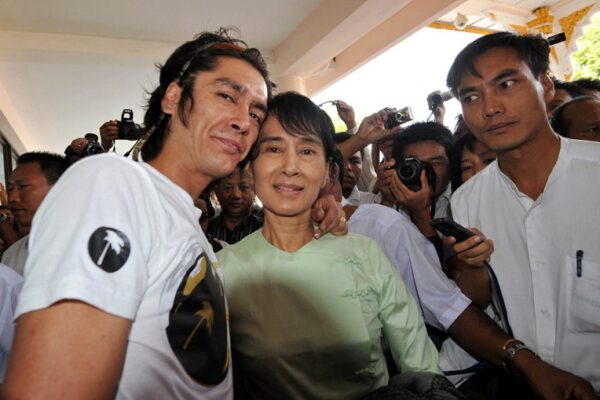
In mid-January, Kim Aris received a letter from his mother, Aung San Suu Kyi, the former de facto leader of Myanmar and Nobel laureate who is serving a 27-year prison sentence.  It was the first public communication from her since late 2022, when the junta barred her legal team from visiting her in prison, and the first time he had heard from her since before the Feb. 1, 2021, coup d’etat that removed the democratically elected government from power. After the coup, the ruling junta sentenced Suu Kyi to 33 years in prison on 19 charges, including corruption. In August, her sentence was reduced to 27 years after she was pardoned for five cases. Suu Kyi, 78, is suffering from medical and dental problems, including gingivitis, sources have told Radio Free Asia, but the junta has denied her outside medical treatment. On Jan. 21, Myanmar’s Supreme Court ordered the auction of her family lakeside villa in Yangon, where she spent more than 15 years under house arrest. The starting price is US$90 million. There is a decades-long ownership dispute between Suu Kyi and her estranged older brother, Aung San Oo, who says the house is his. Last year, Aris, 47, who is based in the United Kingdom, began a new campaign to free her by trying to draw worldwide attention to her incarceration. In an exclusive interview, RFA Burmese reporter Soe San Aung spoke with Aris. The content has been edited for length and clarity. RFA: What is your reaction to the junta’s plans to auction off your mother’s house at 54 University Avenue Road in Yangon?  Aris: I was sorry to hear that. This auction is going to go ahead. I know my mother was wanting to use that property for her charities in the future, but at the moment she has no say in what’s happening since she’s locked up, and she’s not even allowed to see her lawyers. So, I know that in the past, she has contested my uncle’s claim on the property, and I know that she would still do so if she had freedom. RFA: How was Suu Kyi planning to use the property for charities? Aris: I don’t know exactly what she was going to use it for, but she set up the charity in her mother’s name, the Daw Khin Kyi Foundation. I knew it was going to be used for that, but I believe the military has stripped her of all the assets that she has built up for those various charities. So, I don’t know what’s going to happen there. Aung San Suu Kyi and her son Kim Aris, left, at the airport in Bagan before flying back to Yangon on July 8, 2011. (Soe Than Win/AFP) RFA: Can you recall any memories you have of the house? Aris: I have many memories of that house going back to before my grandmother died. And then, obviously, I was there when my grandmother was dying and for her funeral. When [my mother] was first put under house arrest, I was there as well. And I’ve been back since she was freed from house arrest. So, I have good memories of that house.  Even though some of those memories may not sound that good, they’re good memories for me. For instance, being with her when she was put under house arrest. It may not sound like a particularly good time, and it wasn’t a good time, but it’s still a good memory for me. Aung San Suu Kyi’s family home is seen on the banks of Inya Lake in Yangon, Nov. 12, 2010. (Reuters) RFA: Have you heard anything about the care package that you sent to your mother last year? Aris: I sent a care package last year when we heard that she was not well, and I was given the go-ahead to send a care package. She finally received that at the end of last year, and I received a letter back from her this month. This is the first I have heard from her since before the coup. RFA: What did the letter say? Aris: It’s just to do with family and to say that the care package arrived safely. There’s really very little to say. It’s just sending love to the rest of the family and saying that she’s in good spirits. Her spirit is strong, even if her health is not as good as it was in the past. RFA: Has the junta contacted you about your request to meet with your mother? Aris: No, they haven’t contacted me at all. I’m still trying to have contact with her regularly, hopefully. But, so far we have only managed to have this one communication. Aung San Suu Kyi holds the hand of her younger son Kim Aris after his arrival at Yangon airport on Nov. 23, 2010. (Soe Than Win/AFP) RFA: Is she in good health? Aris: I believe she is in reasonable health. I think she has ongoing issues with her teeth and with problems with her neck as well. So, I know she has some of the ongoing health concerns. RFA: How did you get the letter? Aris: Through the British Foreign Office. RFA: When did you receive it? The date when I got the letter was about two weeks ago, so in mid-January. RFA: What was written in Aung San Suu Kyi’s handwriting? Aris: Yes, it was photocopied, and they emailed me the photocopy. I now have the hard copy in my hands as well. RFA: It’s almost been three years since the military coup d’état and the subsequent fighting between junta and resistance forces and ethnic armies. Where’s this heading? Aris: Well, I hope that the fighting will stop. It’s been going on for far too long as it is. I know that my mother would be desperately sad to see the situation the country is in at the moment. It’s very hard to say from the outside. It’s very hard to see…

Read More