Another brick wobbles in China’s Great Wall of debt

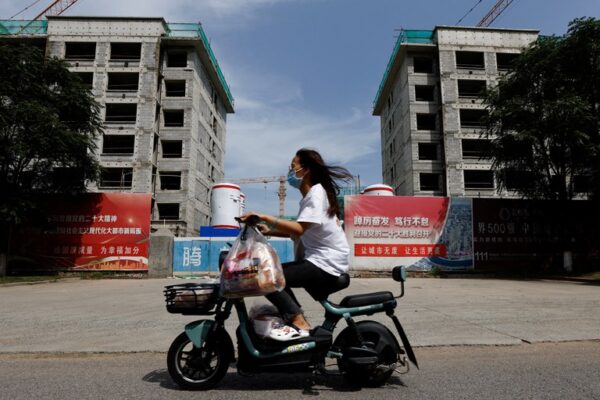
As China’s economic miracle has unraveled over the past several years, property giant Country Garden Holdings appeared to be an unassailable fortress redoubt. Rival Evergrande tried to restructure its debt, failed, and now its founder, Hui Ka Yan, once the richest man in China, is under house arrest. But Country Garden, until very recently, was considered safe as houses. On Tuesday the walls of the Country Garden redoubt crumbled, as the property giant missed a HK$470 million (US$60 million) loan repayment and issued a statement on the Hong Kong Stock Exchange warning that it wasn’t going to be able to repay all of its creditors – not even those that had extended it a grace period. The company has about US$200 billion in liabilities and close to US$10 billion in debt, it said in the Tuesday statement. “I think it’s not so much ‘final straw’ as ‘high profile symbol’ of the structural reversal in China’s property market bust. But it’s also possible that because of that, confidence in this fragile market will be further undermined,” said George Magnus, research associate at the China Centre, Oxford University, and the School of African and Oriental Studies in London. “The knock-on effects of a property bust in a market that’s as big as China’s are going to be remarkable,” added Magnus. “There simply isn’t anything that can compensate [for the problem] because nothing – least of all Xi’s new productive forces – is sufficiently big. It’ll keep the Chinese economy on a low-growth path with all the attendant consequences for unemployment, absent a major program of market reforms, which Xi is opposed to.” Chinese President Xi Jinping is famously opposed to “welfarism,” which he reportedly equates with laziness. A person rides a scooter past a construction site of residential buildings by Chinese developer Country Garden, in Tianjin, China Aug. 18, 2023. Credit: Reuters   Markets have found some solace in announcements emanating out of Beijing, suggesting that stimulus is on the way, but analysts are skeptical even though Hong Kong and Shanghai stocks rallied on Thursday, after China’s investment fund had bought a stake in the country’s banking giants. Bill Bishop of the widely read Sinocism newsletter commented, “The relatively small investment by Huijin in the four banks – 477 million RMB, about USD $65 million – is not meaningful financially,” adding that the investment fund Huijin had bought similar stakes in the past with the probable aim of achieving a short-term boost to stock values. ‘All the money in the world’ “They’ll respond with some stimulus but there isn’t enough money in the world to make a difference,” said Anne Stevenson-Yang, founder and research director at J Capital Research, “Consider,” she said: “If they lend an extra 1 trillion yuan (US$137 billion) – and bank lending is around 90% of financing in this economy – you get less than a 1% boost in credit. “Basically, so what?” Oxford’s Magnus agreed. “The speculation is that the central government will use its own balance sheet to announce a stimulus program of about 1 trillion yuan or about 0.7% GDP to breathe new life into the economy,” he said. “If it goes, as in the past, towards infrastructure and real estate projects, it’ll spur activity in the short term but leave China’s structural malaise worse. “What China needs is household demand and income stimulus, but this has been studiously avoided so far – and it’s not the CCP’s way.” Stevenson-Yang said, “We’re not going to see a bank failure, because they [the Communist Party] can control that. But the whole shadow sector has collapsed or is collapsing, and that erases a lot of personal wealth. “And local services are going away,” she added in a reference to the belt-tightening forced on local governments, which have even been reducing civil service salaries to make ends meet. Michael Pettis, Carnegie Endowment economist, writing on X, formerly known as Twitter, pointed out that there may be hidden liabilities for the banking sector with as-yet unknown consequences. “Mounting damage to banks’ balance sheets from the property meltdown could also make stabilizing other parts of the economy more difficult,” Pettis said. “This is likely to be what causes the most long-term damage to the economy … There is likely to be a lot more exposure in less direct forms. That’s because after three decades of soaring prices, it would be astonishing if Chinese banks didn’t have a lot of indirect exposure to the property market, partly reflected for example in the RMB 3.4 trillion in supplier trade payables estimated by Gavekal,” he wrote referring to research by Gavekal Research. The firm predicted that China’s property sector owes 3.4 trillion yuan in trade payables to their suppliers. “The major damage to the economy caused by a property sector collapse usually occurs not directly through the property sector but indirectly, through wealth effects and, above all, the impact on the banking system,” said Pettis. “With one of the biggest property sectors in history, and perhaps the most expensive real estate bubble since Japan in the 1980s, I’d be really surprised if we were near the end of the adjustment process.” Stability above all In its Tuesday statement Country Garden admitted, referring to its inability to meet debt commitments, “Such non-payment may lead to relevant creditors of the group demanding acceleration of payment of the relevant indebtedness owed to them or pursuing enforcement action.” A Chinese flag flutters in front of the logo of China Evergrande Group seen on the Evergrande Center in Shanghai, China September 22, 2021. Credit: Reuters   Property developer Evergrande’s collapse led to widespread “mortgage strikes” and protests China-wide in 2021 and 2022. The fear in Beijing is that Country Garden, which is heavily invested in third- and fourth-tier cities, where the economic crisis is at its worst, will lead to yet more protests. “The first and utmost priority of Xi and the CCP [Chinese Communist Party] is to maintain power, which means maintaining order and stability,” said Australia-based…

Read More

Chinese police harass family of Washington DC student activist

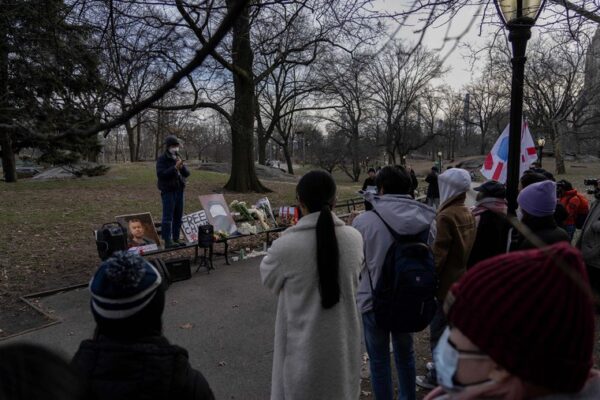
An international student in the U.S. capital has been harassed by China’s state security police for pro-democracy activism on American soil, with his loved ones back in China hauled in by police for questioning and told to get him in line, Radio Free Asia has learned. Zhang Jinrui, a law student at Washington’s Georgetown University, said his family in China received an unexpected visit in June from state security police, who interrogated his father about Zhang’s level of patriotism and questioned him about his activities in the United States. “The state security police knocked on our door and took my father away for lengthy questioning,” Zhang told Radio Free Asia in a recent interview. “[They asked him] ‘Does this child of yours take part in pro-democracy activities? Do they usually love their country and the [ruling Chinese Communist] Party?’” “If not, you have to teach him to love his country and the party better,” the police said. “It’s not OK that he’s doing this, and it won’t do any good.” Zhang’s experience comes amid growing concern over Beijing’s “long-arm” law enforcement targeting overseas activists and students, who had expected to enjoy greater freedom of speech and association while living or studying in a democratic country. Zhang said the questioning of his father came after he took part in protests in support of the “white paper” protest movement in November 2022, and against Beijing’s hosting of the Winter Olympics in February. There are growing concerns over Beijing’s “long-arm” law enforcement targeting overseas activists and students. Here, “Viola,” a New York University graduate student, delivers a speech during a gathering to mark the third anniversary of the death of Chinese whistleblower Li Wenliang in New York on Feb. 5, 2023. Credit: Gemunu Amarasinghe/RFA Yet he wasn’t contacted at the time by police, who sometimes contact overseas Chinese nationals via social media platforms to get their message across.  “On the evening of June 29, I suddenly received a WeChat message from my sister saying ‘Contact me urgently, something happened,’” Zhang said. “The people from the police station had called my sister and asked about her [relative] in Washington, wanting to know if they took part in the Torch on the Potomac group, saying I was a key member.” Fear and self-censorship Torch on the Potomac was set up by students at the George Washington University in April, to provide a safe space for dissident activities by Chinese students. But Zhang was nonplussed by the accusation, saying that the group has yet to organize any activities, and that police have also been harassing the families of Chinese students who haven’t taken part in any activism at all. Calls to the Wusan police station, which is close to Zhang’s family home in the northeastern Chinese city of Shenyang, rang unanswered during office hours on Sept. 19. Several other Chinese students declined to be interviewed when contacted by Radio Free Asia. Sarah McLaughlin, senior scholar at The Foundation for Individual Rights in Education, said speaking to the foreign media could bring down further trouble on the heads of students who may already have seen their families hauled in for questioning. “I know that that’s something that international students have run into before,” she said. “They’ve gotten in trouble when they returned home for things they’ve said online while in the United States.” McLaughlin said the harassment of their families in China will have a chilling effect on students’ speech, even overseas. “There are definitely some real fears among these students, and there’s definitely self censorship,” she said. Classroom informants And the police aren’t the only source of such anxiety – there is also the risk of being reported by fellow students from China, who are encouraged via the Chinese Students and Scholars Associations to keep an eye on each other. A Georgetown University faculty member who asked to remain anonymous said the problem is becoming more and more serious, with Chinese students feeling unable to speak freely in class, for fear of being informed on by their Chinese classmates. Georgetown University student Zhang Jinrui says he was harassed by members of the Georgetown branch of the Chinese Students and Scholars Association as he was distributing flyers. Credit: Gemunu Amarasinghe/RFA Last year, when students at George Washington University put up posters on campus opposing China’s hosting of the 2023 Winter Olympics, the Chinese Embassy sent members of the campus branch of the Chinese Students and Scholars Association to tear them down again and put up posters denouncing their actions. “They even got in touch with the school, saying that the Chinese students who support democracy and oppose zero-COVID are racist,” Zhang said. “That’s why they set up the Torch on the Potomac, because a lot of their activities weren’t getting the support of the school.” George Washington University President Mark Wrighton admitted in a Feb. 8 statement that the removal of the posters was a mistake, and the university administration should have waited until they better understood the situation before acting. “We began to receive a number of concerns through official university reporting channels that cited bias and racism against the Chinese community,” Wrighton said. “I also received an email directly from a student who expressed concerns.” “I have since learned from our university’s scholars that the posters were designed by a Chinese-Australian artist, Badiucao, and they are a critique of China’s policies,” he said. “Upon full understanding, I do not view these posters as racist; they are political statements.” Neither Georgetown University nor George Washington University had responded to requests for comment on the renewed harassment of Chinese students in the United States by Sept. 19. A wall with posters at Georgetown University in Washington. Torch on the Potomac was set up by students at the George Washington University in April, to provide a safe space for dissident activities by Chinese students. Credit: Gemunu Amarasinghe/RFA Close contact with embassies Zhang said he has also been personally harassed by members of the Georgetown branch of the…

Read More

Vietnam wants it all in balancing its ties with the US and China

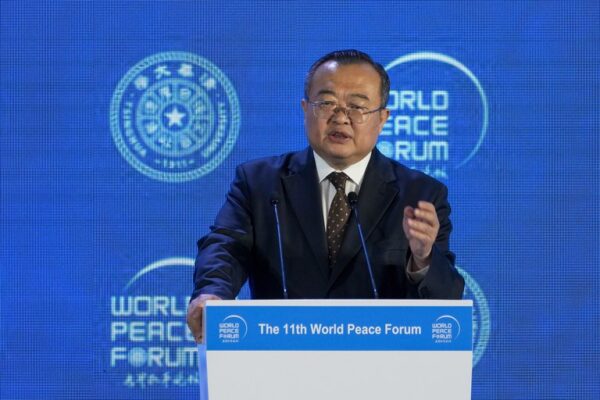
President Joe Biden is heading to Vietnam for a visit that will upgrade bilateral relations to a “strategic comprehensive partnership,” a symbolic step that opens the door to wider cooperation between former Cold War foes who are now grappling with an assertive, powerful China.  The elevated status is a symbolic gesture that recognizes the developed state of U.S.-Vietnam ties, almost 30 years after they normalized diplomatic relations and a half century since the end of the Vietnam War.  But it doesn’t reflect a fundamental change in Vietnamese policy. Indeed, it should be seen as a manifestation of what Hanoi calls its omnidirectional and independent foreign policy. The overall growth of the relationship will remain hemmed in by the fact that the communist leaders who run Vietnam share  the same world view as those who control China. In a partnership hierarchy created by the Vietnamese government, at the very top are neighbors Laos and Cambodia. However, what was once Vietnam’s secure western flank is now a source of concern with China’s surge in influence through investment, lending, development projects, and corruption. Comprehensive strategic partnerships had been reserved for Vietnam’s friends since the days of the revolution: Russia, China, and India. In 2023, in recognition of their burgeoning economic relationship, Vietnam elevated South Korea to that pantheon, recently followed by Singapore and Australia, and soon Indonesia. Liu Jianchao [shown], the head of the Communist Party of China’s International Liaison Department, recently met with General Secretary of Communist Party of Vietnam, Nguyen Phu Trong. Credit: Andy Wong/AP file photo For the U.S., the leapfrog from Vietnam’s comprehensive partner to a comprehensive strategic partner is important for three reasons. First, for top leaders in Hanoi, symbolism does matter. That a former foe is now on a par with revolutionary era friends is a win.  Second, this upgrade will not please China, even though Hanoi has worked assiduously to try to convince Beijing that it is maintaining its independent foreign policy. It is inconceivable that Hanoi has not briefed Beijing on this, and Communist Party of Vietnam General Secretary Nguyen Phu Trong has made party-to-party ties stronger than ever. He would not have approved the relationship upgrade if he felt insecure by Beijing’s reaction.  Five days before Biden’s expected arrival this weekend, Liu Jianchao, the head of the Chinese Communist Party’s  International Liaison Department met with Trong, who no doubt gave him further assurances. While Washington may want to rankle Beijing, which has overplayed its hand in the region with its aggressive South China Sea behavior and hawkish “Wolf Warrior” diplomacy, its real goal is to see Vietnam be strong enough to assert its vaunted autonomous foreign policy.   Hanoi will no doubt be sending a politburo-level delegation to assure Beijing that the upgrade is not a lurch towards the United States or in any way anti-Chinese, but a manifestation of Vietnam’s independent and omni-directional foreign policy. Third, at the bureaucratic level, it’s hoped that the upgrade gives political top cover for the line ministries to increase their cooperation with U.S. counterparts across a range of issues, from countering narcotics and human trafficking to security cooperation.  The upgrade does not automatically lead to more market access, more trade and investment, more port visits and other military engagements, but it won’t hurt their prospects either. In short, this upgrade is long overdue, and reflects the fact that the U.S. has far deeper ties than many other states ranked above it.  An economic imperative  The upgrade comes as Vietnam’s economy is slowing dramatically. Despite 8.5% growth in 2022, GDP only grew by 3.72% in the first six months of 2023, half the target. The Asian Development Bank and IMF have lowered their annual forecasts to 5.8% and 4.7%, respectively. While Vietnam has benefitted from corporate supply chain diversification out of China, that trend has also made the economy over-dependent on exports, which have fallen for five consecutive months, the longest slump in 14 years. In July, exports fell 3.5%. Industrial production contracted 1.8% in the first half of 2023, causing a 13% year-on-year increase in industrial layoffs. While Vietnam enjoys a large trade surplus with the U.S. – $44.3 billion in the first seven months of 2023 – that is down 24% year-on-year. Vietnam runs enormous trade deficits with China, as its manufactured goods are highly dependent on imported Chinese components. Without its exports to the U.S., Vietnam would run chronic trade deficits. As a direct foreign investor, the U.S. lags behind South Korea, Singapore, China, and Japan. In early 2023, Boeing announced a production facility, while Apple shifted an iPad production line out of China to Vietnam. But there’s plenty of room for growth. We should also not lose sight of portfolio investment from the U.S., where one fund alone has invested $1.5 billion in six projects.  An employee works at Heesung Electronics Vietnam factory in Hai Phong, Vietnam, Aug. 29, 2023. Vietnam’s economy is slowing, with GDP growth of only 3.72% in the first six months of 2023. Credit: Nhac Nguyen/AFP Corporate Vietnam is trying to make a splash in the U.S.. Electric vehicle maker VinFast broke ground on a $4 billion plant in North Carolina, and has seen wild stock valuations after its recent listing on NASDAQ. VinFast sees the United States as the key to its growth, if not viability, despite a rocky first nine months that saw few sales and a recall. The tech firm VNG, Vietnam’s first “unicorn,” has filed paperwork for its listing on NASDAQ. If Vietnam is to escape the middle-income trap, it’s through trade and investment ties with the U.S., not China. To that end, executives from a swath of U.S. semiconductor and other tech industry will be joining Biden’s trip. What remains missing in U.S. policy towards the Asia-Pacific is an economic architecture. Since the withdrawal from the Trans-Pacific Partnership in January 2017, the United States has abdicated its leadership. States are going along with the Indo-Pacific Economic Framework for Prosperity (IPEF) , but only to keep Washington…

Read More

Philippine officials release footage of sea standoff, as senator pushes for inquiry

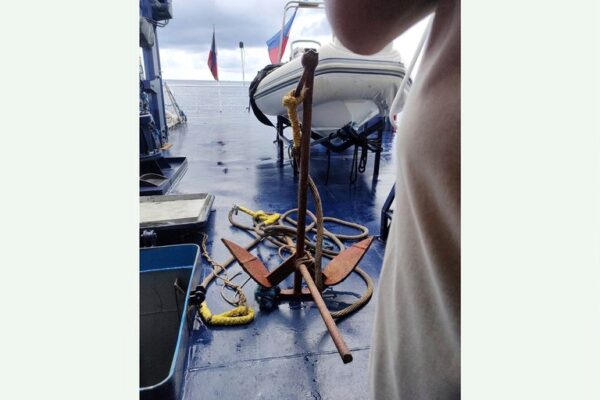
A senator called Wednesday for an inquiry into how the Philippines could strengthen control of its South China Sea territory, as the coast guard released footage from a standoff between Filipino and Chinese ships in disputed waters a day earlier.  The videos showed a convoy of Philippine boats and ships as they maneuvered past the China Coast Guard while sailing on a resupply mission to a remote military outpost in Ayungin Shoal (Second Thomas Shoal) in the Spratly Islands.  Two Philippine Coast Guard (PCG) ships, the BRP Cabra and BRP Sindangan, escorted the convoy. They had arranged a rendezvous with civilian boats contracted by the military on Monday before setting off for Ayungin Shoal the following day, Commander Jay Tarriela said.   The PCG spokesman challenged Chinese claims that its ships allowed the supply mission to proceed peacefully, and said that when the Philippine ships were within 2.5 nautical miles of reaching the shoal “we experienced dangerous maneuvers by four China Coast Guard vessels backed by four Chinese maritime militia.  “They executed different ways for the Philippine Coast Guard to be separated from the supply boats so that they would be able to prevent (them) from entering the shoal,” Tarriela told reporters.  Also on Wednesday, Sen. Risa Hontiveros alleged that the People’s Republic of China had continued to militarize portions of the West Philippine Sea, despite international condemnation. Manila uses that name for South China Sea waters that lie within its territory. During a speech in the Senate, Hontiveros called “for an inquiry, in aid of legislation, into further capacitating and empowering the Philippine Coast Guard to enable it to carry out its primary mission of enforcing Philippine law and upholding national sovereignty within the country’s maritime zones, particularly the West Philippine Sea.” China’s actions, she said, had led to an “unprecedented challenge to the Philippine Coast Guard’s primary mission of enforcing Philippine law, maintaining the country’s sovereignty and upholding vital national interests. In Beijing on Wednesday, China’s foreign ministry called on the Philippines “to immediately stop any actions that may complicate the situation on the ground.  “Let me stress that in response to what the Philippines did, China Coast Guard took necessary law enforcement action in accordance with the law,” ministry spokesman Wang Wenbin said.  Tuesday’s incident followed one about two weeks ago where the China Coast Guard fired water cannons at the BRP Sierra Madre, a World War II-era ship deliberately run aground by the Philippines to serve as its military outpost in Ayungin Shoal.  The shoal is about 200 km (124 miles) from the western Philippine island of Palawan, and more than 1,000 km (621 miles) from China’s nearest major landmass, Hainan island. “Now, it has become clear that China has her eye on Ayungin Shoal. The water cannons, the military laser, the removal of a naval gun cover – all these severe provocations were against Philippine vessels making their way to Ayungin,” Hontiveros told the Senate on Wednesday. “China is actively blocking these missions because she does not want any further reinforcement to our most defiant sovereign marker in the West Philippine Sea, the BRP Sierra Madre.” Videos On Wednesday, Tarriela presented a video that showed a China Coast Guard ship blocking a Philippine Coast Guard ship from entering the shoal.  A second Chinese ship was positioned to intercept the Filipinos in case they got through the first cordon, the video showed.  “There are also other videos that we have showing that our supply boats were being blocked by China Coast Guard vessels and the four Chinese maritime militia,” he said.  “Well, this time our game plan really was to outmaneuver the China Coast Guard vessels … and make sure that the supply boats would be successful in entering the shoal,” Tarriela said.    A U.S. Navy plane flies over the Ayungin Shoal during a Philippine resupply mission to the BRP Sierra Madre, Aug. 22, 2023. Credit: Aaron Favila/AP     The Chinese ships issued radio challenges and warnings that said Beijing had “indisputable sovereignty” over the sea region, according to officials. The Chinese ships said they were allowing the Philippine Coast Guard and the supply boats to pass through “in the spirit of humanism.”  “[W]e don’t need permission from the People’s Republic of China and Ayungin Shoal is within our exclusive economic zone. We have the sovereign right over these waters,” Tarriela said. “Secondly, it is not true that they are humane or extended humanitarian assistance.” Journalists who traveled with the Philippine Coast Guard on Tuesday posted photos of a U.S. Navy P-8 Poseidon patrol and reconnaissance plane flying overhead during the resupply mission.  In Washington on Wednesday, officials at the Pentagon did not immediately respond to a BenarNews request for comment about the flight. On Monday, U.S., Australian and Philippine troops held an air assault drill in Rizal town, in the western island province of Palawan, about 108 nautical miles from Ayungin Shoal. BenarNews is an Ijreportika-affiliated online news organization.

Read More

Pacific island countries facing faster sea level rise, UN says

The low-lying Pacific islands face severe threats due to rising sea levels, which are increasing quicker than anticipated, while heightened temperatures impact marine habitats, according to a new U.N. meteorological body report. The Pacific region is experiencing an approximate increase of 4 millimeters of sea level rise annually in certain regions, which is higher than the worldwide average of 3.4 mm per year, the World Meteorological Organization, or WMO, said in its 2022 State of the Climate report released on Friday. The Pacific islands most vulnerable to this rising sea level include nations such as Kiribati, Tuvalu, the Marshall Islands, and the Maldives. These low-lying nations, often no more than a few meters above sea level, are alarmingly at the forefront of this crisis. Their unique geographies and limited land mass make them especially susceptible to even the slightest increase in sea level, threatening their very existence and the livelihoods of their residents. Separately, the report added that ocean heat and acidification threaten vulnerable marine ecosystems and their way of life. It said that weather-related disasters and climate change impacts are posing socio-economic risks and effects on key sectors like agriculture in the South-West Pacific region, which comprises all countries between Malaysia and Kiribati. The ocean absorbs over 90% of the surplus heat in our climate system, the WMO said, as the warming is responsible for about 40% of the average global sea-level increase due to the thermal expansion of seawater. It also impacts ocean currents and storm patterns. In 2022, the South-West Pacific experienced 35 recorded natural disasters that killed more than 700 people, with floods accounting for over 70% of these incidents, according to the report. These events impacted over 8 million individuals, inflicting an economic toll nearing U.S.$9 billion. In the Philippines and Fiji, storms were the predominant reason for the high death toll and the many affected individuals. A woman walks past a flooded market caused by monsoon rains and the recent typhoon Doksuri, in Balagtas, Bulacan province, Philippines, July 29, 2023. Credit: Reuters Even though the number of reported disaster events decreased in 2022, economic losses increased mainly due to a series of flooding events in Australia. Last year’s flood damage of U.S.$8.5 billion was over four times the 20-year average from 2002 to 2021. “Early warning is one of the most effective ways of reducing damage from disasters, as it empowers people to make risk-informed decisions for food security, as well as other sectors,” said WMO Secretary-General Petteri Taalas. “Despite continuous efforts to strengthen multi-hazard early warning systems, the present report clearly shows that there are still significant gaps to be addressed to strengthen these systems to reduce the adverse impacts of hydrometeorological hazards in the region.” El Nino this year might make it worse The WMO said the three-year-long La Nina event, from 2020 to the start of 2023, had a temporary cooling influence, though 2022 still ranks within the top ten warmest years for the region, with the mean temperature of 0.2 to 0.3 degrees Celsius higher than during the last intense La Nina event in 2011. The report said that prominent marine heatwaves persisted for over six months in a vast region northeast of Australia and south of Papua New Guinea, specifically in the Solomon and Coral Seas. The region has now entered El Nino, which means drier and hotter weather. “This will have a big impact on the South-West Pacific region as it is frequently associated with higher temperatures, disruptive weather patterns and more marine heatwaves and coral bleaching,” said Taalas.  According to the WMO, the upper ocean (between zero and 700 meters below the surface) has warmed since 1993 in most of the Pacific’s South-West region. The report said that many regions in the Pacific region, including the Solomon Sea, Banda and Timor Seas, and regions east of the Philippines and the southern shoreline of Indonesia, have experienced significant warming, with the rates two to three times higher than the global average. The WMO said the glacier size in the western part of the Indonesian island of New Guinea decreased by 15% from 0.27 to 0.23 square kilometers between July 2021 and April 2022, while ice thickness dropped 24 meters from June 2010 to early 2021, with only 6 meters remaining in December 2022. July had warmest ocean temperature Earlier this month, another report from the European Union’s Copernicus Climate Change Service, or C3S, said the global average sea surface temperatures continued to rise after a long period of unusually high temperatures since April 2023, reaching a new high of 20.96 degrees Celsius (69.73 degrees Fahrenheit) in July. Global ocean temperatures are usually warmest in March, so scientists say the record will likely keep increasing. Overall, the global mean sea surface temperature for the month surpassed the 1991-2020 average by 0.51 degrees Celsius, Copernicus said in its report on July 8. For July, the North Atlantic recorded temperatures of 1.05 C higher than usual, while marine heatwaves were observed south of Greenland, in the Labrador Sea, within the Caribbean region, and throughout the Mediterranean Sea. “These records have dire consequences for both people and the planet exposed to ever more frequent and intense extreme events,” said Samantha Burgess, Deputy Director of the C3S. “2023 is currently the third warmest year to date at 0.43ºC above the recent average, with the average global temperature in July at 1.5°C above pre industrial levels.” “Even if this is only temporary, it shows the urgency for ambitious efforts to reduce global greenhouse gas emissions, which are the main driver behind these records,” she said. July also had the warmest global air temperature, according to the WMO. Edited by Mike Firn and Taejun Kang.
Read More

Will US break APEC rules if Hong Kong leader barred from summit?

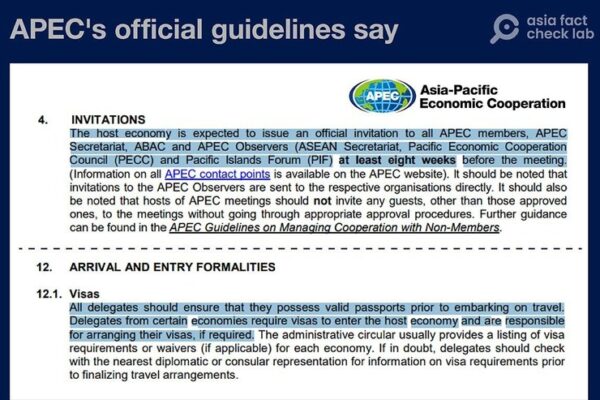
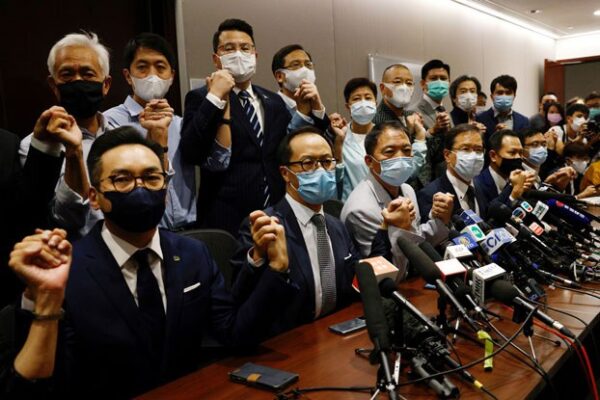
Chinese authorities claimed that it would be a “violation of Asia-Pacific Economic Cooperation (APEC) rules” if the United States bars Hong Kong Chief Executive John Lee Ka-chiu from attending the APEC leaders summit in San Francisco in November. The claim came after media reports that Washington plans to prohibit Lee from attending the meeting of 21 regional economies.  But the claim is misleading. APEC guidelines state visiting delegates are responsible for arranging their visas if they require them. The Hong Kong leader is under sanctions that bar his entry into the U.S. In a report published on July 27, The Washington Post cited unnamed White House officials as saying that the U.S. has decided to bar Lee from participating in the APEC Economic Leaders’ Meetings (AELM) to be held in San Francisco from Nov. 15  to 17, 2023.  In response to the report, Chinese Foreign Ministry spokesperson Mao Ning said that refusing to invite Lee due to current U.S. sanctions against him was a mistake which “blatantly violates APEC rules and gravely contravenes the U.S. commitment as the host.” Lee currently cannot obtain any U.S. immigrant or non-immigrant visas due to an earlier U.S. presidential order and subsequent sanctions imposed on him and 10 other Hong Kong officials implicated in a 2020 government crackdown against democracy protestors. Hong Kong’s government pointed out in a separate statement that as the host of AELM, the U.S. had a basic responsibility to invite Hong Kong’s leader to the meeting. However the claim is misleading. Below is what AFCL discovered.  Is the AELM host responsible for inviting the leaders of all APEC members? Yes. Article 4 of APEC’s guidelines for hosting meetings state that the host is supposed to send official invitations at least eight weeks in advance of the meeting, after deciding upon the meeting’s location and time.  The guidelines also say: “APEC Leaders implicitly understand that they are invited to attend this meeting; the letter of invitation from the host economy’s leader is simply a formality.”  But Matthew Goodman, a former National Security Council staff member who personally helped prepare for APEC meetings, told AFCL that APEC’s guidelines are neither related to international law nor legally binding. The explanation of rules concerning invitations and visa preparations for countries participating in APEC meetings. (Screenshots taken from APEC’s official website) Will invited representatives always be able to attend AELM? No. Section 12 of the guidelines states that all delegates invited to attend APEC meetings are responsible for arranging any required travel documents themselves. The section does not state that the host is required to issue them visas or waive policy or laws that would prohibit a person from entering its borders.           “Given that the domestic laws of host countries must be respected, it isn’t right to claim that the U.S. is violating APEC’s rules,” Goodman says.     What will happen to Lee? Unknown. A State Department spokesperson told AFCL that members of a foreign delegation must abide by U.S. laws and regulations when participating in APEC activities.  “The U.S. will work with Russia and Hong Kong to ensure they participate in AELM ‘in an appropriate way’,” said the spokesperson without elaborating further.  Russian President Vladimir Putin is in a similar situation to Lee as a result of U.S. sanctions put on him following the start of the Russo-Ukrainian war in 2022.  This means Both Lee and Putin would need to secure a special visa waiver from the U.S. in order to attend this year’s AELM in San Francisco.  The APEC Secretariat has not responded to inquiries about Hong Kong and Russian leaders as of press time. Meanwhile, a spokesperson from Hong Kong’s Chief Executive Office reiterated its earlier call on the U.S. to abide by APEC’s rules when inviting leaders to attend AELM.  “Hong Kong will attend the APEC meeting in accordance with APEC rules, guidelines and practices,” the spokesperson told AFCL. APEC guidelines state that representatives can remotely attend AELM and other preparatory meetings leading up to the conference.  Is there a history of a host refusing to invite APEC member economies to AELM?  Yes – particularly in the case of APEC member Chinese Taipei, as Taiwan is referred to by the 21-member grouping. China strongly objects to Taiwan’s participation as it regards the island as part of China although Taiwan is self-governing.  When China hosted AELM in 2001, it did not invite any Taiwanese representatives, despite then-Taiwanese President Chen Shui-bian’s expressed desire to attend in person. South Korea, the host of AELM in 2016, also refused to invite then-President of Taiwan’s Legislative Yuan Wang Jin-pyng to the meeting, requesting that Taiwan instead send an economic official rather than a political figure.  Australia, which hosted AELM in 2007, rejected Tsai Ing-wen, who had just left her position as vice premier of Taiwan’s Executive Yuan, for similar reasons. Former Taiwanese President Chen Shui-bian expressed regret and dissatisfaction over China’s refusal to allow Taiwan’s delegates to attend the APEC meeting (Screenshot taken from the official website of Taiwan’s Office of the President) Translated by Shen Ke. Edited by Taejun Kang and Mat Pennington. Asia Fact Check Lab (AFCL) is a new branch of RFA established to counter disinformation in today’s complex media environment. Our journalists publish both daily and special reports that aim to sharpen and deepen our readers’ understanding of public issues.

Read More

Did US falsify medal tally in the 2023 World Aquatics Championships?

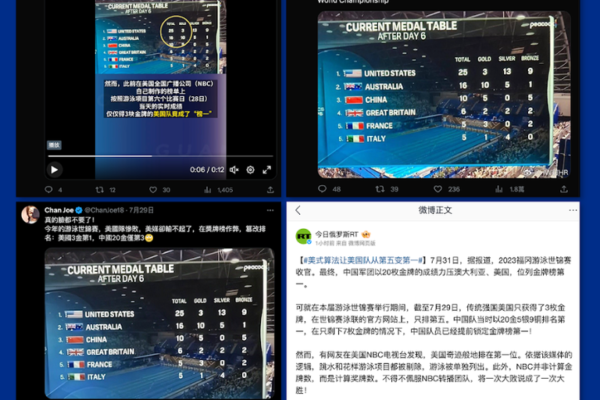
A screenshot taken from a broadcast of the 2023 World Aquatics Championships has been repeatedly shared in Chinese-language social media posts that claim it shows U.S. media had falsified the country’s final rank in the international championships. But the claim is false. The screenshot only shows partial results for the swimming match – one of the competition’s six disciplines, not the final ones for all events, where China ended with the most gold medals. A tweet posted by a user @ChanJoe18 on July 29 reads: “Rigging the standings, falsifying the rankings: U.S. ranks first with 3 gold medals, China only ranks third with 20 gold medals.”  The claim was accompanied by a screenshot of a medal table of the 2023 World Aquatics Championships, which shows the U.S. ranked first, Australia second and China third by total medals.  The same screenshot alongside similar claims has also been shared in Chinese-language social media posts as well as state media reports in China and Russia.  The international championships were held in Fukuoka, Japan, between July 14 and 30, 2023, with a total of 75 medals awarded across six disciplines: swimming, artistic swimming, open water swimming, diving, high diving, and water polo.   Although it’s a subject of debate whether nations should be ranked by total medals won, rather than gold medals won, there was no factual error in the screenshot, which was misrepresented in these social posts. So the claim is false. A widely circulated post on Chinese social media claimed that U.S. media falsified the results of the 2023 World Aquatics Championships, with Chinese and Russian official media soon claiming the U.S. was “fooling itself.” (Screenshots taken from Twitter and Weibo) Origin of screenshot Through keyword searches, AFCL found the identical screenshot published on July 28 in a tweet by the founder of swimming news outlet SwimSwam, Braden Keith. A logo and text included in the screenshot show that it was taken from a broadcast of the competition on the NBC streaming platform Peacock. NBC is the oldest of the three major traditional American television networks and covers major sporting events.  “Today, NBC and USA Swimming officially waived (sic) the white flag at the end of finals by changing their medals table graphic to a total medals sort,” said Keith, pointing out the broadcaster’s move to rank nations by total medals won rather than by gold medals won. Some netizens joined him in mocking how the medals tally was presented. According to the medals table in the screenshot, the U.S. leads the tally with a total of 25 medals, despite earning fewer gold medals than Australia and China.  Braden Keith, editor-in-chief of a swimming news outlet SwimSwam, posted the tweet which contained the screenshot later spread by Chinese netizens. (Screenshot taken from Twitter) Not final results AFCL found that the screenshot only displayed results from the first six days of the nine-day swimming match at the championships, and is clearly marked as such. The medal counts depicted in the screenshot correspond to the official tally between July 22 and July 27.   The championships concluded on July 30 with China leading the medal tally in all disciplines with 20 gold medals followed by Australia and the U.S. in second and third place, respectively.  Translated by Shen Ke. Edited by Taejun Kang and Mat Pennington.  Asia Fact Check Lab (AFCL) is a new branch of RFA established to counter disinformation in today’s complex media environment. Our journalists publish both daily and special reports that aim to sharpen and deepen our readers’ understanding of public issues.

Read More

Activist says he’ll continue to struggle for democracy in Vietnam

Radio Free Asia interviewed 74-year-old Australian citizen and democracy activist Chau Van Kham after his release from a Vietnamese prison last week. He was arrested in 2019, hours after he arrived in Vietnam and met with a fellow pro-democracy activist. He was sentenced to 12 years in prison for “terrorism aimed at toppling the people’s administration.” Kham was a member of Viet Tan, a pro-democracy group with members inside Vietnam and abroad. It has been described by the Office of the United Nations High Commissioner for Human Rights as a moderate activist group advocating for democratic reform. Hanoi claims it is a terrorist organization that aims to topple the government. Kham suffers from glaucoma, high blood pressure and kidney stones, according to Viet Tan. His release came on humanitarian grounds “in a spirit of friendship” between Canberra and Hanoi, according to Australian Deputy Prime Minister Richard Marles, CNN reported. He returned home to Sydney on July 25. RFA: You have just returned home. Please tell us your thoughts about being released? Chau Văn Kham: My first emotion is only after leaving the Vietnam Airlines plane do I truly feel that I have freedom. My emotions were lifted when I saw my wife and my younger brother at the airport, and at the same time the reception of Mr. Chris Bowen, representative of the Australian prime minister.  I remembered those who struggle and are still in prisons under the communist regime, especially those who fight for freedom and democracy for Vietnam. RFA: The Vietnamese government accused you of “terrorism against the people’s government.” The government said that the activities of the Viet Tan Party were characteristic of “terrorism.” Could you tell us what you have done in Vietnam that they would accuse you of such a severe charge? Chau Văn Kham: When I went to Vietnam through Cambodia, I had a bag in which there were only a pair of clothes and several pairs of underwear. No documents, no leaflets, no laptops. And I used a very old mobile phone. During the time I stayed in Vietnam, I didn’t do any activities that they could accuse me of being terrorism. During the investigation process, police decided to prosecute me with “having activities to protest against the people’s government.” But after some months, the investigative agent told me that the government didn’t see any activities of me in that purpose so the government lowered the crime down to “terrorism.”  I thought that the “terrorism” crime was heavier than “having activities to protest against the people’s government,” but I didn’t dispute what he said. But they still couldn’t find any activities to accuse me. They told me that when I sat by the Bach Dang River, it was to investigate how to attack vessels on the river. I told them that I used to be a Navy sailor, and I went there to have coffee with my friends and to remember the past. I just laughed at such an accusation. The investigative agents showed me online photos of the Viet Tan Front with guns. I explained to them that such photos with armed guerrillas were for propaganda purposes, not for attacking. I myself know well that the Viet Tan Party, announced to the world its existence in 2004, had a non-violence policy that was announced in 2007. I joined the Viet Tan in 2010. Vietnamese-Australian democracy activist Chau Van Kham [left] is escorted into a courtroom in Ho Chi Minh City, Vietnam, Nov. 11, 2019. (Credit: Vietnam News Agency/AFP) RFA: Could you tell us what you did in Vietnam, and what evidence and any grounds they used to prove that you did terrorist acts? Chau Van Kham: In fact I didn’t do anything that could be seen as terrorism. They used an announcement on the website of the Ministry of Public Securities that said Viet Tan was a terrorist organization since 2017. They asked me if I heard about that. I replied that I had heard but I didn’t care. They asked why. I replied to them with these reasons: Firstly, Viet Tan operates all over the world, even in Vietnam, and only Vietnam accuses Viet Tan a terrorist organization. Secondly, the announcement on the website of the Ministry of Public Securities had not been adopted into law. If there had been a law naming the Viet Tan as a terrorist organization, the Australian government would have known and would have ended our operation. But at court, when I explained this, the chief judge slammed his hand on the table saying that I came to Vietnam and Vietnamese law applied. RFA: Why do you think Vietnam has accused Viet Tan of being a terrorist organization – a very severe accusation – while others have been accused as being “anti-people’s government” organizations? Châu Văn Kham: To many Vietnamese inside the country, “terrorism” means “death, sorrows, breaking down, back to the terrible time of war.” Even me, as a war veteran, when mentioning war, I feel appalled. As a result, any organizations that would bring about such things would be avoided.  The purpose for accusing me as a terrorist was to create the thinking of “deaths, sorrows.” It was completely wrong. The evidence was aired on state television stations at least five days a week during prime time. News about terrorism and deterioration to corruption was aired, and the Viet Tan Party was always mentioned. In the prison, other cellmates asked me what I had done to become jailed with terrorist charges. I told them, “Look at me – a small guy with a meek personality. How could I terrorize others?” It was just the Vietnamese government’s propaganda.  Now, in my opinion, the only force that can counter Vietnam’s government for the time being is the Viet Tan Party. So, by all means, they try to destroy our prestige, making Vietnamese people avoid us.    I would add the purpose of my trip to Vietnam was to do fact-finding about the real human rights situation…

Read More

Democrats question proposed part of AUKUS deal

A key part of the AUKUS security pact aiming to create a “seamless” defense industry across Australia, the United Kingdom and the United States appears at risk after congressional Democrats raised doubts about Canberra’s ability to protect U.S. military designs from China. The concerns were raised during a session of the House Foreign Affairs Committee on Wednesday, just days before U.S. Secretary of State Antony Blinken and Secretary of Defense Lloyd Austin arrive in Brisbane, Australia, for talks with their Australian counterparts. Democrats including Rep. Gregory Meeks of New York, the party’s ranking member on the committee, said that they opposed two bills introduced by the Republican majority to exempt Australia and the United Kingdom from the Arms Export Control Act of 1976. The law created the International Traffic in Arms Regulations, or ITAR, which forces foreign entities, except for those in Canada, to apply for licenses when importing sensitive U.S. defense technology.  Meeks argued that Australia and the United Kingdom could seek exemptions from the State Department under the standing law, and said a blanket exemption would circumvent important checks. “Prematurely lifting them risks compromising our national security by allowing unfettered transfers of our most sensitive defense technology including to private-sector foreign firms, which risk exposure to or theft by our most capable adversaries, especially China,” he said. The former committee chair pointed to Australian intelligence chief Mike Burgess’s comments earlier this year that more Australians are being targeted by foreign spies, due in part to the AUKUS pact. “The U.K. faces similar intelligence threats,” he said. Roadblocks Experts in Australia have warned that the U.S. arms-control laws are a roadblock to the so-called “pillar 2” of the AUKUS pact, which aims to create a “seamless” defense industry across the three countries and could be hampered by bureaucracy without a blanket exemption. Those concerns have been echoed by top Australian officials. Australia’s ambassador in Washington, Kevin Rudd, told a forum in Washington last month that the so-called “pillar 2” of AUKUS “could be even more revolutionary than the submarine project in itself” but said it had a “complex process” ahead of it to get through Congress. Britain’s Prime Minister Rishi Sunak [second right] walks during a meeting with U.S. President Joe Biden [second left] and Australian Prime Minister Anthony Albanese [left] at Point Loma naval base in San Diego, Calif., on March 13, 2023, as part of AUKUS. (Stefan Rousseau/Pool via AP) On Wednesday, Rep. Michael McCaul, a Republican from Texas who has served as chairman of the committee since the start of this year, said providing Australia and the United Kingdom similar exemptions as those given to Canada would cut “red tape” with minimal risks. “This licensing exemption will add more submarine capabilities to the South China Sea as we see a more aggressive China on the march,” he said. “It also removes restrictions on innovation, and collaborating on quantum computing, autonomous vehicles and long range weapons.” McCaul argued the 1976 law was “outdated” and from “a time when the U.S. dominated defense innovation in defense technology,” which he said was no longer. He noted the United States had “never denied a sale or license to Australia” after the lengthy approval process. “Times have changed,” McCaul said, “and we now need to rely on our allies and partners, many of which out-innovate us in key areas.” Five Eyes partner Wearing a koala pin on her lapel, Rep. Young Kim, a Republican from California who introduced the bill for the exemption for Australia, said she could not understand the Democrats’ reluctance. Kim, who titled the bill the “Keeping Our Allies Leading in Advancement Act,” or KOALA Act, said Australia had already proven itself a trusted partner as part of the Five Eyes intelligence pact that also includes Canada, the United Kingdom and New Zealand. “Australia is one of our closest allies and is one of our Five Eyes partners. We let the Australians have access to some of the most sensitive intelligence we have,” Kim said. “So why shouldn’t we expedite collaboration with them on sensitive technologies?”  Rep. Young Kim says Australia has already proven itself a trusted partner of the United States as part of the Five Eyes intelligence pact. (Ken Cedeno/Pool via AP file photo) It was disingenuous, the second-term lawmaker added, to “grant them access to some of our most sensitive intelligence but say we’re concerned that the Australians will let this technology fall into the hands of the CCP,” referring to the Communist Party of China. Kim also tabled a July 24 letter in favor of “an expedited AUKUS process” that she said was signed by a number of Obama administration officials including former director of national intelligence James Clapper and former Defense Secretary Chuck Hagel. McCaul summarized the letter as making the case “Australia has sufficient safeguards in place already” as a Five Eyes member, and dismissed the argument that Canberra and London can apply for Canada-like exemptions from the U.S. State Department. “State will not issue the exemption,” he said. “State has shown it will never certify Australia or the U.K. for an exemption, because it does not want to give up its bureaucratic power over licensing.” A State Department spokesperson declined to comment on the issue but pointed to May 24 testimony to the committee by Jessica Lewis, assistant secretary of state for political-military affairs, in which she suggested bulk approvals of AUKUS-related exemption requests. “Every transfer between AUKUS partners will not be subject to case-by-case review, but will be pre-approved” if the case meets certain criteria laid out by the State Department, Lewis said at the time. Charles Edel, the Australia chair at the Center for Strategic and International Studies, told Radio Free Asia he believed changes to the law were needed that protect U.S. defense secrets while also allowing Australian, American and British companies to collaborate easily. He said the speed of the current approval process was the issue. “The question surrounding export controls,” Edel said, “is not whether…

Read More

Deep-sea mining has long-lasting impact on marine ecosystems, research shows

A deep-sea mining test that lasted only two hours might have decreased fish and shrimp populations in the surrounding vicinity significantly even after a year, research in Japan showed. Deep-sea mining is the extraction of valuable minerals from the ocean below 200 meters (650 feet), potentially impacting fragile ecosystems.  Lately, it has become a contentious issue, as several countries and companies have joined the global race to mine resources including cobalt, copper, and manganese amid increasing demand for renewable energy and consumer electronics. The research was based on an investigation into the environmental impact of Japan’s first successful test in 2020 to extract cobalt crusts from the top of Takuyo-Daigo deep-sea mountains, in the northwest Pacific Ocean, to mine cobalt, a vital mineral in electric vehicle batteries. The data, examined by the researchers one month before and after, as well as a year following the experiment conducted at the site, showed that the mined areas became less habitable for ocean animals and created a plume of sediment that spread through the surrounding water, according to the study published Friday in the Current Biology journal. One year after the mining test, researchers observed a 43% drop in fish and shrimp density in the areas directly impacted by sediment pollution, a statement accompanying the study said. They also noted a 56% drop in the fish and shrimp density of surrounding areas, adding the research team thinks it could be due to the mining test contaminating fish food sources. “’Enough to shift things’ Even a brief two-hour test could have long-lasting consequences on the marine life in a particular area, the research said, adding further study is needed. “I had assumed we wouldn’t see any changes because the mining test was so small,” said the study’s first author Travis Washburn, a marine ecologist who works closely with the Geological Survey of Japan.  “They drove the machine for two hours, and the sediment plume only traveled a few hundred meters. But it was actually enough to shift things.” A Greenpeace activist holds a sign as he confronts the deep sea mining vessel Hidden Gem, commissioned by Canadian miner The Metals Company, as it returned to port from eight weeks of test mining, off the coast of Manzanillo, Mexico, Nov. 16, 2022. Credit: Reuters. The study concluded that “although highly mobile swimmers likely simply leave the area, resulting in little loss of biodiversity, this may not be possible if multiple mining operations occur at similar times resulting in a very large, cumulative deep-sea mining areal footprint.”  Experts say seabed ecosystems are not yet fully explored, so the impact of deep-sea mining on marine ecosystems is unknown. Friday’s research authors said they would need to repeat the study several times to understand better how deep-sea mining impacts the ocean floor.  They said that multiple years of data should be collected before a mining test occurs to account for any natural variation in ocean animal communities. “These data are really important to get out,” Washburn said in the statement. “A set of regulations is supposed to be finalized soon, so a lot of these decisions are happening now.” “We’ll have to look at this issue on a wider scale, because these results suggest the impact of deep-sea mining could be even bigger than we think.” Lasting impact James J. Bell, a professor at the Victoria University of Wellington in New Zealand who was not involved in the study, said the “results demonstrate just how susceptible the marine communities associated with seamounts might be to the impacts of mining and that these impacts could be long-lasting.” “Importantly, this study also shows that even very small-scale mining activity can have lasting impacts. Until we have a full understanding of what the impact of mining is on these ecosystems, we should take a very cautious approach,” Bell said, especially given that seabed mining is being considered by many states worldwide. Commercial deep-sea mining has not yet begun, though exploratory licenses have already been granted by the United-Nations-backed regulator International Seabed Authority, or the ISA, which has authority over seafloor resources outside a given country’s jurisdiction. It has yet to finalize a set of deep-sea mining regulations. The ISA started global discussions in Jamaica on Monday to possibly adopt mining regulations, with talks expected to continue until the end of July. Many countries, the seafood industry, marine conservancy groups, and scientists have called for a “pause” to proceed in developing regulations and complete them before granting any licenses to mine seabed thousands of feet under the ocean’s surface.  Kat Bolstad, an associate professor at the Auckland University of Technology, said deep-sea mining could be “catastrophically destructive to the immediate seafloor, and producing noise, vibrations, clouds of sediment, and other impacts that we cannot yet fully predict.” “The effects of large-scale deep-sea mining are likely to be substantial, longer lasting, and more complex than we can anticipate,” she said. “There is widespread scientific agreement: We need a far greater understanding of deep-sea ecosystems before we can make responsible decisions.” Edited by Malcolm Foster.

Read More